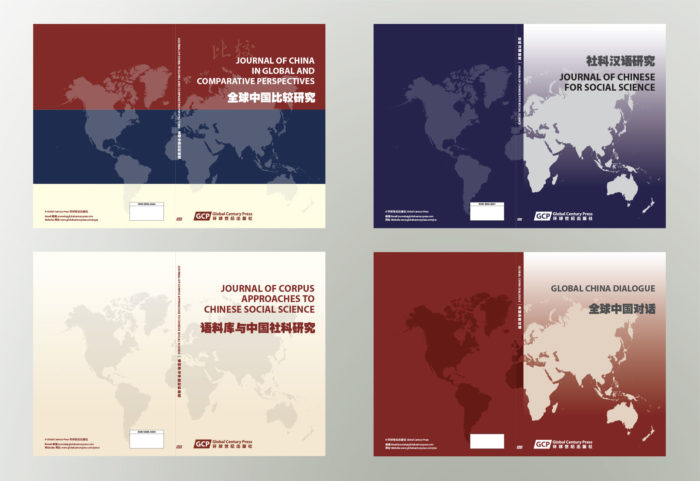
Call for Journal Themes and Paper Submissionsfrom Global Century Press
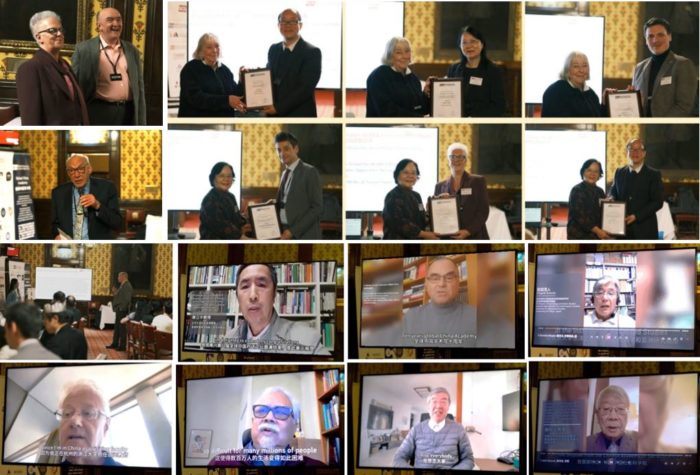
These photos selected from new GCA fellowships award seremoney at At the dinner celebrating the conclusion of the 8th Global China Dialogue and the 10th Anniversary of the Global China Academy.
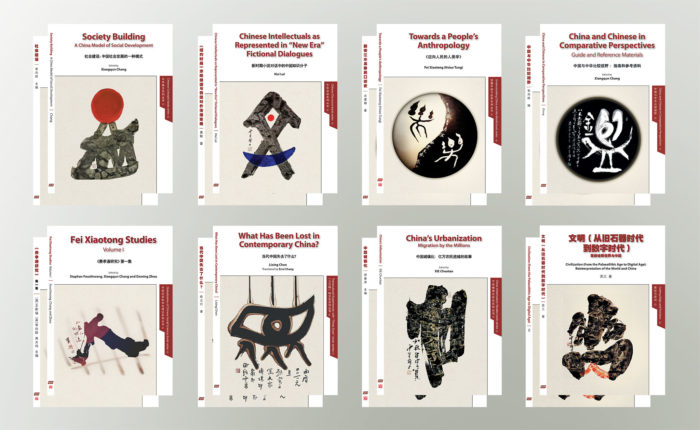
Call for Proposals or Manuscripts:Global Century Press Book series
These photos selected from new GCA fellowships award seremoney at At the dinner celebrating the conclusion of the 8th Global China Dialogue and the 10th Anniversary of the Global China Academy.
Call for Volunteers / Voluntary Trainees in Residence at the Global China Academy
These photos selected from new GCA fellowships award seremoney at At the dinner celebrating the conclusion of the 8th Global China Dialogue and the 10th Anniversary of the Global China Academy.
An Invitation for Recommendations / Applications: Global China Academy Fellowships
These photos selected from new GCA fellowships award seremoney at At the dinner celebrating the conclusion of the 8th Global China Dialogue and the 10th Anniversary of the Global China Academy.
10th Global China Dialogue: Governance for Global Education
Call for Papers
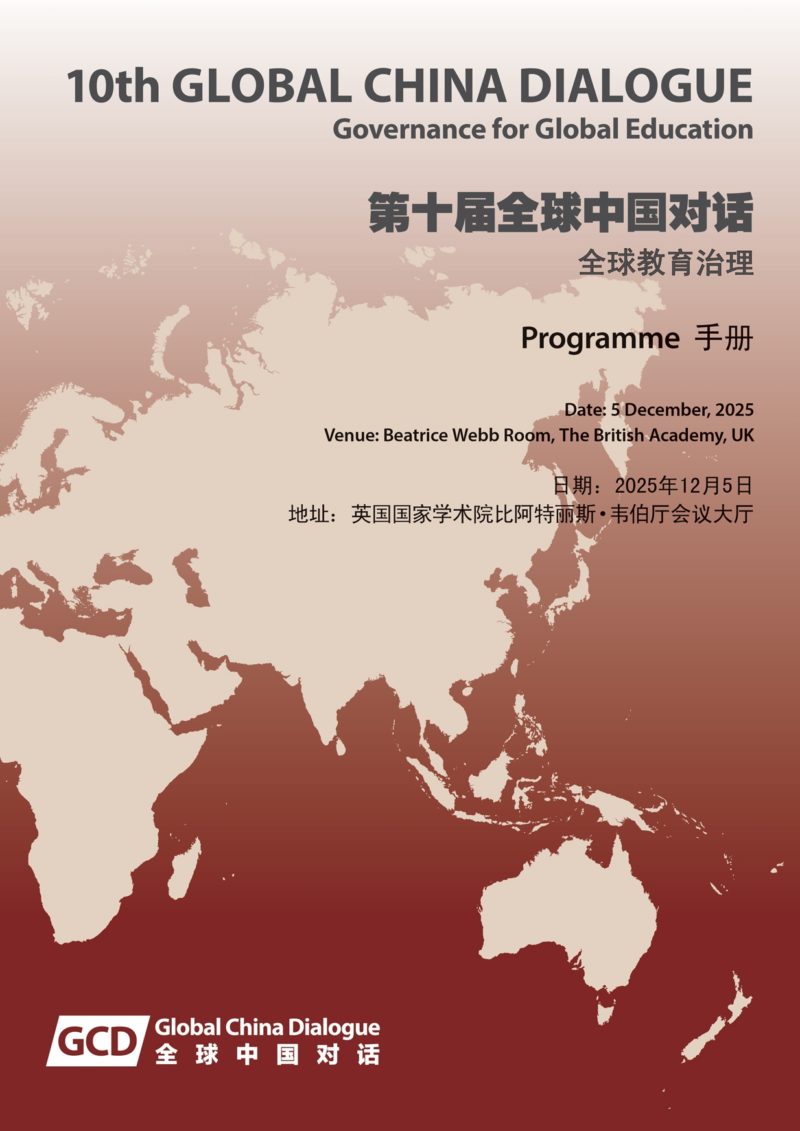
Following nine successful Global China Dialogue (GCD) Forums, the 10th GCD (GCD10) – ‘Governance for Global Education’ – will be held at the British Academy on Friday, 5 December 2025. GCD10 will focus on how to promote sustainable development in education worldwide through policy coordination, international cooperation, equity assurance, quality improvement, and institutional innovation.
As a vital foundation for achieving social justice, fostering global prosperity, and addressing future transformations, education increasingly relies on cross-border collaboration, multi-stakeholder engagement, and technological empowerment. In particular, with the profound impact of emerging technologies such as Artificial Intelligence (AI) and big data reshaping educational models and learning ecosystems, global education governance faces both unprecedented opportunities and challenges.
This Dialogue will provide a platform for diverse conversations, bringing together policymakers, scholars, educators, business leaders, and representatives from international organizations to explore new ideas, mechanisms, and pathways for global education governance.
Organizers:
- Global China Academy, UK
- ESRC Centre for Corpus Approaches to Social Science, Lancaster University, UK
- Faculty of Humanities, Arts, and Social Sciences, University of Exeter, UK
- Institute for Communication Studies of Chinese Culture, Beijing Normal-Hong Kong Baptist University (BNBU), China
Organizing committee:
Chairs
- Professor Tony McEnery FAcSS FRSA, FGCA and Chair of Global China Academy Council; Distinguished Professor of English Language and Linguistics at Lancaster University; Council Member of Academy of Social Sciences, UK
- Professor Xiangqun Chang FRSA FGCA and President of Global China Academy; Honorary Professor of University College London (2015-20), UK; Distinguished Professor of Nankai University, China
- Professor Li Li, Associate Pro-Vice-Chancellor for Global Engagement in the Faculty of Humanities, Arts, and Social Sciences (HASS), University of Exeter, UK; Deputy Secretary General (UK) of UK-China Humanities Alliance for Higher Education, UK
- Professor Yu Huang, Associate Vice President, Executive Director of Institute for Communication Studies of Chinese Culture, Beijing Normal University–Hong Kong Baptist University (BNBU), China
General Secretaries
- Professor LI Boyi, Associate Fellow and Secretary of the GCA Chinese Council, Global China Academy; School of Business Administration, Nanjing University of Finance and Economics, China
- Mr Kai Liang, Event Officer, Global China Academy;Director of Business Development of MEL Science, UK
Members (in alphabetical order)
- Professor BING Zheng FGCA, Chinese Chair of Global China Academy Council; Former Vice-President of Jilin University; Former Vice-President of Chinese Sociological Association
- Dr Yuan Cheng, Trustee of the Global China Academy Board of Trustees; Greater China Chairman, Russell Reynolds Associates, China
- Professor Martin Jacques FGCA, a British academic, journalist, political commentator, and author; Senior Fellow and Visiting Professor at several leading universities in the UK and China
- Professor Li Wei FBA FAcSS FRSA FGCA and Director and Non-Executive Chair of Global China Academy Council; Director and Dean of the UCL Institute of Education (IOE), UCL’s Faculty of Education and Society, UK
- Mr Barnaby Powell, Council Member, Society for Anglo–Chinese Understanding, UK
- Professor Laurence Roulleau-Berger FGCA, Vice President for European engagement of Global China Academy; Research Director at the National Centre for Scientific Research; Professor at Triangle, École Normale Supérieure of Lyon, France
- Professor Peter Schröder, FGCA and Vice-President and Founding Fellow of Global China Academy; Department of History and European and International Social and Political Studies, University College London, UK
- Professor Elena Semino FAcSS FRSA, Professor at Department: Linguistics and English Language, Director of ESRC Centre for Corpus Approaches to Social Science (CASS), Lancaster University, UK
- Professor Shigeto Sonoda FGCA and Vice-President of Global China Academy (Asian engagement), UK; Professor of comparative sociology and Asian studies at the Institute for Advanced Studies on Asia for Information Studies, University of Tokyo, Japan
- Professor XIE Lizhong FGCA and Chinese President of Global China Academy; Former Head of Institute of Sociology and Anthropology and Department of Sociology, Peking University; President of Association of Social Theory Studies of China, UK
- Professor ZHANG Xiaodong FGCA and Chinese Non-Executive Chair of Global China Academy Council; Executive Director, Academic Committee of the Chinese Management Association; ECO of Agile Think Tank, China
GCD10 consists of four thematic panels:
- Panel 1 Governance Innovation and Technological Empowerment
This panel explores collaborative governance, model innovation, and the use of AI, big data, and digital platforms in education. It will also address the global digital divide and how AI can either bridge or deepen disparities in education. Advances in technology have the potential to bring immense economic benefits, but an estimated 2.6 billion people remain offline, exacerbating inequality and poverty. The panel will encourage comparative reflections on how equity and quality are defined and operationalised across diverse educational systems and cultural settings. The discussion will include comparative analyses of how different governance cultures and institutional structures shape the adoption, regulation, and integration of emerging technologies in education.
- Panel 2 Educational Equity, Inclusion, and Quality Assurance
This panel focuses on protecting rights, promoting research integrity, and improving quality through assessments, certification, and teacher training. It will address persistent gaps in education due to poverty, gender, geography, and conflict, and explore how education can continue in crisis contexts. Scholarship has provided evidence that global education systems, using curricula rooted in Western norms, can erode local languages, traditions, and knowledge systems. Moreover, teaching global education without awareness of educational backgrounds—such as those shaped by enduring neo-Confucian conventions—creates barriers for international students adapting to unfamiliar pedagogical systems. Gender disparities also feature prominently, with unequal access to basic and tertiary education remaining a significant issue.
- Panel 3 Global Education Policy and International Cooperation
This panel will explore policy frameworks, the role of international organizations, and cross-border collaboration through university alliances and digital platforms. Discussions will address balancing the push for global competencies with the need to preserve cultural relevance and indigenous knowledge. For instance, the dominance of English in global education raises concerns when juxtaposed with the value of multilingualism and the nurturing of local languages. Multilingual education fosters inclusive societies and is pivotal in preserving non-dominant, minority, and indigenous languages. This panel will also compare how different national education systems conceptualize international cooperation, language policy, and academic autonomy, highlighting the institutional and cultural variations in global engagement.
- Panel 4 Education Financing and Sustainable Development
This panel highlights financing mechanisms, international aid, and the integration of education with technology and industry to support innovation and inclusive growth. Critical questions arise regarding the financing of global education—specifically, who controls the agenda: governments, donors, or private actors? Inadequate financing for education threatens sustainable development, with a funding gap of US$97 billion annually looming for low- and lower-middle-income countries to achieve Sustainable Development Goal 4 (SDG4) by 2030. This panel will also examine cross-national differences in educational investment strategies, fiscal governance models, and public-private partnerships, offering a comparative perspective on sustainable financing cultures.
Through diverse perspectives and cross-sector dialogue, the 10th Global China Dialogue aims to contribute both Chinese insights and international experience to global education governance, working together to build a fairer, higher-quality, more inclusive, and sustainable global education ecosystem.
Important Dates for GCD X:
- 31st August 2025: Deadline for submitting abstracts for proposed topics.
- 8th November 2025: Deadline for speakers to submit their notes and PowerPoint presentations.
- 11th November 2025: Final deadline for registration.
- 25th November 2025: Programme available for download in English, Chinese, and dual-language formats.
- 5th December 2025: Date of the 10th Global China Dialogue.
The proceedings of GCD X will be published in 2026, featuring transcribed records, bilingual translation, and editing.
More info
- Registration
- Registration (Chinese)
- GCD10 Call for Participants
- GCD10 Call for Participants (Chinese)
- Abstract Submition
- GCD10 Call for Papers (Download PDF file)
- GCD10 Call for Papers (Chinese)
- GCD10 Partnership Guidelines
- GCD10 Partnership Guidelines (Chinese)
- GCD10 Homepage
- GCD10 Homepage (Chinese)
- GCD series Homepage

GCA President Professor Xiangqun Chang Participates in the Third China-Focus Student Research Forum at LSE
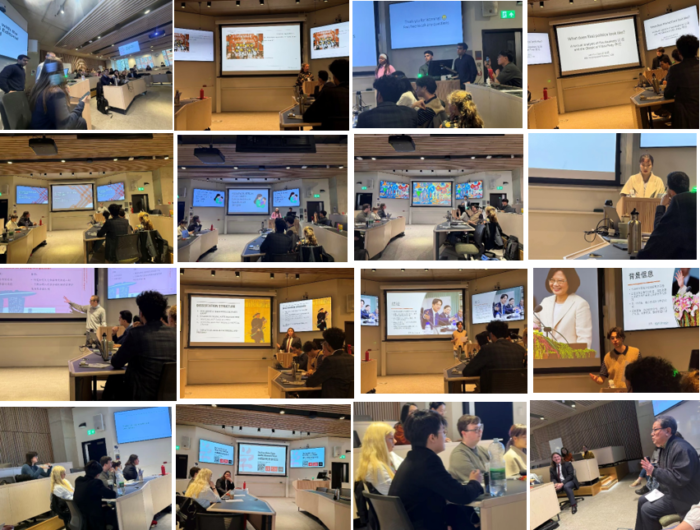
On 22 March 2025, Professor Xiangqun Chang, President of the Global China Academy (GCA) and Editor-in-Chief of Global Century Press, participated in the Third China-Focus Student Research Forum, hosted by the London School of Economics and Political Science (LSE). The forum was held from 1:00 PM to 4:00 PM at the LSE campus (MAR.1.04), marking the third consecutive year of this student-led, cross-institutional China studies initiative.
Following the first forum held at SOAS, University of London in May 2023, and the second forum hosted by King’s College London in June 2024, the third edition was organised by the LSE Language Centre, led by Dr Lijing Shi, Assistant Language Coordinator (Mandarin), with strong support from student volunteers.
Invited academic participants included:
- Dr Lianyi Song, Principal Teaching Fellow in the School of Languages, Cultures and Linguistics at SOAS and co-founding editor of the Journal of Chinese for Social Sciences (JCSS);
- Ms Lik Suen, Principal Lector at SOAS and editor of the JCSS;
- Dr Hongfen Zhou, Senior Lecturer in Chinese Language Education at King’s College London.
Students from LSE, King’s College London, and SOAS took part in the forum, continuing its tradition of bilingual presentations and interdisciplinary dialogue.

Photo 1 (displayed in random order, can be updated)
The forum featured 13 student presentations delivered in both Chinese and English, covering a wide range of China-related research topics. Each presentation was followed by a short Q&A session, with a scheduled break enabling informal discussion and exchange. In the last row, far right, Dr Lianyi Song is seen raising a question to a student presenter.

Photo 2 (Academic commentary and award presentation)
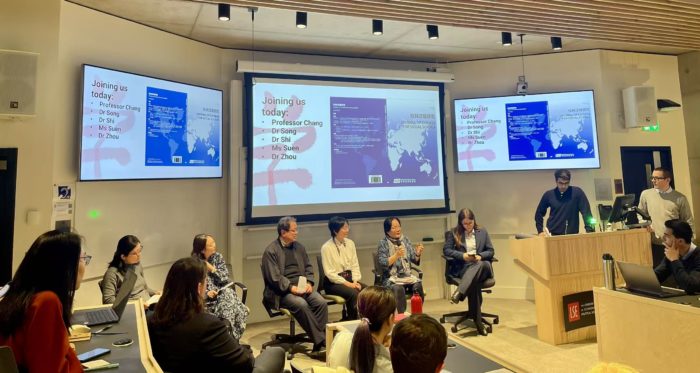
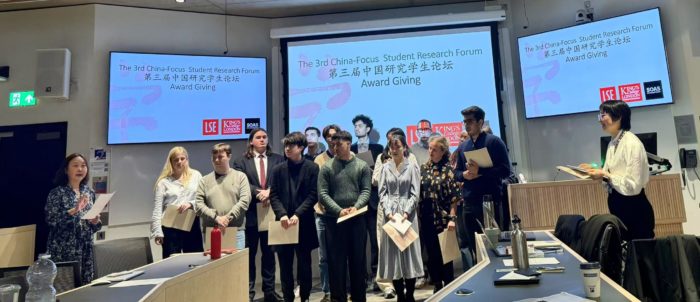
Ms Lik Suen (left), Principal Lector in the School of Languages, Cultures and Linguistics at SOAS, provided academic commentary on student presentations, offering professional and constructive feedback. The forum concluded with an award ceremony and networking session, strengthening academic connections among participants and institutions. Dr Lijing Shi (right) is shown presenting awards to student participants.

Photo 3 (Editorial exchange with JCSS)
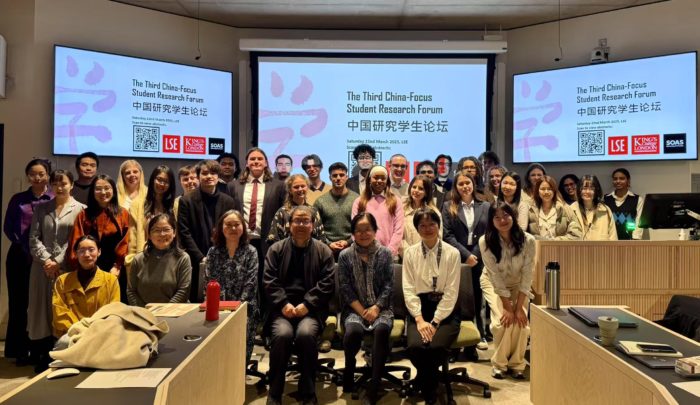
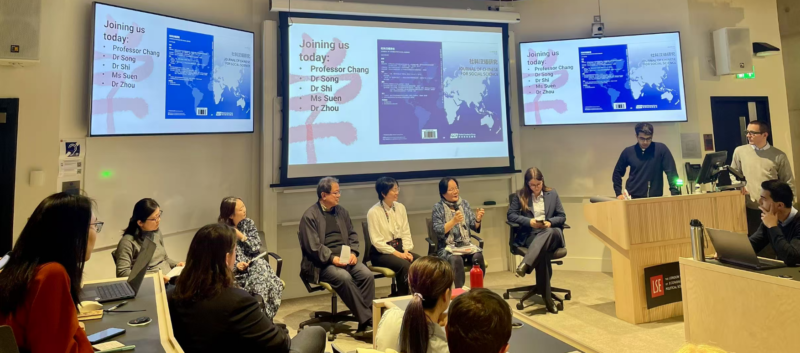
A key highlight of the forum was the dedicated Q&A session with the editorial team of the Journal of Chinese for Social Sciences (JCSS). Professor Xiangqun Chang shared experience on academic writing, research development, and publication pathways, drawing on the Global China Academy’s long-term support for student and early-career scholars. This exchange further connected student research with formal academic publishing, reinforcing continuity within the scholarly community.

Photo 4 (Group photo)
The Third China-Focus Student Research Forum demonstrated the growing maturity of this student-led academic platform and the sustained collaboration between university language centres, student societies, and the Global China Academy. Through bilingual presentations, editorial engagement, and cross-institutional participation, the forum continues to nurture the next generation of China scholars and advance transcultural knowledge production and public academic practice.

GCA President and Past Honorary President Welcome GCA Fellow Professor Li Linxue of Tongji University in London
During the five-day UK study visit on the built environment, on the afternoon of 4 March 2025, Professor Li Linxue, Fellow of the Global China Academy and Professor at Tongji University, met with Professor Xiangqun Chang, President of the Global China Academy, and Professor Martin Albrow, Past Honorary President of the Academy, at the Royal Society of Arts (RSA) in London. Their discussion focused on the mission of the Academy, ongoing academic initiatives, and potential directions for future collaboration.

The meeting also included discussion of Professor Albrow’s newly published book, Integrity: The Rise of a Distinctive Western Idea and Its Destiny (诚信:一种独特的西方观念的形成及其命运). In the book, Albrow traces the historical development of integrity from ancient Greece and Rome, through Christianity, the Renaissance, and into modern society, showing how it evolved from an idea of value-based unity and adherence to external standards into a core ethical principle of public life. He argues that contemporary society is marked by a troubling paradox—while integrity is widely demanded, it is not necessarily a prerequisite for political success, resulting in what he calls a “politics of the integrity vacuum.” Albrow therefore calls for the renewal of integrity through dialogue with non-Western wisdom, in order to rebuild trust, reliability, and ethical foundations in public and social life.
Professor Li also introduced his architectural design philosophy and selected works. In 2001, he founded Atelier L+ (麟和建筑工作室), part of the Tongji Architectural Design and Research Institute (Group) Co., Ltd. The studio is an architect-led team grounded in architectural practice and urban research, employing “Nature–System–Construction” as its core methodological framework. Through this approach, the studio continuously explores architectural modernity and multi-scalar construction within the context of Chinese cities. Characterised by the integration of research and building practice, Atelier L+ emphasises the realisation of high-quality architecture under real-world conditions through full-process participation in design. To date, the studio has completed or is undertaking more than fifty public building projects, including urban landmarks, industrial heritage regeneration, and a wide range of educational, cultural, civic, and infrastructural complexes, establishing a distinct and influential position within contemporary Chinese architectural practice.

The feature image on this page captures a symbolic moment: the three scholars standing side by side, holding hands, representing trust, collaboration, and a shared scholarly community. Two of Professor Li’s colleagues, standing nearby, spontaneously responded to the camera with “V” gestures, conveying a relaxed, confident, and positive atmosphere of academic exchange. More than a group photograph, this gesture symbolises the organic emergence of a transcultural academic network at London as a global node of ideas—the joined hands representing long-term partnership and institutional commitment, while the “V” signs express openness, goodwill, and optimism for future collaboration. Set within the RSA, an institution renowned for public thought and social innovation, the image resonates naturally with the Academy’s commitment to transcultural dialogue, the co-production of knowledge, and scholarly friendship.

Afterwards, the three walked together through central London, with the cityscape becoming the backdrop for continuing academic exchange. The image on the left shows a street scene spontaneously photographed by Professor Li during the walk, capturing urban details as sources of architectural inspiration; the image on the right records their arrival at a riverside restaurant in County Hall on the South Bank of the Thames, with the river and the Houses of Parliament visible outside the window. Upon being seated, they took a group photograph while Big Ben and the Parliament building were still clearly visible across the river. As dinner progressed and night fell, the cityscape gradually faded into the London dusk, bringing this transcultural academic encounter to a symbolic close.
Selected Works by Professor Li Linxue


Among the eight projects shown above, the second from the left in the bottom row is the Tongji Yijia Building. Responding to the contemporary Chinese urban context through a clear and powerful modern architectural language, the building integrates function, space, and cultural expression through geometric façades, transparent glass interfaces, and abundant natural light. Its open and flexible interior spaces accommodate exhibitions, exchanges, meetings, and office use, while its emphasis on spatial adaptability and publicness encourages interaction and collaboration. In this building, a transcultural spatial practice takes form—where Chinese urban experience, global modern architectural language, and academic public life are translated and integrated within a single architectural framework. Through green landscaping, material selection, and sustainable strategies, the building further responds to environmental and real-world conditions, becoming a public platform that connects local experience with global contemporaneity, and embodies both cultural sensibility and contemporary spirit.
When Professor Li encountered the title of Martin Albrow’s new book, his spontaneous Chinese rendering was “integration.” This response was not a conceptual misreading, but rather an architect’s interpretation: how, in a highly differentiated contemporary world, values, institutions, and public life might be reconnected into a workable whole. While Albrow approaches integrity through the lens of intellectual history, questioning its meaning and crisis in public life, Li responds through architecture—by integrating different cultures, forms of knowledge, and practices in real space, enabling publicness to be built and experienced. The book and the buildings thus enter into a dialogue across disciplines, pointing toward a shared question: how trust, publicness, and reliable social order might be rebuilt in a complex and plural world.

GCA President Professor Xiangqun Chang Visits Tongji and Fuudan Universities
Since my first visit to Tongji University more than a decade ago, I have attended many meetings and academic events there, yet never truly walked through the campus. Compared with Peking University, Tsinghua University, Wuhan University, and Xiamen University—institutions celebrated for their scholarly traditions and scenic campuses—Tongji’s campus had not particularly drawn my attention. However, my visit to two Tongji campuses on 26–27 February 2025 completely changed this perception.
Tongji University’s main campus is located on Siping Road, with additional campuses at South Campus, Zhangwu, Jiading, Huxi, and Hubei. This visit was hosted by the College of Arts and Media, primarily based at the Jiading Campus, the Chinese partner institution for the 9th Global China Dialogue (GCD9). Accompanied by doctoral student GAO Yuan, I was able to walk through the Siping Road Campus and, for the first time, understand through bodily experience the relationship between the name Tongji and the campus space itself.

We all know that Tongji means “crossing the river together in the same boat,” and that the university originated over a century ago as a Sino–German medical school. Yet it was only by walking through the campus that I realised Tongji truly has water. These waterways are not symbolic landscaping features but historical continuations of the natural rivers and canals of the Jiangnan region. Preserved in campus planning and enhanced through dredging and bank reinforcement, they form walkable and perceptible spatial networks together with buildings, bridges, and pathways. As part of Shanghai’s local river system, they flow eastward or southward, eventually joining the Huangpu River and the Yangtze estuary, embedding the campus within a wider urban and regional geography.
In contrast to the waterways, bamboo groves are mainly found around the early campus buildings, particularly the quiet grove near Sanhao Dock. This area evokes a classical atmosphere that resonates with traditional Chinese garden aesthetics, forming a subtle dialogue with the surrounding modern architecture. These garden spaces are often regarded as embodiments of Tongji’s humanistic spirit—places where faculty and students walk, pause, and sense the layered presence of nature and campus history. Here, the campus becomes not merely a functional educational space, but a lived, immersive environment.
In the past, the most prominent image of Tongji for me was the Mao Zedong statue on campus—a historical and political landmark anchoring a specific era and memory. This time, however, I encountered another sculpture: a contemporary public artwork composed of three figures pulling and supporting one another as they move forward together. There is no hierarchy among them; strength emerges through mutual reliance, forming a dynamic, collective whole. Its mirrored stainless-steel surface reflects buildings, trees, and passers-by, allowing the sculpture to transform continuously with light and time.
At dusk, our walking discussion naturally paused in front of the sculpture. As twilight and artificial light flowed across its metallic surface, memories of the 9th Global China Dialogue (GCD9) held here last November on “AI Governance,” and the subsequent campus visit and roundtable at the College of Arts and Media, seemed to converge into a single, perceptible experience. At that moment, “crossing the river together in the same boat” ceased to be merely a university name or slogan; it became a visible, experiential form of collective action—a public spirit continually generated through collaboration, integration, and shared responsibility.
It was during this walk that I gradually realised Tongji’s campus does not impress through scenery alone, but through the cooperative spirit and engineering rationality embedded in its spaces. Water, bamboo groves, architecture, and sculpture together weave a spatial order that integrates nature, history, and contemporary academic life, giving the name Tongji renewed, tangible meaning through everyday movement and experience.


On the morning of 27 February, I visited the Jiading Campus of the College of Arts and Media at Tongji University. The visit began with an interview conducted by Professor Wang Xin, Head of the Department of Communication. The interview, consisting of 12 questions, explored the transcultural significance of li (ritual/propriety) and exchange, focusing on how the Chinese tradition of li shang wanglai (ritualised reciprocity) can be translated and practised across different civilisations, everyday interactions, and international exchanges, and how it might contribute to contemporary public relations, social trust, and global communication. This was my second interview with Professor Wang; the first was published in Intercultural Communication Studies (Vol. 5, 2022) under the title “Transculturality in Global Perspective: Concepts, Practices, and Production — A Dialogue with Professor Xiangqun Chang.”
The central event of the morning was my public lecture, “Corpus-Based Social Science: A Text Analysis Method for the Big Data Era and ChatGPT.” The lecture addressed key methodological challenges facing social sciences in the age of big data, where traditional quantitative and qualitative approaches struggle to cope with massive electronic text corpora. The method introduced draws on my training at the Centre for Corpus Approaches to Social Science (CASS) at Lancaster University, supported by the UK Economic and Social Research Council (ESRC). Following the 3rd Global China Dialogue in 2016, the Global China Academy launched the “Corpus Approaches to Chinese Social Science” (CACSS) initiative, which has since promoted and applied corpus-based social science methods within Chinese research contexts.
Over the past eight years, in collaboration with several Chinese universities, we have built the Collected Works of Fei Xiaotong (20 volumes) corpus and the Collected Works of Marx and Engels (50 volumes) corpus, and founded the journal Corpus and Chinese Social Science Research, contributing to the institutionalisation of this methodological approach. The lecture presented a framework bridging sociology and applied linguistics, and shared practical experiences using ChatGPT in corpus analysis, research collaboration, and knowledge production, prompting lively discussion among faculty and students.
The lecture was chaired by Professor Wang Xin, with active participation from students and staff. Professor Li Linxue, Dean of the College of Arts and Media, offered concluding remarks, responding to the lecture from perspectives of methodology, knowledge production, and public communication, and proposing future collaboration. From interview to lecture, from concept to method, the morning’s exchanges outlined a clear pathway for transforming Chinese experience into dialogical knowledge and rebuilding public academic practice in the digital era.
Professor Li is a Fellow of the Global China Academy; Professor Wang is an Associate Fellow; and the College of Arts and Media is an Institutional Fellow. The College has served as the Chinese partner for the 8th Global China Dialogue (GCD8) on Global Health Governance and hosted the 9th Global China Dialogue (GCD9) on Global AI Governance, playing a key role in advancing the Academy’s mission, organising international dialogues, and practising transcultural knowledge production.


After the lecture, Dean Li personally guided me through the Jiading Campus, focusing on Yijia Building, a major work of his design. Walking through the building inside and out, he explained the spatial concepts while responding to my questions about the relationship between details and the whole. The building unfolds in a restrained yet powerful modern architectural language: transparent façades, cascading atria, continuous steps and ramps weave teaching, exchange, and public activities into one coherent spatial system. Large-scale halls, open learning spaces, and flexible performance areas transform the building into a “walkable academy” that continually generates opportunities for interaction. Being guided by the designer himself turned architectural concepts into lived experience—this was not merely a tour, but a deep conversation on how architecture can carry public academic life and respond to contemporary educational and cultural missions through spatial practice.

In the afternoon of 27 February, I visited Fudan University. Previous visits to Fudan Library had been for research, but this time was entirely different. I first toured a special exhibition on Yan’an woodcuts, wartime Sino–foreign exchange, and the political mission of art, focusing on the historical connections between American journalist and diplomat George A. Harlan and Chinese revolutionary culture. Titled Return, the exhibition draws mainly on donations from Harlan’s three children, documenting his journeys into Yan’an and liberated areas and his participation in and recording of revolutionary practice. It highlights the Yan’an Woodcut Movement as a form of art that combined political mobilisation, social education, and cultural enlightenment—an essential medium for communication, solidarity, and documentation under wartime conditions. The section “Woodcuts in Yan’an” vividly demonstrates the deep entanglement of art and social practice, offering a compelling lens for understanding knowledge, art, and public life during the revolutionary era.
Through timelines and maps tracing Harlan’s travels across China, the exhibition interweaves personal experience with the histories of war and revolution. Sections such as “Voices of Individuals” and “Collective Echoes” reveal a transcultural network that continued to resonate during and after the war. Letters, manuscripts, prints, and archival documents transform abstract history into tangible evidence.
The exhibition’s restrained curatorial language—dominated by red, grey, and white—creates a powerful narrative space that draws visitors into a shared memory crossing cultures, politics, and media. It is not only a historical reflection but a contemporary question: how can art assume public responsibility in times of crisis, and how can intellectuals forge genuine connections in a fractured world?
Within the library gallery, this exhibition became a living transcultural experience. Different civilisations, political contexts, and knowledge traditions once formed real networks of cooperation through art and action in moments of crisis. As part of an academic visit, this viewing placed present-day scholarly exchange within a longer historical arc—reminding us that scholarship is not only knowledge production, but also a form of public practice. From Yan’an woodcuts to today’s academic dialogues, art, thought, and public spirit are continually reactivated, making “visiting” itself an act that connects past and future.

The visit continued with a tour of the Institute for Humanities and Social Sciences Data at Fudan’s Big Data Research Center. The Contemporary Life Archive founded by Professor Zhang Letian, Founding Chinese President of the Global China Academy, and the Secretariat of the Global Contemporary Life Data Alliance he initiated, are both housed here. We also visited the office of Professor Pan Wuyun, a leading scholar in Chinese linguistics and linguistic anthropology, who has played a pivotal role in building the 21st-Century Chinese Language and Dialect Database and advancing research on cultural transmission and population migration. The library thus serves as a vital base for continued scholarly influence after retirement.
This was followed by a roundtable discussion with: Zhang Jilong, Deputy Director of Fudan Library and Executive Deputy Director of the Institute; Yin Shenqin, Deputy Director of the Institute and Deputy Director of the Shanghai Big Data Laboratory for Scientific Research; and Dr Wang Shunqing, Associate Professor and Director of the Contemporary Life Archive and Secretariat. I introduced the academic resources and publishing system of the Global China Academy and Global Century Press. The team expressed strong interest in data sharing, corpus construction, and the upcoming 11th Global China Dialogue (GCD11) on “Global AI and Data Governance” in December 2026.
Yin Shenqin presented the institute’s database system and vast humanities and social science data resources. Zhang Jilong introduced the 2025 Conference on Intelligent Humanities and Social Sciences to be held on 1 March, themed “AI-Driven Theoretical Innovation and Paradigm Transformation in the Humanities and Social Sciences,” covering topics such as AI4SS social agents and complex systems, AI risk identification and decision-making, AI4H and Chinese civilisation, and AI ethics and governance. Dr Wang discussed potential collaboration with the Global Contemporary Life Data Alliance. Both sides expressed a desire for sustained interaction and deeper cooperation.
This visit not only deepened my understanding of Fudan’s digital humanities and data infrastructure, but also established new academic connections for the Global China Academy in AI, data governance, and transcultural research.


Our exchanges continued over dinner. In China, food often carries layered social meanings, and the innovative Shanghainese–Cantonese fusion cuisine at Longzhuang Xiuchu was particularly memorable. Just as red banners often greet visitors to Chinese universities, this restaurant used bold red slogans as part of its spatial language. Yet unlike traditional restaurants with “No Entry to the Kitchen” signs, its large open kitchen placed cooking at the centre, making every process visible. Slogans such as “Freshly cooked, no pre-made dishes—safety you can see” and “Ingredients have character, cooking has emotion, dishes reflect the person—craftsmanship creates excellence” served not only as quality commitments but as statements about food, labour, and public trust, turning the meal itself into a perceptible form of communication.
The dishes represented a mature style of high-end Chinese cuisine—a contemporary fusion of refined Shanghainese and Cantonese traditions. Plating was restrained and orderly, with precise control of colour and negative space, reflecting clear aesthetic judgement and professional confidence. The sequence of cold dishes, hot dishes, soups, and main courses unfolded with measured rhythm and logic, emphasising natural flavours while building subtle layers through technique rather than visual spectacle. From the textures and flavours, it was evident that the kitchen prioritised heat control and process over heavy sauces: seafood was tender, mushrooms carried wok hei, and soups were clear yet rich—demonstrating solid craftsmanship and fulfilling the promise of visible, honest cooking.
In this atmosphere, conversation was no longer merely verbal continuation; through real cooking, stable quality, and visible labour, a quiet but solid sense of trust was built, allowing dinner itself to become a daily scene in which public spirit found tangible form.