GCA President Professor Xiangqun Chang Visits Tongji and Fuudan Universities
Since my first visit to Tongji University more than a decade ago, I have attended many meetings and academic events there, yet never truly walked through the campus. Compared with Peking University, Tsinghua University, Wuhan University, and Xiamen University—institutions celebrated for their scholarly traditions and scenic campuses—Tongji’s campus had not particularly drawn my attention. However, my visit to two Tongji campuses on 26–27 February 2025 completely changed this perception.
Tongji University’s main campus is located on Siping Road, with additional campuses at South Campus, Zhangwu, Jiading, Huxi, and Hubei. This visit was hosted by the College of Arts and Media, primarily based at the Jiading Campus, the Chinese partner institution for the 9th Global China Dialogue (GCD9). Accompanied by doctoral student GAO Yuan, I was able to walk through the Siping Road Campus and, for the first time, understand through bodily experience the relationship between the name Tongji and the campus space itself.
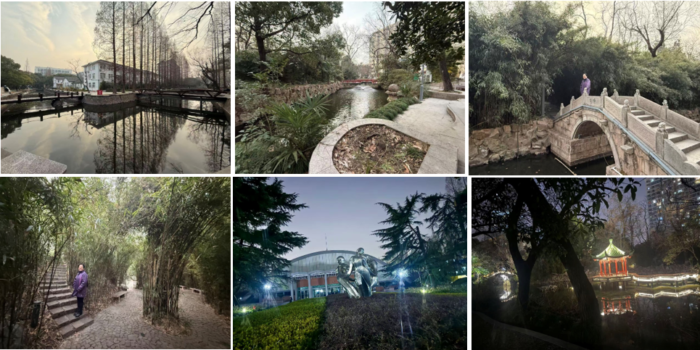
We all know that Tongji means “crossing the river together in the same boat,” and that the university originated over a century ago as a Sino–German medical school. Yet it was only by walking through the campus that I realised Tongji truly has water. These waterways are not symbolic landscaping features but historical continuations of the natural rivers and canals of the Jiangnan region. Preserved in campus planning and enhanced through dredging and bank reinforcement, they form walkable and perceptible spatial networks together with buildings, bridges, and pathways. As part of Shanghai’s local river system, they flow eastward or southward, eventually joining the Huangpu River and the Yangtze estuary, embedding the campus within a wider urban and regional geography.
In contrast to the waterways, bamboo groves are mainly found around the early campus buildings, particularly the quiet grove near Sanhao Dock. This area evokes a classical atmosphere that resonates with traditional Chinese garden aesthetics, forming a subtle dialogue with the surrounding modern architecture. These garden spaces are often regarded as embodiments of Tongji’s humanistic spirit—places where faculty and students walk, pause, and sense the layered presence of nature and campus history. Here, the campus becomes not merely a functional educational space, but a lived, immersive environment.
In the past, the most prominent image of Tongji for me was the Mao Zedong statue on campus—a historical and political landmark anchoring a specific era and memory. This time, however, I encountered another sculpture: a contemporary public artwork composed of three figures pulling and supporting one another as they move forward together. There is no hierarchy among them; strength emerges through mutual reliance, forming a dynamic, collective whole. Its mirrored stainless-steel surface reflects buildings, trees, and passers-by, allowing the sculpture to transform continuously with light and time.
At dusk, our walking discussion naturally paused in front of the sculpture. As twilight and artificial light flowed across its metallic surface, memories of the 9th Global China Dialogue (GCD9) held here last November on “AI Governance,” and the subsequent campus visit and roundtable at the College of Arts and Media, seemed to converge into a single, perceptible experience. At that moment, “crossing the river together in the same boat” ceased to be merely a university name or slogan; it became a visible, experiential form of collective action—a public spirit continually generated through collaboration, integration, and shared responsibility.
It was during this walk that I gradually realised Tongji’s campus does not impress through scenery alone, but through the cooperative spirit and engineering rationality embedded in its spaces. Water, bamboo groves, architecture, and sculpture together weave a spatial order that integrates nature, history, and contemporary academic life, giving the name Tongji renewed, tangible meaning through everyday movement and experience.
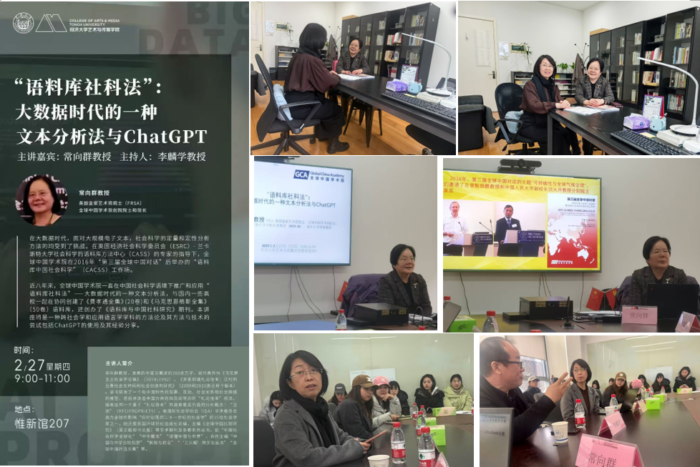
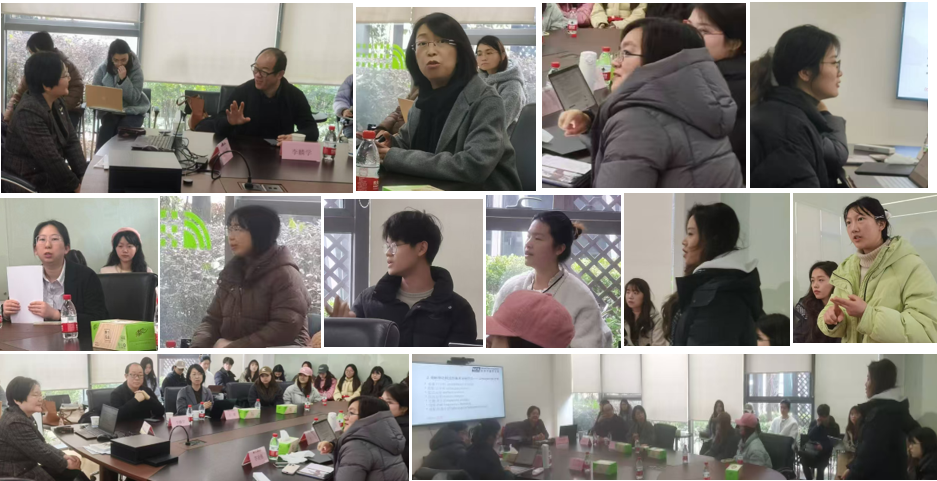
On the morning of 27 February, I visited the Jiading Campus of the College of Arts and Media at Tongji University. The visit began with an interview conducted by Professor Wang Xin, Head of the Department of Communication. The interview, consisting of 12 questions, explored the transcultural significance of li (ritual/propriety) and exchange, focusing on how the Chinese tradition of li shang wanglai (ritualised reciprocity) can be translated and practised across different civilisations, everyday interactions, and international exchanges, and how it might contribute to contemporary public relations, social trust, and global communication. This was my second interview with Professor Wang; the first was published in Intercultural Communication Studies (Vol. 5, 2022) under the title “Transculturality in Global Perspective: Concepts, Practices, and Production — A Dialogue with Professor Xiangqun Chang.”
The central event of the morning was my public lecture, “Corpus-Based Social Science: A Text Analysis Method for the Big Data Era and ChatGPT.” The lecture addressed key methodological challenges facing social sciences in the age of big data, where traditional quantitative and qualitative approaches struggle to cope with massive electronic text corpora. The method introduced draws on my training at the Centre for Corpus Approaches to Social Science (CASS) at Lancaster University, supported by the UK Economic and Social Research Council (ESRC). Following the 3rd Global China Dialogue in 2016, the Global China Academy launched the “Corpus Approaches to Chinese Social Science” (CACSS) initiative, which has since promoted and applied corpus-based social science methods within Chinese research contexts.
Over the past eight years, in collaboration with several Chinese universities, we have built the Collected Works of Fei Xiaotong (20 volumes) corpus and the Collected Works of Marx and Engels (50 volumes) corpus, and founded the journal Corpus and Chinese Social Science Research, contributing to the institutionalisation of this methodological approach. The lecture presented a framework bridging sociology and applied linguistics, and shared practical experiences using ChatGPT in corpus analysis, research collaboration, and knowledge production, prompting lively discussion among faculty and students.
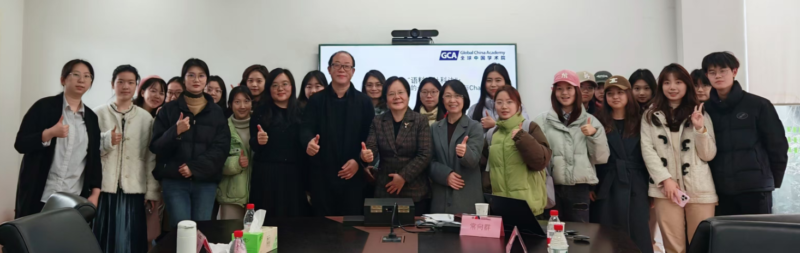
The lecture was chaired by Professor Wang Xin, with active participation from students and staff. Professor Li Linxue, Dean of the College of Arts and Media, offered concluding remarks, responding to the lecture from perspectives of methodology, knowledge production, and public communication, and proposing future collaboration. From interview to lecture, from concept to method, the morning’s exchanges outlined a clear pathway for transforming Chinese experience into dialogical knowledge and rebuilding public academic practice in the digital era.
Professor Li is a Fellow of the Global China Academy; Professor Wang is an Associate Fellow; and the College of Arts and Media is an Institutional Fellow. The College has served as the Chinese partner for the 8th Global China Dialogue (GCD8) on Global Health Governance and hosted the 9th Global China Dialogue (GCD9) on Global AI Governance, playing a key role in advancing the Academy’s mission, organising international dialogues, and practising transcultural knowledge production.
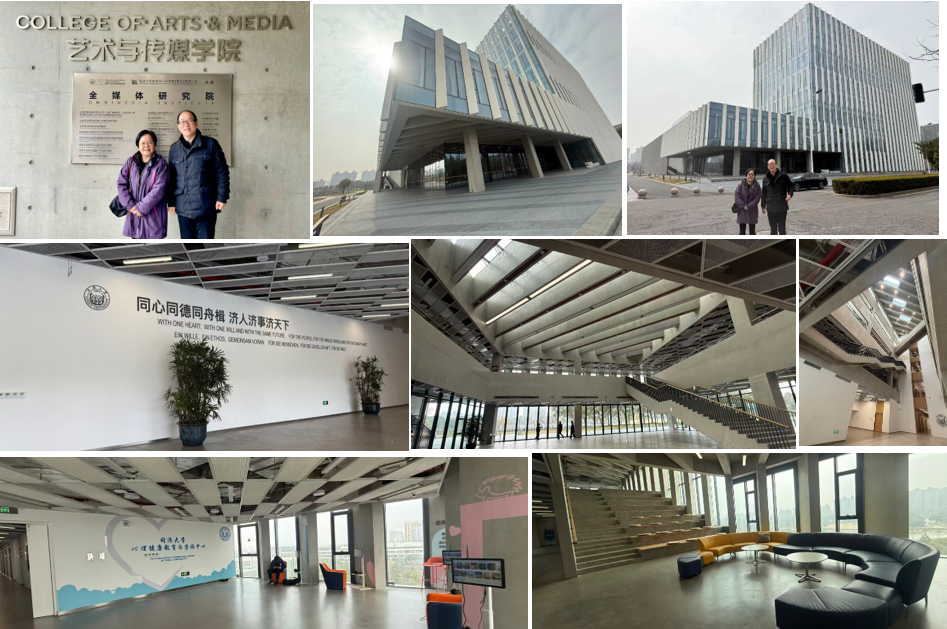

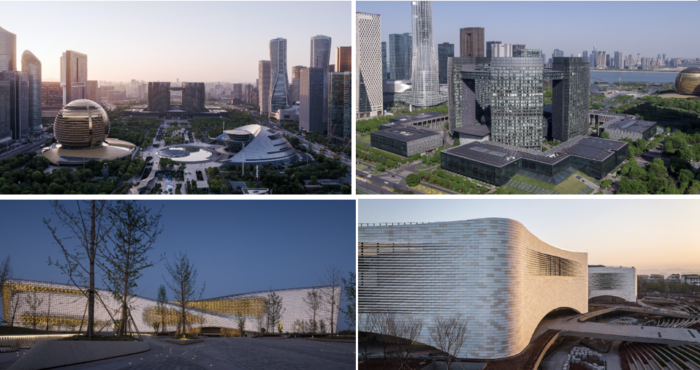
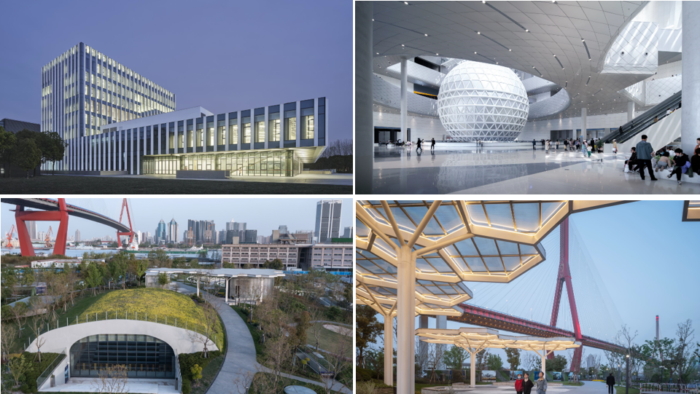
After the lecture, Dean Li personally guided me through the Jiading Campus, focusing on Yijia Building, a major work of his design. Walking through the building inside and out, he explained the spatial concepts while responding to my questions about the relationship between details and the whole. The building unfolds in a restrained yet powerful modern architectural language: transparent façades, cascading atria, continuous steps and ramps weave teaching, exchange, and public activities into one coherent spatial system. Large-scale halls, open learning spaces, and flexible performance areas transform the building into a “walkable academy” that continually generates opportunities for interaction. Being guided by the designer himself turned architectural concepts into lived experience—this was not merely a tour, but a deep conversation on how architecture can carry public academic life and respond to contemporary educational and cultural missions through spatial practice.
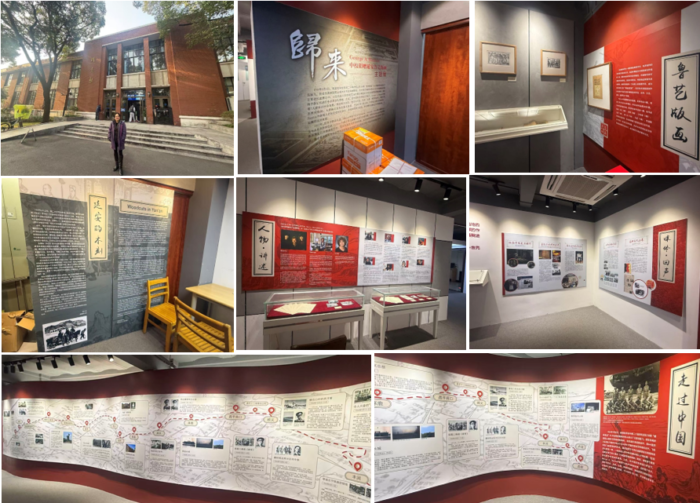
In the afternoon of 27 February, I visited Fudan University. Previous visits to Fudan Library had been for research, but this time was entirely different. I first toured a special exhibition on Yan’an woodcuts, wartime Sino–foreign exchange, and the political mission of art, focusing on the historical connections between American journalist and diplomat George A. Harlan and Chinese revolutionary culture. Titled Return, the exhibition draws mainly on donations from Harlan’s three children, documenting his journeys into Yan’an and liberated areas and his participation in and recording of revolutionary practice. It highlights the Yan’an Woodcut Movement as a form of art that combined political mobilisation, social education, and cultural enlightenment—an essential medium for communication, solidarity, and documentation under wartime conditions. The section “Woodcuts in Yan’an” vividly demonstrates the deep entanglement of art and social practice, offering a compelling lens for understanding knowledge, art, and public life during the revolutionary era.
Through timelines and maps tracing Harlan’s travels across China, the exhibition interweaves personal experience with the histories of war and revolution. Sections such as “Voices of Individuals” and “Collective Echoes” reveal a transcultural network that continued to resonate during and after the war. Letters, manuscripts, prints, and archival documents transform abstract history into tangible evidence.
The exhibition’s restrained curatorial language—dominated by red, grey, and white—creates a powerful narrative space that draws visitors into a shared memory crossing cultures, politics, and media. It is not only a historical reflection but a contemporary question: how can art assume public responsibility in times of crisis, and how can intellectuals forge genuine connections in a fractured world?
Within the library gallery, this exhibition became a living transcultural experience. Different civilisations, political contexts, and knowledge traditions once formed real networks of cooperation through art and action in moments of crisis. As part of an academic visit, this viewing placed present-day scholarly exchange within a longer historical arc—reminding us that scholarship is not only knowledge production, but also a form of public practice. From Yan’an woodcuts to today’s academic dialogues, art, thought, and public spirit are continually reactivated, making “visiting” itself an act that connects past and future.
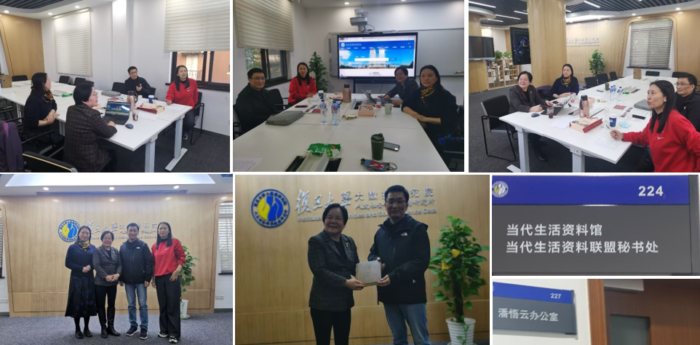
The visit continued with a tour of the Institute for Humanities and Social Sciences Data at Fudan’s Big Data Research Center. The Contemporary Life Archive founded by Professor Zhang Letian, Founding Chinese President of the Global China Academy, and the Secretariat of the Global Contemporary Life Data Alliance he initiated, are both housed here. We also visited the office of Professor Pan Wuyun, a leading scholar in Chinese linguistics and linguistic anthropology, who has played a pivotal role in building the 21st-Century Chinese Language and Dialect Database and advancing research on cultural transmission and population migration. The library thus serves as a vital base for continued scholarly influence after retirement.
This was followed by a roundtable discussion with: Zhang Jilong, Deputy Director of Fudan Library and Executive Deputy Director of the Institute; Yin Shenqin, Deputy Director of the Institute and Deputy Director of the Shanghai Big Data Laboratory for Scientific Research; and Dr Wang Shunqing, Associate Professor and Director of the Contemporary Life Archive and Secretariat. I introduced the academic resources and publishing system of the Global China Academy and Global Century Press. The team expressed strong interest in data sharing, corpus construction, and the upcoming 11th Global China Dialogue (GCD11) on “Global AI and Data Governance” in December 2026.
Yin Shenqin presented the institute’s database system and vast humanities and social science data resources. Zhang Jilong introduced the 2025 Conference on Intelligent Humanities and Social Sciences to be held on 1 March, themed “AI-Driven Theoretical Innovation and Paradigm Transformation in the Humanities and Social Sciences,” covering topics such as AI4SS social agents and complex systems, AI risk identification and decision-making, AI4H and Chinese civilisation, and AI ethics and governance. Dr Wang discussed potential collaboration with the Global Contemporary Life Data Alliance. Both sides expressed a desire for sustained interaction and deeper cooperation.
This visit not only deepened my understanding of Fudan’s digital humanities and data infrastructure, but also established new academic connections for the Global China Academy in AI, data governance, and transcultural research.
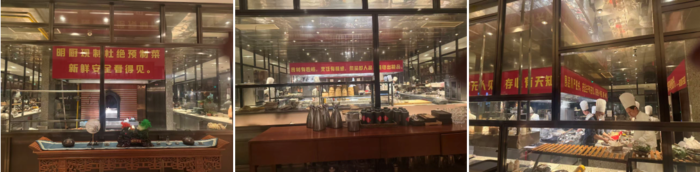
Our exchanges continued over dinner. In China, food often carries layered social meanings, and the innovative Shanghainese–Cantonese fusion cuisine at Longzhuang Xiuchu was particularly memorable. Just as red banners often greet visitors to Chinese universities, this restaurant used bold red slogans as part of its spatial language. Yet unlike traditional restaurants with “No Entry to the Kitchen” signs, its large open kitchen placed cooking at the centre, making every process visible. Slogans such as “Freshly cooked, no pre-made dishes—safety you can see” and “Ingredients have character, cooking has emotion, dishes reflect the person—craftsmanship creates excellence” served not only as quality commitments but as statements about food, labour, and public trust, turning the meal itself into a perceptible form of communication.
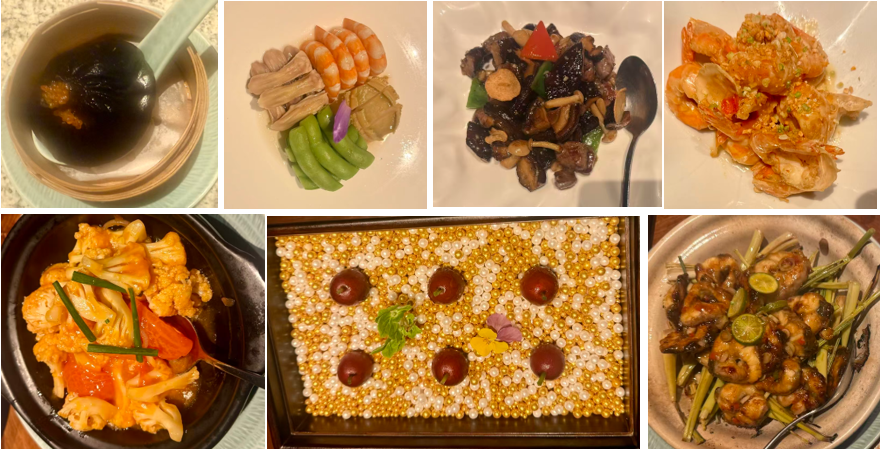
The dishes represented a mature style of high-end Chinese cuisine—a contemporary fusion of refined Shanghainese and Cantonese traditions. Plating was restrained and orderly, with precise control of colour and negative space, reflecting clear aesthetic judgement and professional confidence. The sequence of cold dishes, hot dishes, soups, and main courses unfolded with measured rhythm and logic, emphasising natural flavours while building subtle layers through technique rather than visual spectacle. From the textures and flavours, it was evident that the kitchen prioritised heat control and process over heavy sauces: seafood was tender, mushrooms carried wok hei, and soups were clear yet rich—demonstrating solid craftsmanship and fulfilling the promise of visible, honest cooking.
In this atmosphere, conversation was no longer merely verbal continuation; through real cooking, stable quality, and visible labour, a quiet but solid sense of trust was built, allowing dinner itself to become a daily scene in which public spirit found tangible form.

Chinese New Year Greetings, Global China Academy Fellows’ Newsletter and GCA 2024 Annual Report
Dear colleagues and friends,
As the Year of the Snake 2025 slithers forward, we are delighted to take this opportunity to update you on our situation and activities.
Following the comprehensive report on Special Edition for the 10th GCA Anniversary (2013–2023) we have updated Global China Academy’s brochure to highlight A Decade of Achievement to be Associate Member of the Academy of Social Sciences Since 2014 and celebrating the 10th anniversary of the Global Century Press (GCP, UK Company No.: 08892970).
The year 2024 marks the beginning of GCA 2.0, with changes in governance structure and policy development as key priorities. These initiatives lay the foundation for GCA’s future decades. This Annual Report is based on information from the GCA Trustees’ Annual Return Report to the Charity Commission (1st April 2023 to 31st March 2024) and the GCA Fellows’ first half-year Newsletter for 2024. This Annual Report also serves as the second half-year Newsletter. Please follow the links to read more details.
- Global China Academy
- Global China Academy Fellowship
- Global Century Press
- The 9th Global China Dialogue
Click here to download 2024 report.
- Click here to visit 2023 report (Special Edition for the 10th GCA Anniversary: 2013–2023). Download report.
- Click here to visit the Chinese New Year Greetings and the GCA Annual Report for the year 2021–2022. Download report.
- Click here to visit the Chinese New Year Greetings for 2022.
- Click here to visit Chinese New Year Greetings and the GCA Annual Report for the year 2020–2021. Download report.
- Click here to visit Chinese New Year Greetings and the GCI Annual Report for the year 2019–2020. Download report.
- Click here to visit Chinese New Year Greetings and the GCI Annual Report for 2018–2019. Download report.
- Click here to visit Chinese New Year Greetings and the GCI Annual Report for 2017–2018. Download report.
- Click here to visit Chinese New Year Greetings and the GCI Annual Report 2016–2017. Download report.
- Click here to visit Chinese New Year Greetings and the CCPN Global Annual Report for 2015–2016. Download report.
- Click here to visit Chinese New Year Greetings and the CCPN Global Annual Report for 2014–2015. Download report.
- Click here to visit Chinese New Year Greetings and the CCPN Global Annual Report for 2013–2014. Download report.
Note: The early greeting newsletters and annual reports contain a large number of web links to the old website. These will be available after being updated.

GCA Fellows Gathering at GCD9, Shanghai (November)
Global China Academy (GCA), the UK-based independent worldwide fellowship institution, is not generally recognized in China by the Chinese academia and public. Clarifications on GCA’s position and status were made before the 9th Global China Dialogue was held in China, entitled ‘Perceptions of Academician and Fellowship Systems in China and the International Context, and Their Chinese Translations‘.
In spite of this, GCA Fellows, Associate Fellows, and Representative Fellows in China have been very supportive and actively participated in our events, either in China or in the UK. For instance, on 17th September 2022, all GCA Fellows met online or in person in Beijing when GCA’s President, Professor Xiangqun Chang, visited China for the first time after COVID-19.
In 2024, the 9th Global China Dialogue Forum (GCD9) was planned to be held at Tongji University in Shanghai, marking the first time the event took place in China. All the GCA Fellows, Associate Fellows, and Representative Fellows in China responded positively and took on various roles at GCD9. They are listed below (in alphabetical order):
GCA Fellows:
- BING Zheng – Closing remarks
- Xiangqun Chang – Opening address and introduction at the GCA Fellows Awarding Ceremony
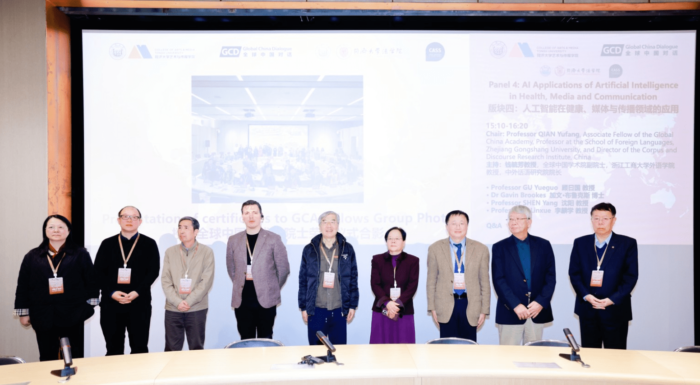
- GU Yueguo – Plenary speaker at Panel 4
- HAO Shiyuan – Presented Fellowship awards to the newly elected GCA Fellows, Associate Fellows, and Institutional Fellows based in China, including Hong Kong
- LI Linxue – Chaired the Opening session and plenary speaker at Panel 3
- Tony McEnery – Sourced relevant speakers and delivered the keynote speech (online)
- XIE Lizhong – Presented Fellowship awards to the newly elected GCA Fellows, Associate Fellows, and Institutional Fellows based overseas
- ZHANG Xiaodong – Plenary speaker at Panel 1
- ZHU Guanglei – Delivered a special speech at the Dinner session
GCA Associate Fellows:
- Gavin Brookes – Plenary speaker at Panel 4
- QIAN Yufang – Chaired Panel 4 and attended as a representative to receive the certificate for the GCA Institutional Fellowship
- WANG Xin – Co-organized GCD9 at Tongji University and chaired the Closing session
Institutional Fellows:
- College of Arts and Media at Tongji University (China) – Co-organizer
- Centre for Corpus Approaches to Social Science at Lancaster University (UK) – Co-organizer
- Global Century Press (UK) – Designed and produced all publicities
- Institute of Linguistics at Sun Yat-sen University (China) – Contributed a small donation
All Fellows, Associate Fellows, and representatives of Institutional Fellows were invited on stage during the Fellowship awarding ceremony at the Closing Session to witness the conferring of honours on the 2024 Fellows.
This page serves to highlight the invaluable contributions of the Global China Academy (GCA) Fellows, Associate Fellows, and Institutional Fellows to the success of the 9th Global China Dialogue Forum (GCD9). It recognizes the active participation of these individuals in various capacities, ranging from keynote speakers to session chairs, and acknowledges their dedication to advancing the GCA’s mission. The diversity of roles and the global representation of the Fellows demonstrate the broad and inclusive nature of GCA’s academic and professional community.
Furthermore, this page illustrates the collaborative spirit between GCA, academic institutions, and organizations from both China and the UK, showcasing the strength of partnerships that transcend borders. By sharing these highlights, the page not only reflects the achievements of the 9th Global China Dialogue but also reinforces the ongoing commitment of GCA members to fostering international dialogue, intellectual exchange, and cross-cultural understanding.
- Click here to visit the New Fellowships awarded in 2024
- Click here to visit the New Fellowships awarded in 2023
- Perceptions of Academician and Fellowship Systems in China and the International Context and their Chinese Translations.
- Click here to return to the Fellowship home page

GCA Formal Chinese President Professor ZHANG Letian Leads Academic Visit to the UK
In mid-November 2024, the Global China Academy (GCA) supported a nine-day academic visit to the United Kingdom by Professor Zhang Letian, founding Chinese President of GCA and Professor at Fudan University, together with his colleagues. Prior to the visit, Professor Zhang contacted GCA to request assistance in expanding the scope of his existing academic engagements and in enriching the overall itinerary. GCA subsequently participated in coordination and liaison work, helping to extend the original plan into a series of academic exchanges and institutional visits across London, Oxford, Lancaster, and Edinburgh, systematically strengthening collaboration between Chinese and UK universities in the fields of social sciences, digital humanities, and social life archives research.
Professor Zhang Letian is the founding Chinese President of the Global China Academy and a professor at Fudan University. The Contemporary Chinese Social Life Archive and the Global Alliance for Contemporary Social Life Archives, which he founded, are both housed within the Fudan University Library system. Accompanying him on this visit were two colleagues: Ms Yin Shenqin, Associate Director of the Institute of Humanities and Social Sciences Data at Fudan University and Deputy Director of the Shanghai Big Data Laboratory for Scientific Research; and Dr Wang Shunjing, Associate Professor at the Institute of Digital Humanities and Social Sciences, and Secretary-General of both the Contemporary Social Life Archive and the Global Alliance.

On 14 November, Professor Zhang attended the book launch of Integrity: The Rise of a Distinctive Western Idea and Its Destiny by renowned sociologist Professor Martin Albrow, former Honorary President of GCA, held at Hatchards Bookshop in London. Published by Polity Press, the book offers a historical and sociological examination of “integrity” as a core value of Western civilization, tracing its evolution from antiquity to the present and addressing its contemporary crisis in public life. The launch brought together scholars, publishers, and friends for a rich exchange on global ethics and social trust.
According to the planned schedule, Professor Zhang and his delegation attended the 8th UK–China Humanities Alliance for Higher Education Annual Conference (Worlds and World Views) at University College London (UCL) on 15–16 November, followed by academic exchanges in Oxford on 19–20 November.
With GCA’s coordination, the delegation also visited the Library of the Oxford China Centre, and, with arrangements made by its director Dr Mamtimyn Sunuodula, toured the Digital Library at the Bodleian Library and the Digital Collaborative Photography Centre. In addition, GCA facilitated academic exchanges with the Centre for Corpus-Based Social Science at Lancaster University and the Business School of the University of Edinburgh.

On 18 November, Professor Zhang and his colleagues visited the Global China Academy for formal exchange with the GCA team. The delegation toured the books and journals published by Global Century Press and held discussions with Professor Xiangqun Chang, President of GCA, and Mr Liu Daquan, Executive Manager of GCA.
During the meeting, Professor Zhang and Dr Wang Shunjing introduced the development and operational framework of the Global Alliance for Contemporary Social Life Archives. Initiated by Fudan University in 2016 and formally established in 2018, the Alliance is headquartered at the Fudan University Library and now brings together 34 university libraries and research institutions from East Asia and North America. It is dedicated to cross-media, interdisciplinary sharing of social life materials and international research collaboration. The Alliance has continuously supported international conferences and research projects, particularly in the areas of family studies, narrative history, and methodologies of social life archives.
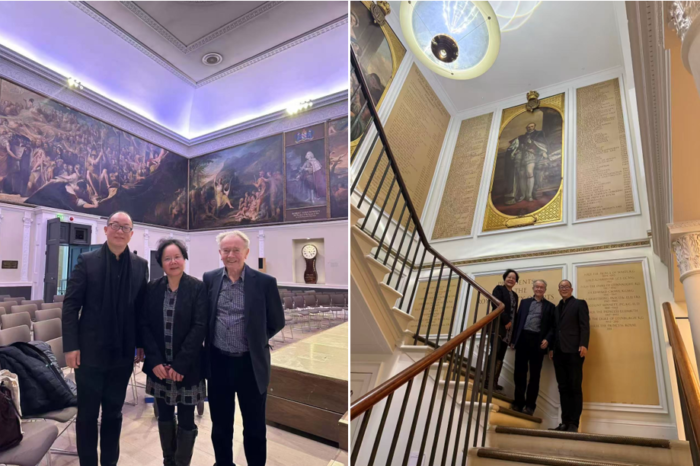
At the conclusion of the exchange, the two institutions exchanged publications. As the visit took place near the end of the year, Professor Zhang’s delegation also brought silk-printed Spring Festival couplets as a gift to the GCA Fellows’ House. The couplets—symbolising scholarly continuity, diligence, and institutional well-being—became a warm and memorable moment of the visit.

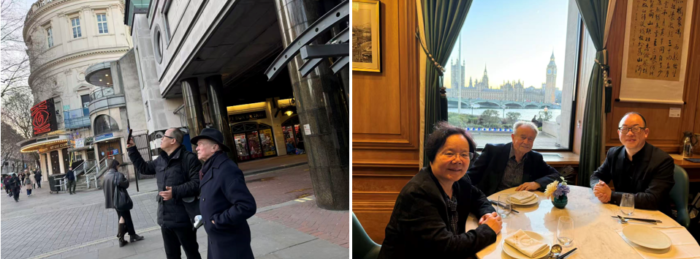
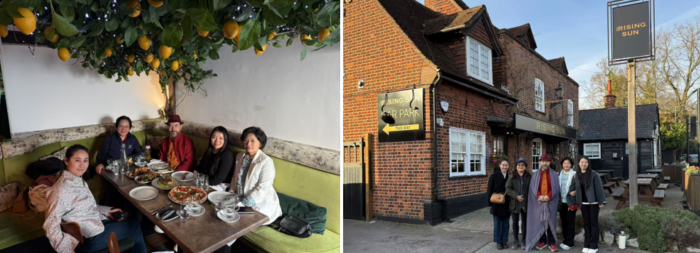
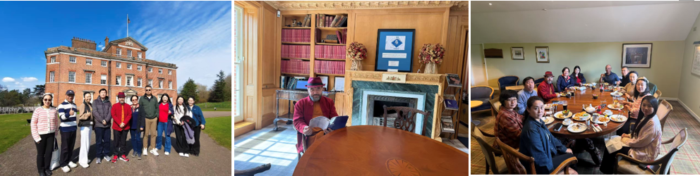
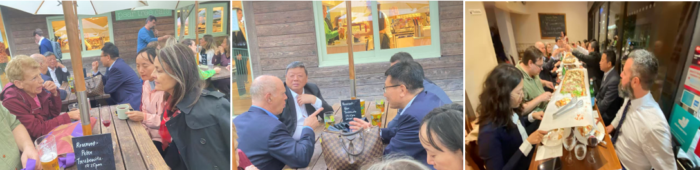
The photo on the left shows a tea break during the academic meetings, where participants continued their conversations in a relaxed setting. The photo on the right captures a Chinese meal shared during the visit, where dining together extended the day’s discussions and strengthened mutual understanding through everyday social interaction, adding a human and cultural dimension to the academic exchange.

In keeping with GCA tradition, visiting scholars are invited to join a “walking dialogue”. During this visit, Professor Zhang and his colleagues participated in the sixth walking route, leading to Brocket Hall. Located in Hertfordshire, Brocket Hall is a historic estate of strong political symbolism, having once been the residence of two British Prime Ministers: Lord Melbourne and Lord Palmerston. In the mid-19th century, Palmerston played a key role in shaping Britain’s hardline China policy before and after the First Opium War—a conflict that profoundly altered China’s historical trajectory and reshaped the global order, while also influencing long-term Western political and cultural perceptions of China.
Situated along the River Lea, Brocket Hall combines classical architecture, landscape design, and waterways, forming a space where British political history and cultural landscape intersect. Today, the estate serves as a venue for international conferences and academic exchanges, carrying new public functions atop its historical foundations. GCA has long used this site as a node for academic visits and walking dialogues, transforming historical space into a platform for reflecting on global order, institutional change, and civilizational interaction.
In the final stage of the visit, scholars walked along the riverbank at Brocket Hall, continuing the day’s academic conversations through movement and dialogue. During a brief ferry crossing, the group collectively experienced the transition from sunset to nightfall. The fading light, shifting space, and uninterrupted conversation intertwined, allowing academic exchange to momentarily leave the conference room and become a situated, embodied, and shared experience.
This moment carried deep symbolic meaning: in a space once deeply entangled in the formation of global inequality and China’s modern historical fate, researchers from different academic traditions walked side by side as equals. Through slow movement and open conversation, they revisited questions of society, memory, archives, and time. Academic exchange thus gained a different rhythm and depth, endowing contemporary Sino–British collaboration with a transcultural dimension—where knowledge was not merely discussed, but re-produced and re-connected through shared experience.

GCA Founding and Past Honorary President Professor Martin Albrow Launches New Book Integrity
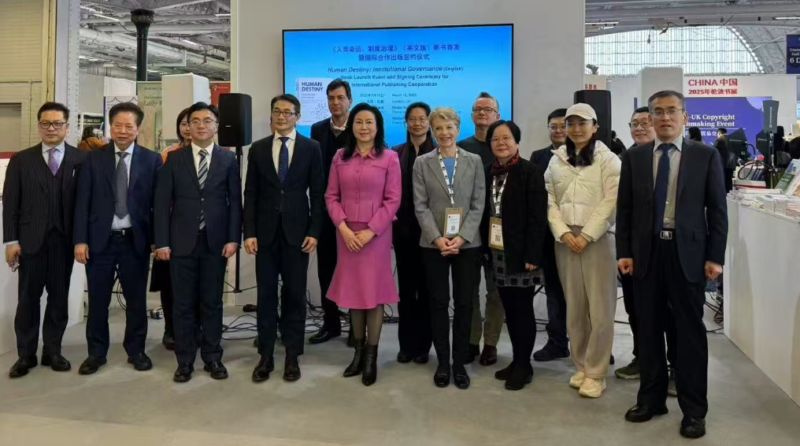
On 14 November 2014, Professor Martin Albrow, Founding and Past Honorary President of the Global China Academy (GCA), launched his new book Integrity: The Rise of a Distinctive Western Idea and Its Destiny at Hatchards, London. Published by Polity, the book offers a profound historical and sociological exploration of integrity as a defining value of Western civilization and its relevance in contemporary public life.
In the book, Albrow traces the idea of integrity from its origins in ancient Greece and Rome—where it signified unity through values and adherence to external standards—through Christianity, the Renaissance, and into the modern era. He argues that today’s public life is marked by a troubling paradox: while integrity is widely demanded, political leaders can often succeed without embodying it, creating what he terms a new “politics of the integrity vacuum.”
Albrow concludes that although integrity emerged as a distinctive Western concept, it has become a shared global concern. He calls for a renewal of integrity through dialogue with non-Western wisdom, emphasizing the need to rebuild honesty, trust, and reliability in public and social life. The launch event at Hatchards brought together scholars, publishers, and friends to celebrate a work that speaks directly to some of the most pressing ethical and political challenges of our time.


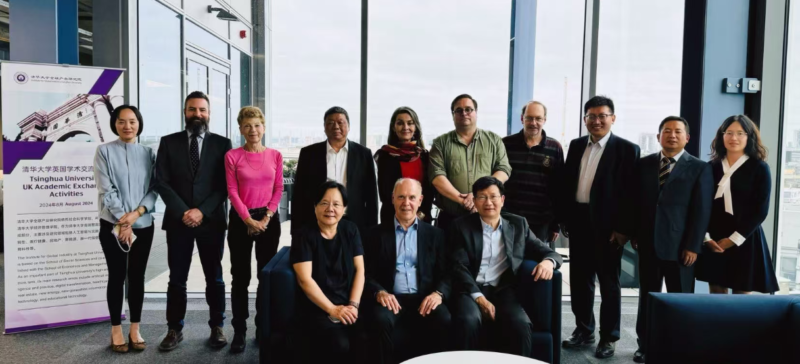
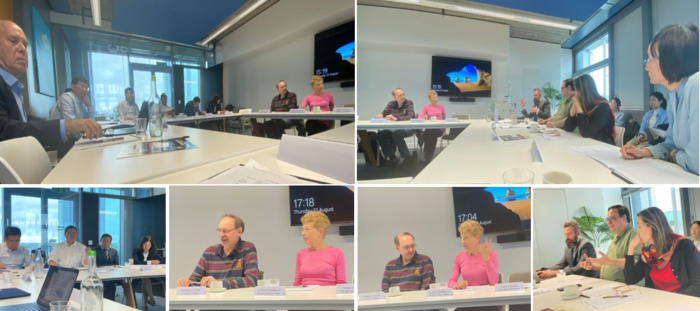
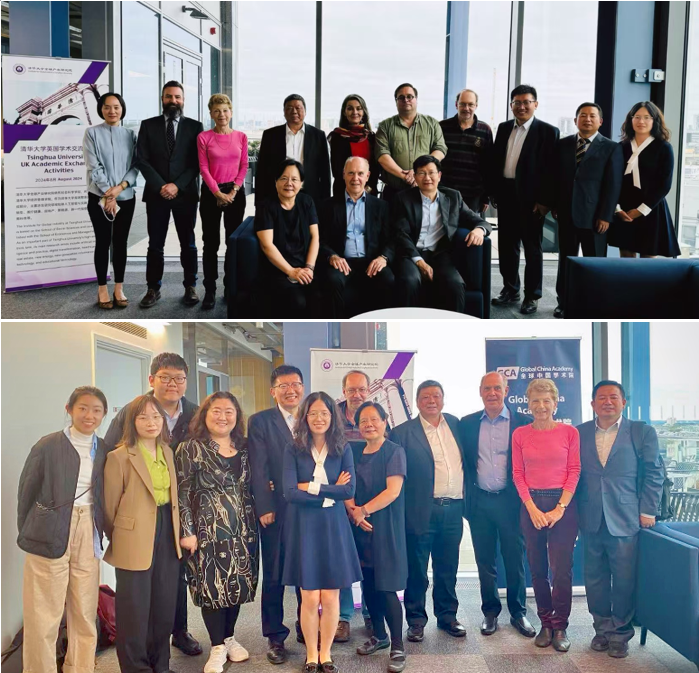
GCA Leaders with Chinese Delegates Participate in “China–US Relations and the International Order” Workshop at LSE (August 22, 2024)
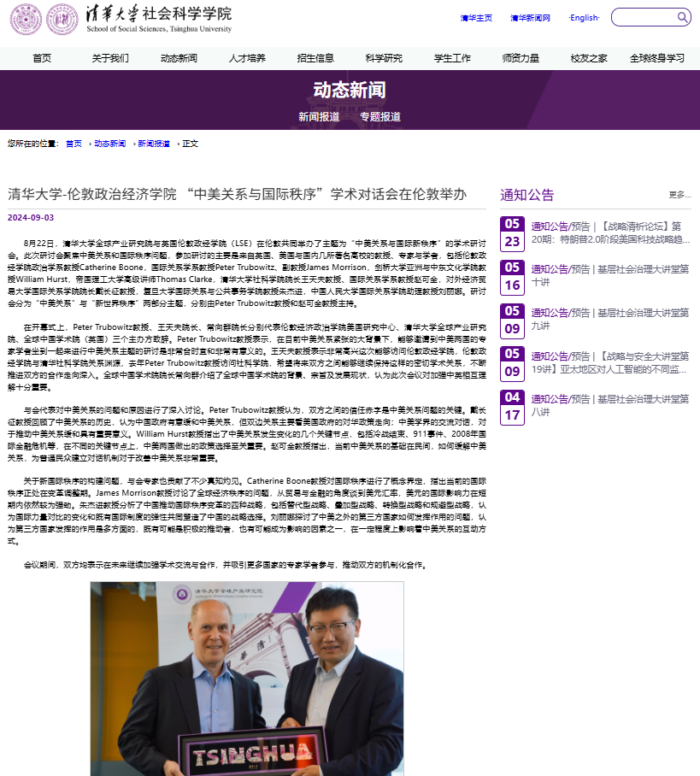
On 22 August 2024, the informal workshop “US–China Relations and the New World Order” was held at the London School of Economics and Political Science (LSE). The event was jointly organised by the Phelan United States Centre at LSE, the Institute of Global Industry at Tsinghua University, and the Global China Academy (UK). Scholars from leading universities in China and the UK gathered to discuss the future trajectory of US–China relations and the reshaping of the global order, addressing issues of international politics, global governance, and institutional change. Through two themed sessions and interdisciplinary exchanges, the workshop enhanced mutual understanding of the current international landscape and the prospects of a new world order, while laying the groundwork for future academic collaboration.
The workshop was attended by Ingrid Cranfield, former Chair of the Board of Trustees of the Global China Academy and President of Global Century Press; Dr Thomas Clarke, Treasurer of the Global China Academy Board of Trustees and Principal Teaching Fellow at Imperial College London; and Professor Xiangqun Chang, President of the Global China Academy. Opening remarks were delivered by Professor Peter Trubowitz, Director of the Phelan United States Centre at LSE; Professor Wang Tianfu, Dean of the School of Social Sciences at Tsinghua University; and Professor Xiangqun Chang, President of the Global China Academy.
In her remarks, Professor Chang noted that “today’s workshop offers us a rare opportunity to explore a range of important issues together in a relatively informal setting—from the challenges and opportunities facing US–China relations to the broader prospects of a new world order. This workshop demonstrates the strength of institutional collaboration and our shared commitment to addressing some of the most pressing issues of our time, especially during the holiday period.”
Participants engaged in focused discussions on US–China relations and international order. Professor Peter Trubowitz identified the trust deficit between the two countries as a core source of current tensions. Dr Thomas Clarke agreed, adding that trust grows from understanding, which requires each side to recognise the different ways in which the other approaches relationships. Professor Dai Changzheng suggested that while China seeks to ease tensions, the direction of bilateral relations largely depends on US policy, and that academic exchanges play a crucial role in improving mutual understanding. Professor William Hurst analysed key turning points in US–China relations, including the end of the Cold War, the 9/11 attacks, and the 2008 global financial crisis. Professor Zhao Kejin emphasised the importance of building dialogue mechanisms at the societal level to provide a foundation for easing bilateral tensions.
On the question of the new international order, Professor Catherine Boone observed that the global order is currently undergoing a period of adjustment. Professor James Morrison noted that the US dollar remains highly influential in the short term. Professor Zhu Jiejin outlined four strategic approaches China has adopted in promoting changes to the international order, while Dr Liu Lina highlighted the multifaceted and shifting roles that third-party countries may play in shaping US–China interactions.
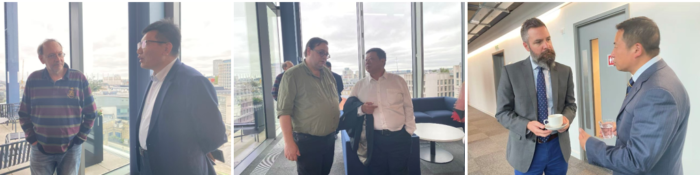
Following the formal sessions, participants continued their conversations in a relaxed and open atmosphere over coffee and dinner. These informal exchanges extended the spirit of dialogue beyond the conference room, deepened mutual understanding, and helped build personal connections. Such interactions reflected the workshop’s commitment to dialogue-based engagement and provided a strong foundation for sustained academic cooperation and more institutionalised communication in the future.
Organizers:
- Phelan United States Center, London School of Economics
- Institute of Global Industry, Tsinghua University
- Global China Academy (UK)
Time: 13:45-17:15 August 22, 2024
Location: London School of Economics and Political Science
Room: Centre Building (CBG); Rm. 11:13
13:45-14:00 Workshop registration (CBG Rm. 11:13)
14:00-14:15 Opening Remarks
- Peter Trubowitz, Director, Phelan United States Center, LSE
- WANG Tianfu, Dean, School of Social Sciences, Tsinghua University
- Xiangqun Chang, President, Global China Academy
14:15-15:15 US-China Relations: The Road Ahead
- Peter Trubowitz, Professor, LSE (Moderator) DAI Changzheng, Professor, UIBE
- William Hurst, Professor, Cambridge University Elizabeth Ingleson, Assistant Professor, LSE
15:15-15:30 Coffee Break
15:30-16:30 A New World Order: Obstacles and Prospects
- ZHAO Kejin, Professor, Tsinghua University (Moderator) Catherine Boone, Professor, LSE
- Thomas Clarke, Principal Teaching Fellow, Imperial College
- James Morrison, Associate Professor, LSE
- LIU Lina, Assistant Professor, Renmin University
- ZHU Jiejin, Professor, Fudan University
16:30-16:45 Concluding Remarks
- Peter Trubowitz, LSE
- ZHAO Kejin, Tsinghua University
16:45-17:15 Group Photo and Short Tour of LSE
17:15-18:15 Drinks Pear Tree Café, Lincoln’s Inn Fields
19:00 Dinner Santoré, 59-61 Exmouth Market, London EC1R 4QL
Related photos
Related pages
- Click here to view the Chinese page
- Click here to view GCA Fellows Participate in a Discussion on the Impact of AI on Work, Life, and Global Governance in University of Oxford (August 19, 2024)
- Click here to view Global China Academy Invites Scholars from Tsinghua University and Three Other Chinese Universities to Visit the UK (17–23 August 2024)
- Click here to view Impressions and Reflections on Visiting Birmingham in the UK
- Click here to view Field Visits on British Modernization and Its Global Development Experience (July – August 2024)
- Click here to view Professor Zhao Kejin visits GCA with the last wish of LI Qiang, former Chinese chairman of the Global China Academy Council (20 Jan. 2024)
- Click here to view the page ‘GCA Life Fellow Korean Sociologist Professor HAN Sang-Jin Meeting Professor Xiangqun Chang at Seoul, January 2023.’
- Click here to view the memorial page for Professor LI Qiang (1950–2023)
- Click here to watch a video of Professor LI Qiang’s greeting for the launch of the Global China Academy as an academy at the 7th Global China Dialogue, on December 10th, 2021, at the British Academy.
- Click here to view Professor LI Qiang’s webpage
- Click here to visit News and Blog section

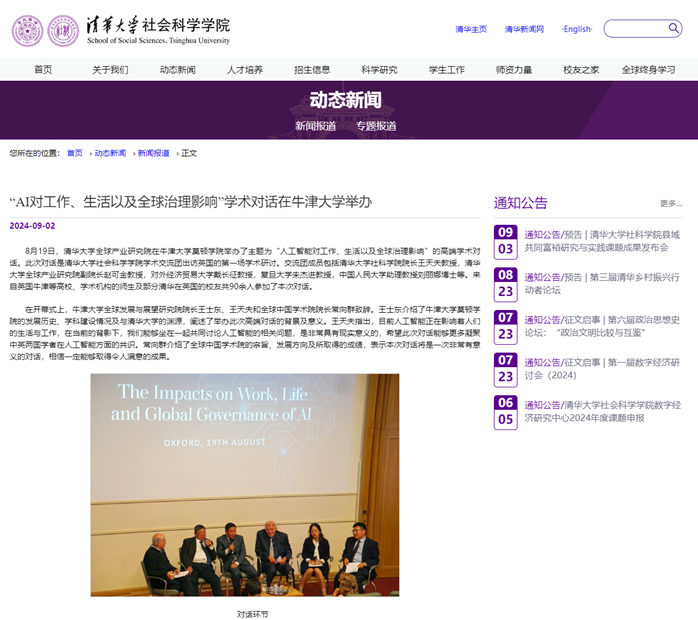
GCA Fellows Participate in a Discussion on the Impact of AI on Work, Life, and Global Governance in University of Oxford (August 19, 2024)
Co-organizers:
- Institute for Global Industry, Tsinghua University
- Global China Academy (UK)
Time: 15:00-17:30 August 19, 2024
Venue: Lecture Hall, Merton College, University of Oxford
Format: Offline、ZOOM Live Stream
15:00-15:10 Opening session
Chair: Dr Shidong Wang, Director, Oxford Outlook and Global Development Research Institute
Opening address
- Professor WANG Tianfu, Dean of School of Social Sciences, Tsinghua University, China
- Professor Xiangqun Chang, President of Global China Academy, UK
15:10-17:00 Panel discussion
- Professor ZHAO Kejin, Deputy Director of Institute for Global Industry, Tsinghua University
- Professor DAI Changzheng, Dean of the School of International
- Relations, UIBE
- Professor ZHU Jiejin, School of International Relations and Public Affairs, Fudan University
- Dr LIU Lina, Assistant Professor, School of International Relations, Renmin
- University of China
- Professor David Parkin FBA FGCA, former head of ISCA and the School of
- Anthropology and Museum Ethnography, University of Oxford
- Professor Robin Cohen FGCA, Former Director of the International Migration Institute, University of Oxford
17:00-17:20 Concluding Remarks
- ZHAO Kejin, Tsinghua University
- Shidong Wang, Oxford University
17:20 Group Photo
18:00 COSMO World Buffet Restaurant,8 Magdalen St, Oxford OX1 3AD
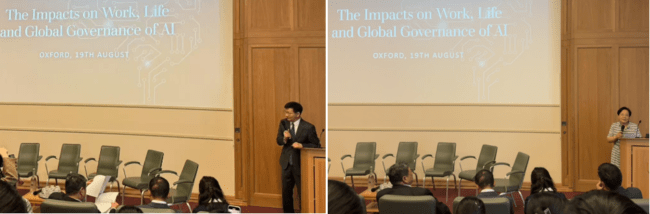
In his introduction, Dr. Shidong Wang, Director of Oxford Outlook and Global Development Research Institute, provided an overview of the development history and academic programs of Merton College, University of Oxford, as well as its connections with Tsinghua University. He also elaborated on the background and significance of hosting this high-level dialogue.
Representing the co-organizers, Professor Wang Tianfu and Professor Xiangqun Chang delivered opening addresses. Professor Wang emphasized that AI is profoundly influencing people’s work and daily lives, making discussions on its impact both timely and essential. He expressed hope that this dialogue would foster greater consensus among scholars from China and the UK on AI-related issues.
Professor Chang highlighted the interdisciplinary nature of the discussion, emphasizing that while not all panelists are AI specialists, they are leading figures in their respective fields. She noted that the Global China Academy contributed two Life Fellows to this event:
- Professor Robin Cohen, Emeritus Professor at the University of Oxford and former Director of the International Migration Institute
- Professor David Parkin, Emeritus Professor at the University of Oxford and former Head of the School of Anthropology and Museum Ethnography
She emphasized that the discussion would explore AI’s far-reaching implications across disciplines, including international relations, public policy, sociology, and anthropology, examining how AI is shaping the future of work, governance, and society as a whole.
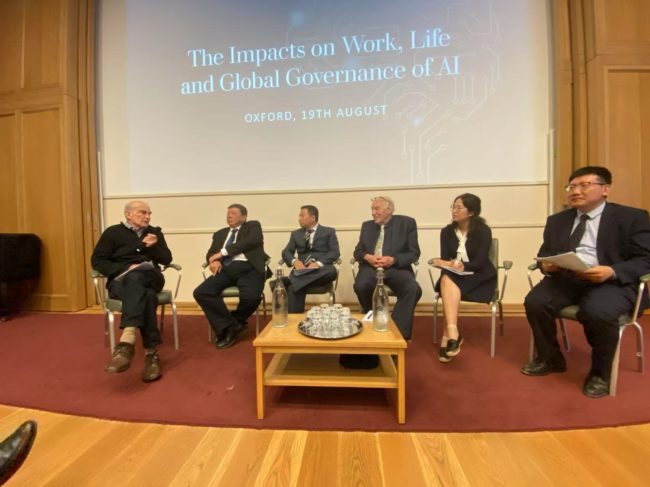

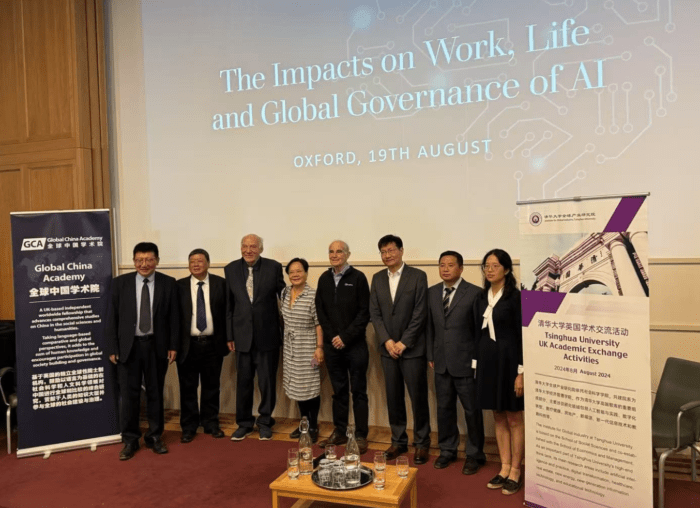
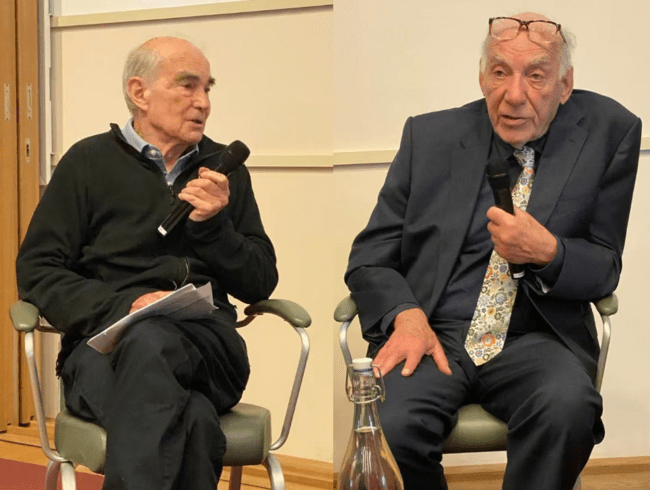
Professor David Parkin (left) discussed the significance of AI from the perspective of language and politics. He emphasized that language is primarily a tool for communication, and in formal settings such as political negotiations, AI’s role becomes particularly prominent, as it can be utilized for persuasion and advocacy.
Professor Robin Cohen (right) highlighted AI’s profound impact on migration. While AI offers convenience, it also presents challenges, including energy consumption and ethical concerns related to privacy. In this context, the question of how humanity can effectively and responsibly harness AI remains critical.
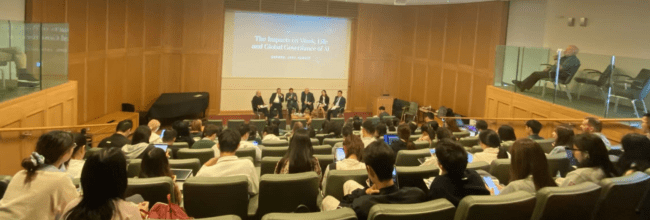
This discussion on The Impact of AI on Work, Life, and Global Governance provided a valuable opportunity for UK-China academic exchange, fostering interdisciplinary dialogue and a deeper understanding of AI’s broader effects.
By bringing together scholars from China and the UK, the event contributed to ongoing discussions about AI’s global impact, touching on governance, policy, and ethical considerations. It also supported Professor Li Qiang’s vision of strengthening collaboration between Tsinghua University and the Global China Academy, promoting continued engagement on key global challenges.
The diverse perspectives and active participation highlighted the increasing significance of AI in shaping our future, emphasizing the need for cooperation and responsible governance. The event was well received and set the stage for our 9th global China Dialogue – Global Governance for AI.
Related pages
- Click here to view the Chinese page
- Click here to view GCA Leaders with Chinese Delegates Participate in “China–US Relations and the International Order” Workshop at LSE (August 22, 2024)
- Click here to view Global China Academy Invites Scholars from Tsinghua University and Three Other Chinese Universities to Visit the UK (17–23 August 2024)
- Click here to view Impressions and Reflections on Visiting Birmingham in the UK
- Click here to view Field Visits on British Modernization and Its Global Development Experience (July – August 2024)
- Click here to view Professor Zhao Kejin visits GCA with the last wish of LI Qiang, former Chinese chairman of the Global China Academy Council (20 Jan. 2024)
- Click here to view the page ‘GCA Life Fellow Korean Sociologist Professor HAN Sang-Jin Meeting Professor Xiangqun Chang at Seoul, January 2023.’
- Click here to view the memorial page for Professor LI Qiang (1950–2023)
- Click here to watch a video of Professor LI Qiang’s greeting for the launch of the Global China Academy as an academy at the 7th Global China Dialogue, on December 10th, 2021, at the British Academy.
- Click here to view Professor LI Qiang’s webpage
- Click here to visit News and Blog section
- Click here to visit GCA Fellowship section

Global China Academy Invites Scholars from Tsinghua University and Three Other Chinese Universities to Visit the UK (17–23 August 2024)
In early June 2024, Professor Zhao Kejin of Tsinghua University contacted Professor Xiangqun Chang to propose two academic visiting programmes. The first was a 22-day field study (27 July–17 August), led by Professor Zhao, focusing on British modernisation and its global development experience. The second was a seven-day visit (17–23 August) to the United Kingdom by scholars from four universities in Beijing and Shanghai, centred on the development of artificial intelligence and global governance.
These visits formed part of the concrete measures agreed upon during Professor Zhao Kejin’s visit to the Global China Academy Centre on 20 January 2024, where institutional cooperation between Tsinghua University and the Global China Academy (GCA) was discussed and confirmed. They also represented the fulfilment of the late Professor Li Qiang’s (1950–2023) long-held vision — founding dean of the School of Social Sciences at Tsinghua University and former Chinese Chair of the GCA Council — to continue strengthening and developing the academic relationship between the two institutions.
For this reason, both the GCA Board of Trustees and the GCA Council attached great importance to the visit of Tsinghua and other Chinese scholars to the UK, and hoped to sustain and deepen the partnership through collaboration with the School of Social Sciences at Tsinghua University. Based on a previous invitation-letter template, Professor Tony McEnery (Chair of the GCA Council) and Professor Xiangqun Chang (President/Director of GCA) jointly issued formal invitations, clearly stating that all programme arrangements and services would be organised and delivered by the Global China Academy, while the associated costs would be covered by the Institute for Global Industry (IGI), Tsinghua University. As the visit took place during the holiday period, GCA also ensured that each key activity would be attended by different GCA leaders or Fellows.
With regard to transport and accommodation, we appropriately outsourced certain elements; for catering, thanks to sponsorship from two entrepreneurs, we raised the standard where appropriate. We also proactively added a clause to the previously signed contract stating that any excess costs beyond the agreed level would be borne by GCA, as a gesture of good faith and commitment as the host. Drawing on decades of experience in academic exchange with Chinese scholars, we extended the traditional Chinese literati ideal of “reading ten thousand books and travelling ten thousand miles” by adding another principle: “sharing international meals and making friends from all corners of the world.” For Chinese guests—given the cultural importance of food—“sharing international meals” is also a practical way to embody Fei Xiaotong’s well-known vision of cultural reciprocity and cosmopolitan coexistence: appreciating one’s own beauty, appreciating the beauty of others, and achieving harmony through mutual flourishing—often summarised as “harmony without uniformity.”
All aspects of the programme — including its academic content, travel arrangements, accommodation, meals, site visits, and scheduling — were discussed, reviewed, and confirmed with the delegation in advance of their arrival in the United Kingdom. Below are brief daily summaries of activities and related photos (mainly based on images shared in our WeChat group). This documentation is not only for record-keeping, but also to uphold the authenticity, fairness, and transparency of academic work—and to demonstrate the work undertaken and the effort invested.
17 August (Saturday) Arrival in London · Welcome Party
- Around 10:45 Arrival at Beijing Capital International Airport (Terminal 3). Check-in counter: H.
- 13:45–17:45 Flight CA937 from Beijing Capital International Airport (T3) to London Heathrow Airport (T2). GCA arranged airport pick-up (7 people + 7 suitcases, 9-seat minibus).
- 20:00 A welcome party was held at the GCA Fellows’ Home. Attendees included:
Chinese delegation (10 people):
- Professor Wang Tianfu (Dean, School of Social Sciences, Tsinghua University);
- Professor Zhao Kejin (Department of International Relations, Tsinghua University);
- Professor Dai Changzheng (Dean, School of International Relations, University of International Business and Economics);
- Professor Zhu Jiejin (Former Vice Dean of School of International Relations and Public Affairs, Fudan University);
- Dr Liu Lina (Assistant Professor, School of International Studies, Renmin University of China);
- Dr Xing Yajie (Department of International Relations, Tsinghua University);
- Ms Yuan Yuhong (Deputy Director, Administrative Office, School of Social Sciences, Tsinghua University);
- Ms Sui Jingzhu (Institute for Global Industry, Tsinghua University);
- and Professor Zhao Kejin’s wife and son.
- In addition, Professor Zhang Shuyan (Northeast Normal University) and her daughter also joined.
Global China Academy participants:
- Professor Tony McEnery (Chair of the GCA Council);
- Dr Frances Wood (former Secretary to the GCA Board of Trustees);
- Professor Xiangqun Chang (President/Director of GCA);
- Mr Liu Daqian (Executive Manager, GCA);
- Mr Liang Kai (GCA Events Officer);
- and volunteer Bruce Liu Hongran (student at King’s College London), among others.
21:30 Check-in at the hotel. Accommodation in London
- The Manor Elstree, Barnet Lane, Elstree, WD6 3RE, UK
(33–55 minutes’ drive from the airport; 65–90 minutes to Oxford; 55–75 minutes to Cambridge) - GCA Fellows’ Home, 32 Hankins Lane, London NW7 3AG
The drive between the two locations is approximately 6–8 minutes, and both are about 40–120 minutes from central London depending on traffic. The minibus first dropped luggage at The Manor Elstree, then proceeded to the Fellows’ Home for the welcome reception.
The welcome party was hosted by Global China Academy at the Fellows’ Home. By early evening, staff and volunteers had already set up a long table. The buffet featured mainly Western hot dishes and cold platters, accompanied by salad, fruit, desserts, and drinks—allowing guests to serve themselves freely and socialise at ease. This welcoming dinner also became a cross-institutional, cross-cultural, and cross-generational exchange carried out in a relaxed atmosphere, laying a warm and solid emotional foundation for the intensive academic itinerary of the week ahead.
Scholars chatted freely by the table, in the garden, and on the steps, creating a rare sense of ease and closeness. Scholars from Tsinghua University, Renmin University of China, the University of International Business and Economics, Fudan University, and Northeast Normal University sat together with UK academics, members of the GCA Board of Trustees and Council, and volunteers. Conversations ranged from research, teaching, and international collaboration to observations of cities, family life, and personal interests. It was precisely in this informal setting that many exchanges—hard to unfold in formal meetings—took place naturally.
Professor Tony McEnery (Chair of the GCA Council), Dr Frances Wood (former Trustee), and Professor Xiangqun Chang (President) each delivered words of welcome, warmly greeting the delegation on their first collective UK visit after the pandemic and thanking them for their trust and support for transnational academic exchange. Professor Wang Tianfu (Dean, Tsinghua SSS), Professor Zhao Kejin (Executive Director, IGI, Tsinghua), and other members of the delegation then expressed appreciation for GCA’s invitation and the careful arrangements throughout, sharing their anticipation for the resumption of face-to-face exchange; applause and laughter were frequent.
On behalf of Tsinghua University, Professor Wang Tianfu presented GCA with a highly symbolic commemorative gift—an art installation themed around “TSINGHUA.” Here, the word “Tsinghua” was no longer merely a university name; it became an academic token crossing geography and institutional boundaries. It marked the reconnection of UK–China academic exchange after the pandemic and signalled a shared commitment to continued collaboration in global academic dialogue and knowledge production.


18 August (Sunday) Greenwich · Canary Wharf · River Thames
- 08:00 Departure. Two cars took participants from their accommodation to the local station.
- 08:14 Jubilee Line from Stanmore Station.
- 09:02 Arrive at North Greenwich.
- 09:09 Bus 129 (towards Lewisham) from North Greenwich Station (Stop C).
- 09:21 Get off at Trafalgar Estate (Stop T).
- 09:34 Arrive at Royal Observatory Greenwich.
- 10:00 Visit the Royal Observatory Greenwich.
- 11:00 Visit the University of Greenwich.
- 11:45 Take the driverless DLR (Cutty Sark → Canary Wharf).
- 12:00 Explore Canary Wharf, Europe’s largest financial district/enterprise zone.
- 12:30 Lunch: Big Easy Canary Wharf (American BBQ & seafood; 12 people).
- Accompanying staff: Bruce Liu Hongran (full day); Fang Zhou (Landmark Pinnacle visit + lunch)
- 14:00 Travel from Canary Wharf to RB1 Tower Pier.
- 15:30 Visit Tower Bridge and the Tower of London (around the sites).
- 16:30 Thames river cruise (London Tower Pier → Westminster).
- 17:00 Visit Westminster Abbey.
- 18:00 Visit the Palace of Westminster (not open on Sundays; visit the surrounding area).
- 18:30 Dinner: Peacock London, County Hall, The Queen’s Walk, London SE1 7PB (10 people + Xiangqun Chang, Liu Daqian, Yu Li, Bruce Liu Hongran)
Background Notes
- Royal Observatory Greenwich: the site of the Prime Meridian (0° longitude), symbolising a global coordinate for time and space.
- University of Greenwich: formerly the Royal Naval College (1890); Yan Fu once studied here.
- Canary Wharf: transformed from a declining docklands area into Europe’s leading financial district—an emblematic case of UK urban regeneration.
- Landmark Pinnacle: Europe’s tallest residential building (75 floors), offering panoramic views of the City, the O2, London City Airport, etc.
- Westminster Abbey: a symbolic site of Britain’s parliamentary monarchy; on Sundays it is open primarily for worship.

On Sunday, the delegation’s first day in London focused mainly on sightseeing and recovery from travel. The itinerary followed the Thames—stretching from Greenwich to Canary Wharf and back to Westminster—forming a classic route through which to understand London’s time, space, and urban transformation.
In the morning, visits to the Royal Observatory and the University of Greenwich began from the global temporal reference point of the Prime Meridian, offering a direct sense of Britain’s historical foundations in navigation, science, and higher education. The group then took the DLR to Canary Wharf to observe the UK model of docklands regeneration into a financial and commercial hub, and went up to Landmark Pinnacle to view London’s wider urban landscape. Lunch in Canary Wharf—seafood and barbecue—provided an easy and restorative break after the journey.
In the afternoon, the group cruised down the Thames, passing Tower Bridge and the Tower of London before reaching Westminster. The Sunday atmosphere around Westminster Abbey and Parliament was calm and spacious. Delegates sat on the grass, slowing down briefly and experiencing London’s distinctive Sunday ease and composure.
What left the strongest impression that day was not only London’s iconic landmarks, but also the lived experience of the city. The day moved from a river journey to moments of rest on the grass, and finally to a carefully structured rhythm of meals. Lunch was a Sunday brunch in Canary Wharf, where a single plate combined lobster and steak, offering a distinctly modern, financial-district version of a London weekend. Dinner, by contrast, was a Chinese meal at County Hall on the South Bank, directly facing Big Ben and the Houses of Parliament. The meal, which happened to pair lobster with crab, echoed the richness of the earlier lunch in a different cultural register. In the evening light by the Thames, familiar flavours returned in a setting framed by the symbols of British governance. The convergence of urban space, institutional landmarks, and everyday dining created a sense of balance and continuity, providing a composed and grounded transition into the intensive academic programme that followed.
19 August (Monday) University of Oxford · Academic Dialogue on AI and Global Governance
- 07:30 Departure for Oxford. Visits included: Christ Church College, University of Oxford and Oxford University Libraries (library system)
- 13:00 Lunch: Comptoir Libanais (Lebanese restaurant; 11 people).
- 15:00–17:20 Academic dialogue at Oxford. Theme: “The Impact of Artificial Intelligence on Work and Life, and the Discussion of Its Global Governance”; Venue: Lecture Hall, Merton College
- 18:00 Dinner: COSMO World Buffet Restaurant
Accompanying staff: Hugo Tai (MSc Politics, University of Oxford; former President of the British Postgraduate Network for Chinese Studies, BPCS)
Participants: the delegation + 4 from GCA (Xiangqun Chang, Robin Cohen, David Parkin, Hugo Tai). Dinner also included two Oxford-based scholars and others such as Cheng Yutong (PhD student, UCL), etc.


That morning, the delegation travelled from London to Oxford and visited Christ Church College—one of Oxford’s most emblematic historic colleges—and the Oxford University library system. In the courtyards of ancient colleges and within library spaces, delegates experienced at close range the academic traditions, institutional culture, and spatial order that Oxford has sustained as a world-leading university, setting a strong scholarly atmosphere for the later dialogue.
At midday, the group had lunch at Comptoir Libanais in central Oxford. The colourful, diverse Mediterranean dishes created a relaxed interlude within a tightly scheduled day. Conversation continued around the morning visits and provided a natural transition to the afternoon academic dialogue on AI and global governance.
In the afternoon, the delegation attended an academic dialogue at Merton College, University of Oxford, themed “The Impact of AI on Work, Life, and Global Governance.” The event was hosted by the Oxford Prospects and Global Development Institute, and co-hosted by the Institute for Global Industry at Tsinghua University and the Global China Academy. It constituted an important interdisciplinary exchange between Chinese and UK scholars on the societal impact of AI.
The meeting was opened and chaired by Dr Wang Shidong, who delivered introductory remarks. Professor Wang Tianfu and Professor Xiangqun Chang also offered opening speeches, noting that AI is profoundly reshaping human work, social structure, and governance—and that international academic dialogue is urgently needed to deepen understanding and build consensus. The roundtable was chaired by Professor Zhao Kejin. Scholars discussed opportunities and challenges from perspectives including international relations, global governance, public policy, and social research. The contributions of two GCA Fellows were particularly memorable to participants: Professor David Parkin (left) emphasised, from the standpoint of language and politics, that language is fundamentally a tool of communication, and that in formal settings such as political negotiation, AI can play a particularly significant role in persuasion and expression; Professor Robin Cohen (right), from the perspective of migration studies, noted that while AI brings convenience, it also raises challenges including energy consumption, privacy, and ethics—making responsible use of AI a global challenge.
This dialogue deepened UK–China scholarly understanding of AI’s broad societal implications and laid a foundation for continued collaboration on global governance and technological transformation.
Related coverage
20 August (Tuesday) Cambridge · Brocket Hall · Walking–Talking Route
- 07:30 Depart for Cambridge.
- 09:15 Punting on the River Cam.
- 10:30 Visit King’s College, University of Cambridge.
- 12:00 Lunch: The Ivy Cambridge Brasserie.
- 14:00 Most members of the delegation travelled to Brocket Hall (Welwyn Garden City). Professor Wang Tianfu and Professor Xiangqun Chang stayed behind in Cambridge for visits and exchanges.
- 17:30 Dinner: Brocket Hall Clubhouse.
- 19:00 Return to the hotel and the Fellows’ Home.
- 20:00 Leadership exchange between the School of Social Sciences (Tsinghua) and GCA.
Cambridge hosts/support:
- Jeni Kong (a white British daughter-in-law of Kong Zhong, 72th-generation descendant of Confucius; speaks Chinese);
- Dr Liu Chong (Tsinghua SSS alumna; postdoctoral researcher at Cambridge’s Department of Land Economy);
- Guo Haotian (PhD student, Cambridge Sociology).
- Brocket Hall hosts/support: David Liu, General Manager.

In the morning, the delegation arrived at Cambridge, visited King’s College and its chapel, and took a punt along the River Cam. Moving among historic colleges, lawns, and waterways, delegates engaged in walking conversations and gained an intuitive understanding of the spatial structure, collegiate system, and academic traditions of a leading UK university. This segment of the day opened the academic visit in the mode of “scholarship in motion.” At noon, the delegation had lunch at The Ivy Cambridge Brasserie. Located in central Cambridge, the restaurant is known for its blend of British tradition and contemporary design, making it a classic setting for rest and conversation between academic visits. In a relaxed atmosphere, scholars continued to exchange reflections from the morning and transitioned naturally into the afternoon programme.

Afterwards, Professor Wang Tianfu (Dean, Tsinghua SSS) and Professor Xiangqun Chang (President, GCA)—both sociologists—visited the teaching and research environment of Cambridge Sociology, accompanied by Dr Liu Chong (Tsinghua SSS alumna, postdoctoral researcher in Cambridge’s Department of Land Economy) and Mr Guo Haotian (PhD student, Cambridge Sociology). As it was the summer vacation, there were relatively few people in the department, and the visit focused mainly on on-site observation and understanding of the academic environment.
The group then met with Professor Bao Xiaohui (Department of Land Economy) for discussion, focusing on topics including urban development, institutional analysis, and comparative research. Finally, they visited Selwyn College and met Professor Patrick Baert in his office, engaging with themes such as social theory, AI, comparative research, and academic training. Exchanges took place across office, library, and college spaces. The pace was unhurried and the discussions substantive—reflecting the British academic style in which openness and seriousness coexist, even during the holiday period.
In the afternoon, most of the delegation travelled to Brocket Hall in Welwyn Garden City. The neoclassical estate was once the residence of Prime Ministers Melbourne and Palmerston, the latter of whom played a pivotal role in the First Opium War. Scholars walked and talked across the lawns, lakeside, and buildings, placing contemporary academic questions alongside a historical site in a manner rich with symbolism—forming a “Walking–Talking” discussion. Debates about UK–China relations initiated by the First Opium War, the formation of the modern state system, the shaping of a global trade order, and their lasting impact on China’s modernisation unfolded naturally through the walk. In this setting, history was no longer simply something narrated; it became a site for renewed understanding and reflection.

In the evening, the delegation dined at the Brocket Hall Clubhouse. Situated at the heart of the estate, it offered a calm and open setting: lake and lawns outside, and an interior preserving the ambience of a traditional English country-house dining room. Dinner was served in a Western set-menu style at a measured pace, providing space to unwind and organise thoughts after a full day. Professor Xiangqun Chang and Professor Wang Tianfu joined the dinner, exchanging reflections with delegates on the day’s visits to Cambridge and Brocket Hall and sharing their own observations. Discussion flowed naturally around the table, creating emotional and intellectual continuity for the more in-depth evening conversations.
The delegation then returned to London. That evening, the leadership teams of Tsinghua’s School of Social Sciences and the Global China Academy held a dedicated exchange, discussing future directions, academic mechanisms, and long-term plans for sustained collaboration. The day concluded with informal yet highly focused dialogue, laying a solid foundation for subsequent visits and cooperation.
21 August (Wednesday) British Museum · National Gallery · Musical Theatre
- 08:00 Depart for Mill Hill Broadway Station; take Thameslink to St Pancras.
Visits included: British Library (exterior), British Museum, National Gallery and Trafalgar Square. - 12:30 Lunch: New China (Chinese restaurant).
- 14:00 Oxford Street, Regent Street, Liberty, Carnaby.
- 16:00 Visit to the Embassy of the People’s Republic of China in the UK.
- 17:30 Dinner: Angus Steakhouse.
- 19:30 Watch the musical Les Misérables.
- 21:30 Return by Underground; 22:30 two cars collected the group and returned to accommodation.
The day concentrated on visits to London’s national cultural institutions and public urban spaces, combining cultural exploration with rest and recuperation. Departing from Mill Hill Broadway in the morning and travelling into central London via Thameslink, the group visited the exterior of the British Library, the British Museum, and the National Gallery, stopping at Trafalgar Square to experience London’s museum ecosystem and civic public spaces as a global cultural capital. Lunch at New China offered a pause and recovery. In the afternoon, the delegation walked through Oxford Street, Regent Street, Liberty, and Carnaby, observing London’s commercial districts and the rhythm of city life.
At 4:00 pm, the delegation visited the Chinese Embassy in the UK for formal exchange. During the visit, the delegation was received by Ambassador Zheng Zeguang. They reported on the gradual resumption of UK–China academic exchange over the four years of the pandemic, and described the overall significance of this UK visit as an academic “ice-breaking journey.” Ambassador Zheng highly affirmed the delegation’s efforts to sustain international academic exchange under special circumstances and offered encouragement and support for further strengthening cooperation between UK and Chinese universities and academic institutions. This meeting added an important official and symbolic dimension to the programme.
After dinner at Angus Steakhouse, the group attended the classic musical Les Misérables, experiencing British public culture through music and theatre. Les Misérables is one of the world’s most famous and longest-running musicals, adapted from Victor Hugo’s novel. Set against the backdrop of nineteenth-century France, it follows the fate of Jean Valjean and explores themes of justice, redemption, love, and revolution. Since its London premiere in 1985, it has remained a flagship production in the West End, emblematic of London’s theatre culture and Britain’s global influence in musical production and dissemination. After the performance, the delegation returned by Underground and was driven back to accommodation by two cars, concluding a culturally rich day.
22 August (Thursday) The British Academy · Buckingham Palace · LSE Workshop
- 07:45 Depart for central London.
- 09:00 Visit the exterior of The British Academy.
- 09:45 Visit Buckingham Palace (interior visit).
- 11:20 Lunch at the Royal Automobile Club (RAC).
- 13:45 Registration for the LSE workshop.
- 14:00–17:15 Workshop theme: “China–US Relations and the New International Order” (Professor Wang Tianfu left after the tea break to take flight CA856 back to Beijing that evening.)
- 17:15–18:15 Drinks (Lincoln’s Inn Fields).
- 19:00 Dinner: Santoré.
The day unfolded along a clear line: “academic institution—national symbol—international dialogue.” In the morning, the delegation travelled into central London, visited the exterior of the British Academy, and entered Buckingham Palace for an interior tour. As one of the most important symbolic buildings of the British monarchy, Buckingham Palace is both the King’s official London residence and the core site for state ceremonies, diplomatic receptions, and major national celebrations. The tour covered multiple State Rooms, including halls and galleries used for state banquets, investitures, and diplomatic events. The rooms display a significant collection of royal paintings, furniture, and decorative arts, offering a concentrated view of the monarchy’s continuity across art, institutions, and national history. Through this visit, the delegation gained a more direct understanding of the relationship between monarchy and governance, public symbolism and political ritual within a constitutional monarchy—completing an on-site observation of institutions and culture within spaces of British academic tradition and national symbolism. This also provided a vivid institutional contrast and real-world context for the afternoon discussions on international order and governance at the London School of Economics.


Afterwards, the delegation had lunch at the Royal Automobile Club (RAC), using this high-end social space—rich in academic and civic tradition—for exchange. This arrangement was supported by Mr Martin Garthwaite, Fellow of Royal Society of Arts, an Outstanding Client Manager at PwC, and Co-Chair of the Social Mobility Network.
This segment of the programme also carried an important academic memory. In July 2014, Professor Li Qiang, Founding Dean of the School of Social Sciences at Tsinghua University, visited the UK for a short holiday and academic exchange with his wife, Ms Zhang Hua. Professor Xiangqun Chang—then President of the CCPN Global, the predecessor of today’s Global China Academy—planned the itinerary in advance as a friend and hosted them throughout their time in London. It left precious and unforgettable memories for both sides. Within just a few days, Professor Li and Ms Zhang visited many of London’s key cultural and academic landmarks, including RHS Wisley Gardens, Tower Bridge, Westminster, Trafalgar Square, the British Museum, the British Academy, and the London School of Economics; they also met and exchanged with Professor Martin Albrow, a leading UK sociologist. The itinerary combined on-site observation of Britain’s history, culture, and institutions with in-depth discussions on globalisation, urbanisation, and social-science methodology. That visit was not only a memory of friendship and scholarly exchange, but also an emotional and intellectual starting point for the long-term engagement between Tsinghua University and the UK academic community—its meaning and value becoming even clearer when revisited ten years later.
Notably, Professor Martin Albrow, former President of the British Sociological Association, hosted Professor Li Qiang—then President of the Chinese Sociological Association and Dean of Tsinghua’s School of Social Sciences—and his wife at the Royal Automobile Club, and presented him with his major work, The Global Age. It was through that meeting that Professor Albrow and the School of Social Sciences at Tsinghua University established sustained and stable academic ties. This relationship continued for many years until Professor Li’s passing, becoming a deep and enduring scholarly friendship in the history of UK–China social-science exchange.
Ten years later, when the Tsinghua SSS delegation returned to the UK in 2024, Professor Albrow happened to be away on holiday and could not meet the delegation in London. In GCA’s overall arrangement, the programme intentionally extended Professor Li’s earlier academic route in London: the delegation again came to RAC for dining and exchange, experiencing the club’s distinctive tradition of academic sociability and public cultural ambience. This visit served both as a tribute to Professor Li’s scholarly footsteps and as a symbol of continuity across time in UK–China academic exchange—people may change, but the pathway endures; the friendship continues forward.
In the afternoon, on 22 August 2024, “US–China Relations and the New World Order” workshop was held at the London School of Economics and Political Science (LSE). The event was jointly organised by the Phelan United States Centre at LSE, the Institute of Global Industry at Tsinghua University, and the Global China Academy (UK).
The workshop brought together scholars from leading universities in China and the UK to discuss the evolving trajectory of US–China relations and the restructuring of the global order, with particular attention to international politics, global governance, and institutional change. Through two themed sessions and interdisciplinary dialogue, participants exchanged perspectives on trust, strategic competition, global monetary systems, and the role of third-party countries in shaping international relations.
The event was opened by Professor Peter Trubowitz (LSE), Professor Wang Tianfu (Tsinghua University), and Professor Xiangqun Chang (Global China Academy). Discussions highlighted both the structural challenges and the necessity of sustained academic dialogue in a period of global uncertainty.
Following the formal sessions, participants continued their exchanges during informal discussions over coffee and dinner, extending scholarly dialogue beyond the workshop setting and strengthening personal and institutional connections. The workshop not only enhanced mutual understanding of the current international landscape but also laid a foundation for future academic collaboration and more institutionalised communication between UK and Chinese research communities.
Related coverage
23 August (Friday) GCA Exchange · Airport Departure
- 09:00 Depart for the GCA Fellows’ Home.
- 09:30 Exchange meeting with the Global China Academy.
- 12:00 Brunch: Mill Hill Golf Club.
- 16:00 Coach transfer for all delegation members (10 people) and luggage to the airport.
- 17:00 After seeing the delegation off, GCA Executive Manager Mr Liu Daqian returned to the Fellows’ Home and met with the President and volunteers, then took a walk around Mill Hill Golf Club.
- 20:25 Flight CA938.

That morning, the delegation travelled from accommodation to the GCA Fellows’ Home for a final exchange meeting with the GCA team. Both sides reviewed the overall outcomes of the visit, discussed future directions of cooperation, and reflected on mechanisms for more institutionalised academic exchange—clarifying pathways for continued collaboration.
At noon, the delegation had brunch at Mill Hill Golf Club, revisiting the week’s intensive and rich academic itinerary in a relaxed setting. In the afternoon, GCA arranged a coach transfer for all delegation members and luggage to the airport. Mr Liu Daqian then returned to the Fellows’ Home, and together with the President and volunteers, joined a walk around Mill Hill Golf Club—bringing the visit to a quiet and composed close.
At 20:25 that evening, the delegation departed London on flight CA938, concluding the one-week UK academic visit.
Related coverage
Summary: An Academic Walk Across Time and the Continuation of Relationships
The UK visit by the delegation from Tsinghua University’s School of Social Sciences and scholars from four universities in Beijing and Shanghai (17–23 August 2024) was not only an academic programme centred on AI, global governance, and US-China relationship and international order; it was also a scholarly pathway reconnected across time. Its institutional and emotional foundations originated in the UK–China academic exchange that the late Professor Li Qiang (1950–2023), founding Dean of Tsinghua’s School of Social Sciences, had long promoted.
Professor Li Qiang served successively as the Chinese Honorary President of the Global China Academy and as the Chinese Chair of the GCA Council. He played a pivotal role in the Academy’s early development and in establishing mechanisms for UK–China academic exchange, laying an important foundation for long-term and stable scholarly engagement between the two sides. A decade ago, the UK–China social-science route he initiated in London has now been walked again by a new generation of scholars; the same city route, the same academic spaces, and the same modes of scholarly interaction have been reactivated and infused with new issues of our time.
This symbolic “renewal of departure” began on the evening of arrival with a welcome gathering at the GCA Fellows’ Home. The welcome party was not a ceremonial formality, but a deliberately designed practice of rebuilding an academic community: scholars exchanged freely across courtyard, garden, and steps, quickly forming cross-institutional, cross-disciplinary, and cross-generational connections in a relaxed atmosphere. It was from this lived and relational beginning that the tightly scheduled academic week gained its shared rhythm and emotional grounding.
Over the following days, the programme unfolded across different cities and institutional spaces. In Oxford, scholars engaged in an interdisciplinary dialogue on AI’s impact on work, life, and global governance. In Cambridge, the delegation revisited collegiate traditions and, within college spaces, libraries, and walking routes, discussed institutions, cities, AI, and social theory with UK scholars—experiencing a British mode of knowledge production in which “life–institution–theory” are deeply intertwined. At the London School of Economics (LSE), UK and Chinese scholars held a high-level workshop on China–US relations and the new international order, where contemporary global issues and institutional comparison intersected within a single academic arena.
At the Royal Automobile Club (RAC), the delegation returned to a symbolic space of scholarly friendship where Professor Li had once forged thought-provoking and enduring ties with leading UK sociologists a decade earlier. At Brocket Hall, scholars placed discussions of modernisation, imperial legacies, and global order directly within a key historical site of modern British political memory—using a “Walking–Talking” approach to embed academic questions in their historical and institutional setting. History, in that moment, was no longer merely narrated; it became a place for renewed understanding and reflection. Such “situated scholarship” is also one of the methodological commitments long advocated by the Global China Academy.
Guided by the principle of “reading ten thousand books, travelling ten thousand miles, sharing international meals, and making friends from all corners of the world,” the Global China Academy integrates Chinese intellectual traditions with British and global academic practice. In this way, academic exchange carries not only intellectual weight, but also cultural depth and lived warmth. Dialogue takes place in lecture halls and meeting rooms, but also extends into city spaces, historical buildings, shared meals, and collective walking—so that knowledge production becomes a holistic cultural practice embedded in everyday life, rather than an isolated series of meetings.
On the final day, the delegation held a concluding exchange meeting with the GCA team at the Fellows’ Home. Both sides systematically reviewed the academic outcomes, cooperation mechanisms, and future pathways. This seemingly quiet farewell conversation in fact marked a key transition from “completing an itinerary” to “continuing a relationship”: it helped consolidate a week of intensive activities into sustainable directions for future cooperation.
At the operational level, both the GCA Board of Trustees and the GCA Council placed high importance on the visit and regarded it as an essential project for fulfilling long-term commitments to UK–China academic collaboration. All core activities were coordinated by GCA, and even under summer constraints, key academic events were attended by GCA leaders or Fellows to ensure programme quality and scholarly continuity.
During implementation, due to peak-season scheduling, changes in delegation size, and necessary on-site adjustments, additional expenditure directly related to the academic itinerary was incurred—primarily for programme meals, local transport, and cultural and educational visits. All such expenditure was approved at executive level, was one-off in nature, and fully served GCA’s charitable objectives of academic exchange, cultural understanding, and international cooperation. It does not constitute recurring expenditure, nor does it alter GCA’s long-term financial structure.
When the delegation departed London on the evening of 23 August 2024, the visit did not end; rather, it entered a new stage. Through shared experience, it reaffirmed the continuity of UK–China academic relations and laid foundations of trust and connection for more institutionalised, longer-term, and deeper cooperation in the future. People may change, but the pathway continues; issues evolve, and relationships deepen—this is precisely the most enduring and vital meaning of academic exchange.
Related pages
- Click here to view the Chinese page
- Click here to view GCA Leaders with Chinese Delegates Participate in “China–US Relations and the International Order” Workshop at LSE (August 22, 2024)
- Click here to view GCA Fellows Participate in a Discussion on the Impact of AI on Work, Life, and Global Governance in University of Oxford (August 19, 2024)
- Click here to view Impressions and Reflections on Visiting Birmingham in the UK
- Click here to view Field Visits on British Modernization and Its Global Development Experience (July – August 2024)
- Click here to view Professor Zhao Kejin visits GCA with the last wish of LI Qiang, former Chinese chairman of the Global China Academy Council (20 Jan. 2024)
- Click here to view the page ‘GCA Life Fellow Korean Sociologist Professor HAN Sang-Jin Meeting Professor Xiangqun Chang at Seoul, January 2023.’
- Click here to view the memorial page for Professor LI Qiang (1950–2023)
- Click here to watch a video of Professor LI Qiang’s greeting for the launch of the Global China Academy as an academy at the 7th Global China Dialogue, on December 10th, 2021, at the British Academy.
- Click here to view Professor LI Qiang’s webpage
- Click here to visit News and Blog section

GCA Life Fellow Professor ZHU Guanglei and His Family’s Visit to the UK (2-11 August 2024)


Around 7 pm. on August 8, I visited the hotel where Professor Zhu and his family were staying in Willesden Green to welcome them. Thanks to Professor Zhu’s thoughtfulness, the postcode is NW2, just a 20-minute drive from the GCA Fellows’ Home (NW7). In a city as vast as London, you could almost call us neighbours! Inspired by the traditional Chinese intellectual ideal of ‘reading ten thousand books and traveling ten thousand miles,’ I added two more phrases: ‘dining on international cuisine and making friends from all corners of the world.’ I chose a nearby Turkish restaurant, Lezziz Charcoal Grill, to host them. The restaurant has a simple yet warm decor and offers authentic Turkish kebabs and a variety of Mediterranean dishes. The top left photo shows our ‘big family photo’ (from left to right): Professor Zhu’s son, daughter-in-law, wife, granddaughter, Professor Zhu himself, and me. After enjoying a rich Mediterranean salad, the barbecue feast that followed was about twice the size of what’s shown in the bottom left photo, and the desserts and tea that came afterward were also quite special.
During the meal, we discussed the differences between Chinese and Turkish cuisine, from their forms to their content, and appreciated their attitude of ‘admiring the beauty of others’ and ‘harmony in diversity’ (Fei Xiaotong’s term). Professor Zhu mentioned that restaurants in the UK are livelier than those in China. However, on the way back after dinner, I noticed that quite a few restaurants were rather quiet, which suggests that my choice was not bad, and everyone seemed quite satisfied. I believe that time abroad is precious, and aside from clothing, the experiences of food, accommodation, and travel should all differ from those in our home country.

From August 9 to 10, accompanied by friends and the Academy’s Operations Manager, David Liu, Professor Zhu and his family visited various attractions in London and the surrounding areas.
On the afternoon of the 10th, Professor Zhu and his family came to GCA Fellows’ Home, where they received a warm welcome. The following photos, from left to right and top to bottom, show: me giving a brief introduction to the day’s activities; Professor Zhu presenting a gift to the Academy. He explained that it is a ‘Lotus and Surplus’ New Year painting from Yangliuqing, Tianjin [Note 2], and he wished it would bring good fortune to the Global China Academy. Following this, Professor ZHAO Kejin presented small gifts to both me and Ingrid Cranfield, the former chair of the Academy’s Board of Trustees and the president of Global Century Press.

The following is an expanded ‘big family photo,’ which includes three generations of Professor Zhu’s family (five members) and a friend, Professor Zhao’s family of three, and four staff members from the Academy. In addition to Ingrid and me, the photo also includes Operations Manager David Liu (fourth from the right in the back row) and Project Manager Li Yu (first on the right in the back row). I appreciate both of them for driving and accompanying the two families on visits to Oxford and other places respectively.

Next is free discussion time (see photos below).

The dinner was a Western-style meal, held in two separate dining rooms: 10 people in the main dining room, and Professor Zhu’s son and his family of three in the garden dining room (as shown in the top left and right of the photos below). It was only afterward that we realized the three courses represented a combination of Italian, French, and British flavors.
- The starter consisted of two parts: one part was a Mediterranean-style seasoned avocado, where the avocado was halved and pitted, then drizzled with balsamic vinegar and olive oil, and sprinkled with black pepper. This dish highlighted the creamy texture of the avocado and its subtle nutty flavour, while the tanginess of the balsamic vinegar and the fruitiness of the olive oil added layers of complexity. The other part of the starter was a beetroot salad with basil and cashews, made with beets handpicked from a nearby farm, boiled, and then mixed with fresh basil leaves and cashews, all tossed in olive oil to create a refreshing salad with a hint of nutty flavour.
- The main course: Since Professor Zhu mentioned he wanted to have grilled fish, we prepared gratinéed salmon with samphire, buttered potatoes, and purple sprouting broccoli. This dish incorporated many classic elements of French cuisine and can thus be classified as a French-inspired dish.
- Dessert: Apple and blackberry pie with cream, all homemade by Ingrid. This is a classic British dessert, combining the sweetness of apples with the slight tartness of blackberries. The pie had a crispy crust and a juicy filling, complemented by smooth, rich homemade white cream. The white of the cream contrasted beautifully with the golden pie crust and the deep red-purple of the fruit filling, enhancing the overall dining experience. The combination of the creamy milk flavour and the fruity aroma of the pie created a striking taste contrast, offering a very comforting culinary experience. [Note 3]
Most importantly, every apple and blackberry used to make these two pies was handpicked by Ingrid herself. We hope that our Fellows and their families can truly feel at home at the GCA Fellows’ Home and take away fond memories of familial warmth.

After dinner, having coffee and tea—a dining habit that combines elements of health, tradition, culture, and social interaction—added much enjoyment and benefit to the evening. The following photos show scenes of everyone chatting and drinking from the dining room to the garden, with everyone leaving fully satisfied.
The photo on the bottom right was taken the next morning when I went to Professor Zhu’s residence to bid farewell to his family. When asked if he felt homesick after coming to the UK, he replied, ‘My whole family is here, and we’ve enjoyed the home-like hospitality at the Fellows’ Home, so of course, I’ll miss this home!’ As I watched the minibus take Professor Zhu and his family to the airport, I felt a deep sense of admiration for the seamless coordination among our colleagues and team during this first-time reception of a Fellow and his family at our Fellows’ Home.


- In 2018, during the preparations for the Fifth Global China Dialogue: Global Governance for Justice, we invited Professor Zhu Guanglei, Vice President of Nankai University, as the keynote speaker from China. Since he was initially introduced as ‘President Zhu,’ we have continued to use this title thereafter in Chinese version.
- This is a New Year painting from Yangliuqing, Tianjin, a famous form of Chinese folk art that originated in the Ming Dynasty. The lotus in the painting symbolizes purity and nobility, the child represents innocence and hope, and the carp signifies good fortune and abundance. The painting is titled ‘Lotus Year with Surplus,’ which is a play on words, as the phrase sounds like ‘abundance year after year’ in Chinese.
- The detailed description of the dinner here might be unnecessary for English readers. However, the following examples encouraged me to write freely on the blog.
- I recall our English editor suggested cutting out the part about ordering and discussing the meal at ‘The Real Greek’ restaurant in the blog post on ‘Global China Academy’s Two-Day Team Building: Integrating Academic Insights with Cultural, Historical, and Natural Exploration,’ because it might seem “boring” to British readers.
- This reminded me of a book published by Global Century Press titled Cultural Gap—Notes of a British Broadcaster Growing Up in China, written by Paul Crook and published in 2017. It’s a Chinese book, and he believed it shouldn’t be translated into English because it would likely seem “boring” to British readers. I accepted his judgment, as he grew up in a bilingual environment of both English and Chinese. Paul’s father, David Crook (1910-2000), was a British communist, writer, and teacher, and his mother, Isabel Crook (1915-2023), was a British-Canadian social anthropologist, professor, and educator. They co-authored several books, including Revolution in a Chinese Village, Ten Mile Inn (1959) and Ten Mile Inn: Mass Movement in a Chinese Village (New York: Pantheon Books, 1979). Since 1949, they had been teaching English at Beijing Foreign Studies University.
- Another example is when our graphic designer added a note in the ‘GCP style rules for rendering Chinese-English dual languages’ (3.1.2 GCP style rules for rendering Chinese-English dual languages) section of the Global Century Press House Style Guide: ‘Note for English-language readers: The following two sections (3.1.2 and 3.1.3) are not relevant. They contain information mostly relating to the typesetting of GCP’s overseas Chinese editions – the transcultural process of combining English and Chinese typesetting styles for overseas Chinese readers.’ (p. 26). I borrowed this note as an explanation for all my blog readers, whether they are English or Chinese speakers.
Chang Xiangqun, August 22, 2024

Impressions and Reflections on Visiting Birmingham in the UK
Impressions and Reflections on Birmingham in the UK[1]
July 30-31, 2024
ZHAO Kejin, YUAN Lijuan
On July 30th, after approximately a two-hour journey, departing from the scholarly haven of Oxford, rich with academic atmosphere, we arrived at the birthplace of the Industrial Revolution, Birmingham.! Birmingham, as the industrial hub of central England, is also the second-largest city in the UK after London, and it’s a magical place with many stories!
For many who still perceive the UK through the various news of the British royal family or the Premier League teams, it’s unavoidable to recognize the over 200 years of industrialization that the UK began. This era propelled human technology, wealth, art, and life to a peak period, significantly widening the modern development gap between the East and the West! We can’t help but ask, did all this originate merely from the bubbles rising in Watt’s eyes?
Next to our hotel was the ancient canal path of Birmingham, with many old buildings and facility remnants from its days as a loading and unloading dock still preserved. One can imagine the bustling scenes and the sweaty work environment of the past, as people laboured hard for a better future! In the period around 1776, Britain’s production was still backward, markets were fragmented, and there were some gaps between people and a life of more wealth and freedom! Many people traveled long distances, setting sail across the ocean to seek a free and beautiful world, while those who stayed had to think hard within the existing structure to seek breakthroughs!

Top Left Photo: This is a view of the canal area in central Birmingham, featuring historical landmarks such as ‘Regency Wharf’ and ‘Rum Runner Works,’ part of the city’s extensive canal network. The photo shows the coexistence of red brick buildings and modern architecture, highlighting the blend of old and new in this area. Top Right Photo: This is Brindley place and its surrounding areas in central Birmingham, known for its beautiful canal scenery, historical buildings, and modern facilities. The modern buildings on the left contrast with the historical buildings on the right, with high-rise buildings and bridges over the canal adding layers to the cityscape, showcasing the city’s diverse development and vibrant urban character. Bottom Left Photo: This is a building in Birmingham’s canal area, with an old crane and pulley system on top, once used for canal cargo loading and unloading, symbolizing the canal trade and industrial activity of the past. The large mural depicting plants on its exterior wall combines industrial, artistic, and historical elements of the canal area. Bottom Right Photo: This is an iron bridge in Birmingham’s canal area, manufactured in 1827 by the Horseley Iron Works in Staffordshire, known for high-quality iron products. The bridge showcases 19th-century industrial technology and design, reflecting the engineering and manufacturing achievements of the British Industrial Revolution.
Birmingham is indeed the birthplace of the Industrial Revolution. However, the secret of British industrialization has not been extended to ecological research. Britain, an island nation surrounded by the sea, relied heavily on maritime transport. However, focusing only on the sea wouldn’t have led to the Industrial Revolution, as seen in Indonesia and India, where no such revolution occurred. The British Industrial Revolution was closely linked to canal digging, similar to China’s Grand Canal and the Red Flag Canal in Linzhou, Henan.
Before the 18th century, Britain had no canal system of its own. The presence of the Pennine and Cambrian Mountains caused rivers like the Thames, Severn, and Trent to flow into the North Sea and the Irish Sea, preventing inland water retention and hindering transportation. Carriage transport was backward. However, as factory handcrafts transformed into machine-driven large-scale industry, with factories emerging in 1721, Watt inventing the steam engine in 1776, trains appearing in 1830, and a nationwide railway network established by 1850, it’s clear that railways were a result, not a driver, of industrialization. Over a century before railways, industrialization accelerated due to the construction of the Bridgewater Canal in 1759.
The digging of canals was spurred by coal and iron ore discoveries in Manchester and Birmingham, with canal transport capacity far exceeding that of carriages. This success prompted British merchants to invest in canal systems. James Brindley planned the Grand Cross Canal, linking Liverpool on the west coast, the Mersey River, and London on the east coast, the Thames River, with the Humber River and Severn River ports. Birmingham, at the intersection of this canal, gained immense industrialization opportunities, poised at this historical crossroads to seize them.
Thus, Birmingham is an industrial city pulled by the Grand Cross Canal, the mother river of British industrialization. This foundation led to the development of the Grand Junction Canal, transforming Britain’s ecological system and setting the stage for industrialization. The engine of the British Empire was ignited, leading the UK into a new era of world history.

Top Left Photo: This is a serene section of the canal area in Birmingham, with three Canadian geese (Branta canadensis) leisurely swimming. The sign on the building’s lower right corner reads ‘The Malt House,’ a historic restaurant or pub in the canal area, showcasing the perfect blend of nature and man-made structures. Top Right Photo: This is a view of the canal area in central Birmingham, with historic red brick industrial or warehouse buildings on the left, now possibly repurposed for modern use, and modern glass buildings on the right, highlighting the stark contrast between old and new. Bottom Photo 1(from left to right): This is a view from inside a canal tunnel in Birmingham, looking out towards the red brick buildings and the small path along the canal, with bridges and modern buildings in the distance, showcasing the blend of old and new in the canal area. Bottom Photo 2: This is part of the ‘Mailbox’ building in central Birmingham, a landmark combining shopping, dining, hotels, and offices. The photo shows restaurant or bar signs like ‘BOX’ and ‘Pitcher & Piano,’ located within the Mailbox. The architectural style blends modern and traditional elements, reminiscent of commercial areas near Shanghai’s City God Temple, perhaps inspiring modern large shopping and entertainment complexes. Bottom Photo 3: This is the exterior of a traditional pub in Birmingham, with signs by the door listing services such as traditional hand-pulled ales and ciders, heated smoking area, open fire, bar snacks, and disabled facilities, reflecting the traditional décor and typical atmosphere of British pubs. Bottom Photo 4: This is a statue of Edward VII in Victoria Square, Birmingham, with the base inscription explaining his reign as King of the United Kingdom from 1901 to 1910. As the eldest son of Queen Victoria, during his reign, he significantly enhanced Britain’s position on the international stage and its social progress by promoting social reforms and modern diplomatic policies. Victoria Square is also home to many other historical monuments and artworks, as well as important buildings like the Birmingham Town Hall and the Birmingham Museum and Art Gallery.
If James Brindley’s planning of the Grand Cross Canal started the engine that ushered the UK into a new era of world history, then James Watt’s discovery of steam’s industrial value and his invention of the machines to harness that value radically transformed human production and lifestyle. Following Watt, many others pushed these unprecedented discoveries and inventions to new heights.

These two photos were taken at Birmingham’s Thinktank Science Museum, located at Millennium Point, an interactive science museum showcasing various exhibits from the Industrial Revolution to modern technology. Left Photo: This is an ancient steam locomotive, demonstrating the complexity and aesthetics of mechanical manufacturing during the Industrial Revolution. The design includes large drive wheels, a complex piping system, and various valves and instruments. Its working principle involves burning coal or wood to heat water, generating steam whose pressure drives pistons, which in turn rotate the wheels, showcasing the engineering achievements and technological progress of the steam power era. Steam locomotives were widely used in industrial and transportation fields in the 19th and early 20th centuries, propelling the progress of the Industrial Revolution. Right Photo: This is a high-wheeled bicycle (Penny-farthing) that was very popular in the late 19th century. The design aimed to increase riding speed since a larger front wheel could cover more distance per rotation. However, due to its instability and tendency to cause falls, it was later replaced by safer and more practical modern bicycles.
Our world is a time-space combination based on energy. With humanity’s current cognitive abilities, we can only perceive and utilize about 5% of time-space energy, with much of the unknown world awaiting our exploration! The exploratory spirit of Watt and his successors, given their limited resources, has already created such a brilliant situation. Imagine the future with countless possibilities, where we seek the value of life in the interplay of the finite and the infinite! What we can see is always just a small part of the totality we possess. Discovery pertains to stock; invention pertains to increment; exploration pertains to infinity. This perhaps embodies the profound and implicit meaning of Chinese words. In the longing for a better life, there is no difference among various races, countries, or civilizations!
During our two-day flying visit in Birmingham, another deeply touching aspect was the presence of a group of people from our homeland, overseas Chinese! For livelihood or studies, they left their homeland, rooted themselves here, and sought development at the intersection of Eastern and Western civilizations, facing imaginable difficulties and challenges! However, they are a wise group, finding suitable living spaces with their strong vitality, integrating into the local energy environment, and becoming one with it! Whether from Darwin’s natural selection or the Chinese saying that ‘a tree thrives by moving, and a person thrives by relocating,’ migration is about opening up new energy fields.

Left Photo: President Wang Shubin of the British Avenue Consulting Group with his colleagues (middle front row and back row) hosted a Cantonese meal for Professors Zhao and Yuan at Chung Ying Cantonese Restaurant, ranked third among the best Chinese restaurants in Birmingham. Right Photo (from left to right): Dr Yongjian Li, Prof ZHAO Kejin, Ms YUAN Lijuan and Dr Mengda WU in front of a blue plaque commemorating Professor Li Siguang at the University of Birmingham.

Photo 1(from left to right): Above the commemorative plaque for Professor Li Siguang pointed out by Professor Zhao Kejin, from top to bottom, are plaques for Charles Lapworth (1882-1923, pioneering work on mountain range formation), Frederick Shotton (1949-1974, advancing understanding of climate change), and Professor Li Siguang (1889-1971, geologist and politician, made pioneering contributions to Chinese geology and natural resource research, received a doctorate from the University of Birmingham in 1927). Photo 2: Chris and Maggie with Professors Zhao and Yuan in front of the Joseph Chamberlain Memorial Clock Tower (Old Joe) at the University of Birmingham’s Edgbaston Campus, showcasing the university’s history and neoclassical architectural style. Photos 3 and 4 (from left to right): Ms YUAN Lijuan, Prof ZHAO Kejin, Dr Yongjian Li, Dr Mengda Wu and Dr Deqing Rong of Birmingham University looking up at the clock tower.
The spread of human civilization is accompanied by human migration, with outward movement always being a positive choice for growth! A child cannot be sheltered under their parents’ wings forever, nor can a nation remain isolated in arrogance! The fusion of different bloodlines and genes gives birth to greater wisdom; stagnation and self-righteousness are undesirable! Buddhism teaches that despising others is a great sin, perhaps laying a spiritual foundation for integration! This integration does not mean the disappearance of uniqueness but finding commonality in differences, learning from others to accurately position oneself, and giving the unknown world necessary respect![2] Just like Birmingham’s extensive canal network or China’s historical Grand Canal, utilizing existing waterways and creating new channels have facilitated communication and trade across regions, diminishing divisions and differences, while conflict and opposition often come with isolation and barriers!
As the train heads towards Manchester, the scenery outside the window keeps shifting, and the future awaits our continuous exploration…
Edited by Xiangqun Chang, 1st August 2024
[1] Editor’s Note: This blog is edited by Xiangqun Chang. The extensive footnotes aim to use the blog as an example for help to understand the Global China Academy. The captions of all the photos, proofreading, and English translation were assisted by ChatGPT-4o.
- Professor ZHAO Kejin, Vice Dean of the School of Social Sciences and Director of the Global Industry Research Institute at Tsinghua University, along with his wife, Yuan Lijuan, were invited by the Global China Academy to conduct an investigation tour and academic exchanges in the UK from July 27 to August 24, 2024. The theme of the investigation tour is ‘Modernization of the UK and Its Global Development Experience.’ Their travel route included London-Oxford-Birmingham-Manchester-Glasgow-London-Cambridge, etc. At each location, volunteers arranged by the academy were present to receive or accompany them.
- We would like to thank the Zhejiang UK Association (ZJUKA) for providing contacts in Oxford, Birmingham, and Glasgow. ZJUKA was one of the supporters of the 2nd Global China Dialogue on ‘Transculturality and New Global Governance’ in 2015. About the ‘transculturality’, in the postscript of the Proceedings of the 1st Global China Dialogue: The Experience of China’s Modernization from a Comparative Perspective, I pointed out, ‘Another key outcome of this dialogue was the recognition of the similarities and differences between various types of dialogue. Cross-Cultural Dialogue refers to exchanges between people from different cultural backgrounds, aiming to understand and respect each other’s cultural differences; Intercultural Dialogue involves deep communication between different cultures to build bridges and reduce misunderstandings and conflicts; Transcultural Dialogue goes beyond the boundaries of a single culture, integrating elements from different cultures to create new cultural consensus. The Global China Dialogue platform will address the challenges of global governance through Transcultural Dialogue and explore the possibilities of mutual benefit, symbiosis, coexistence, and prosperity’ (Page 45, 2016).
- The book Walking for Peace: Transcultural Experiences from a Journey in China, edited by ZJUKA’s founding president Lady Xuelin Li Bates, has been published in both English and Chinese by our Global Century Press. This book is based on the blog posts of her husband, Lord Michael Bates, during his walk from Beijing to Hangzhou in 2015, marking the 70th anniversary of China’s victory in the Anti-Japanese War. The book is part of the ‘Three Eyes Transcultural Series,’ requiring authors to write with three perspectives: ethnic Chinese, culturally Chinese, or having some overseas living experience, and once own working experience. As a ‘son-in-law of China,’ some of Lord Bates’ content reflects this perspective. The book also presents a comparative viewpoint; while Lord Bates served as the UK’s Minister of State for International Development, he contemplated the shipbuilding industries of China, Korea, and the UK during his walk along the Grand Canal.
- The Birmingham visit of ZHAO Kejin and YUAN Lijuan was hosted and arranged by Wang Shubin, President of the UK Pathway Consultancy and Executive President of the Birmingham Chinatown Chamber of Commerce, along with his colleagues. The publication of this blog post on the Global China Academy’s website is also a token of appreciation for their assistance during Professor Zhao and Ms. Yuan’s visit to Birmingham.
[2] Editor’s Note:
- This blog, co-authored by ZHAO Kejin and YUAN Lijuan, vividly presents the 16-character methodology of renowned Chinese sociologist and anthropologist Fei Xiaotong: ‘Appreciate the beauty of oneself, appreciate the beauty of others, share the beauty with all, and achieve harmony in the world.’ For example, Mr Shubin Wang welcomed Professor Zhao and Ms. Yuan with Cantonese cuisine at Chung Ying Cantonese Restaurant, ranked third among the best Chinese restaurants in appreciating Chinese food in the UK. Numerous photos of canals, buildings, daily life, plaques commemorating scientists, and museums exhibit ‘appreciating the beauty of others.’ The coexistence of traditional and modern, natural, cultural, industrial elements, and diverse food cultures demonstrates ‘sharing the beauty with all.’ In their reflections at the end of the blog, the authors mention that ‘finding commonality in differences means learning from others to accurately position oneself and giving due respect to the unknown world!’ This echoes the transculturality promoted by the Global China Academy and, in some sense, surpasses the concept of ‘achieving harmony in the world,’ resonating with Fei’s later advocacy of ‘harmony but not uniformity.’
- Global Century Press publishes a series of books on eight themes, including: Chinese Concepts, Chinese Discourse, Understanding China and the World, Comparative Perspectives on China and the Chinese, Globalization of Chinese Social Sciences, “Three Eyes” Transcultural, Research on China’s Urbanization, and Cutting-edge and Avant-garde Studies. Each series includes academic works, policy research, investigation reports, and popular humanities and social science books. The book Walking for Peace has the nature of an investigation report, featuring over 300 colour photos and numerous photo descriptions provided by authors with sociological training, reflecting methods of visual sociology and visual anthropology. The blog also has a certain global and comparative perspective and many photos. Global Century Press looks forward to adding a new book to the ‘Three Eyes Transcultural Series’ titled ‘Investigating Modernization and Global Development Experience of Modern Britain’ (tentative title), with this blog possibly being included.