Social Mission Activities and Reflection of GCA President Xiangqun Chang in China, April 2023
During her visit to China in April 2023, Professor Xiangqun Chang, President of the Global China Academy (GCA), participated in various social mission activities, encompassing a range of meetings, visits to sponsors, and personal explorations. These activities reflect the organization’s and her own commitment and efforts to promote global understanding and cooperation.
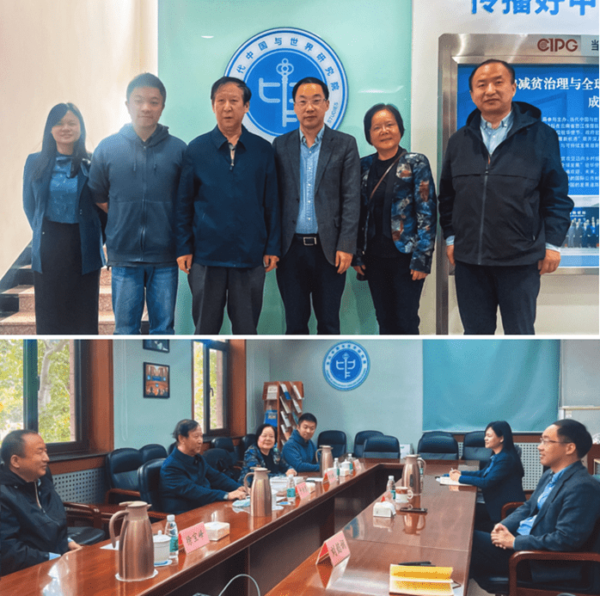
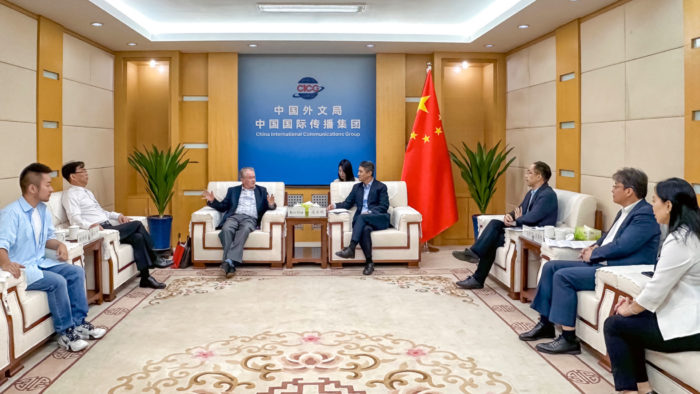
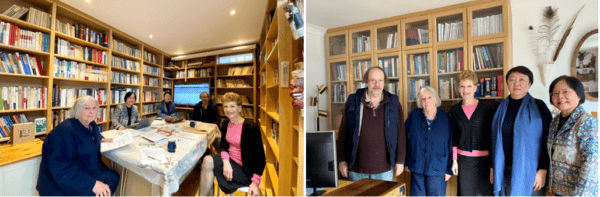
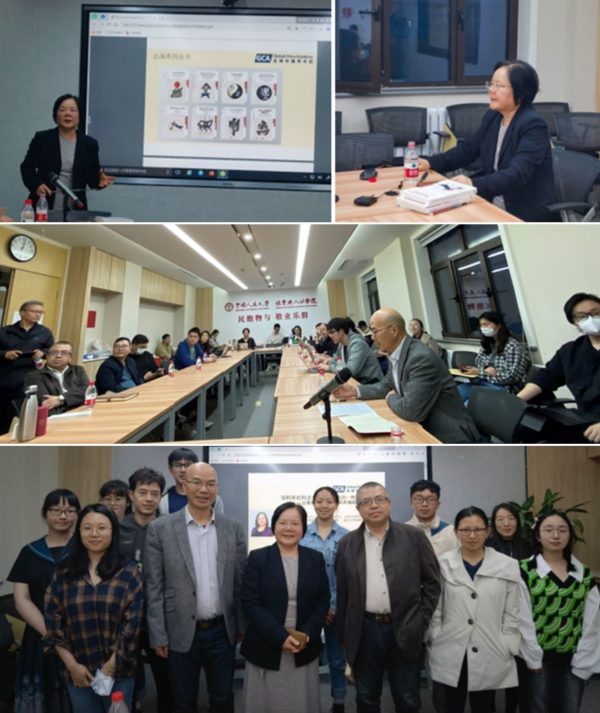
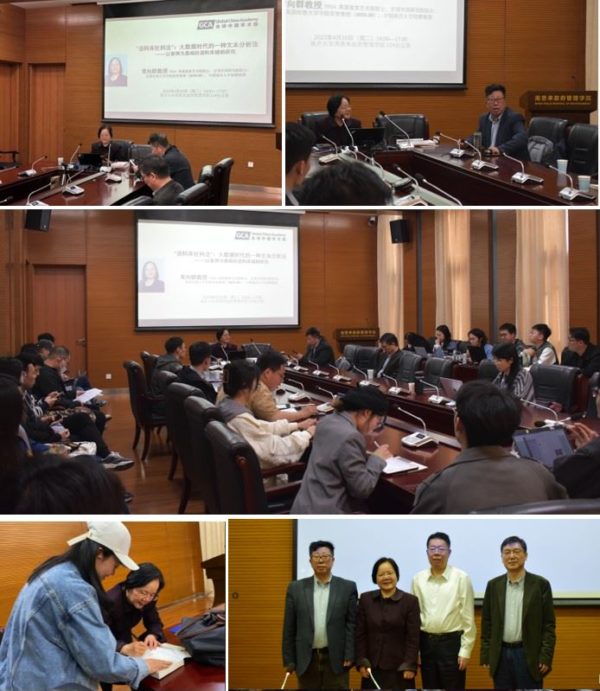
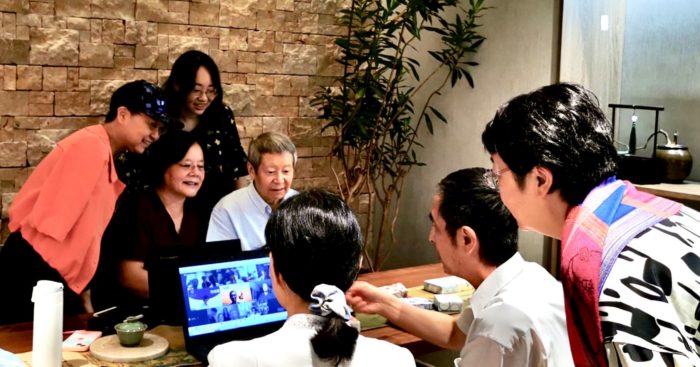
On the morning of April 21st, a meeting took place at the Academy of Contemporary China and World Studies (ACCWS) within the China International Publishing Group (CIPG). Dr YU Yunquan (3rd from the right in the top photo), Director of ACCWS, chaired the session. Dr YU Hongjun (3rd from the left in the top photo), former Vice Minister of the International Department of the Central Committee of the Communist Party of China (IDCPC) and Director of the Centre for Contemporary World Studies, was present as well. He had previously delivered a greeting message at the 6th Global China Dialogue on Governance for World Peace. Professor XU Baofeng from BLCU (1st from the right in the top photo), Director of the Belt and Road Research Institute, Director of the World Sinology Centre, and DU Yichao, Director of Wuxi Institute of New Culture, PhD student at UCL, and GCA Associate (2nd from the right in the top photo), also participated in the meeting. The purpose of this gathering was to advance the GCA’s social mission, specifically in preparation for the 8th Global China Dialogue on Governance for Global Health (GCD III).
During the meeting, Dr YU Hongjun highlighted the shared challenges faced by China and the rest of the world, including climate change, energy security, global health governance, and global economic stability, emphasizing the need for dialogue and collaborative efforts to address these issues. Dr YU Yunquan underscored ACCWS’s objective of fostering understanding and research on China’s global role, committing to the development of a multidisciplinary research platform aimed at expanding global knowledge of China through publishing, seminars, and international collaborations. Professor Xu Baofeng discussed the establishment of the World Sinology Centre and the organization of international conferences in China. Professor Chang Xiangqun shared insights from her observations and experiences in China, focusing on China’s engagement in global governance, its proactive involvement in the United Nations, and other multilateral institutions. She discussed the importance of dialogue in enhancing China’s comprehension of its global responsibilities. The meeting concluded with the decision that the Journal of Contemporary China and World Studies would sponsor GCD III, contingent upon receiving a report on Governance for Global Health, and the Deputy Director of ACCWS would deliver the closing remarks at the final session.
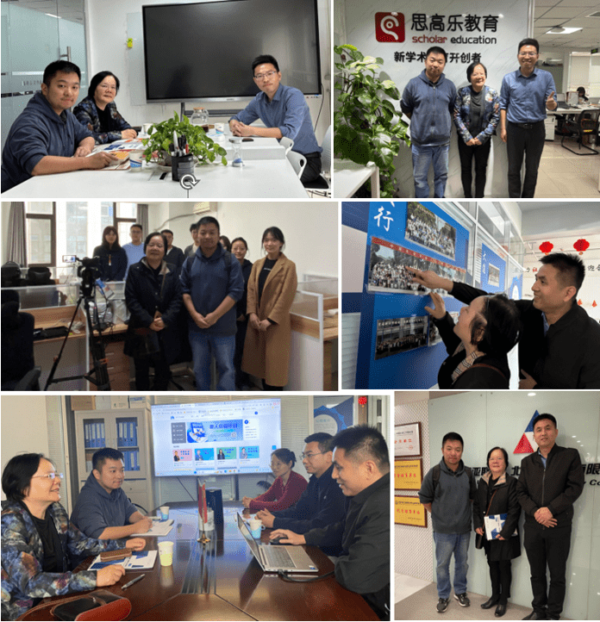
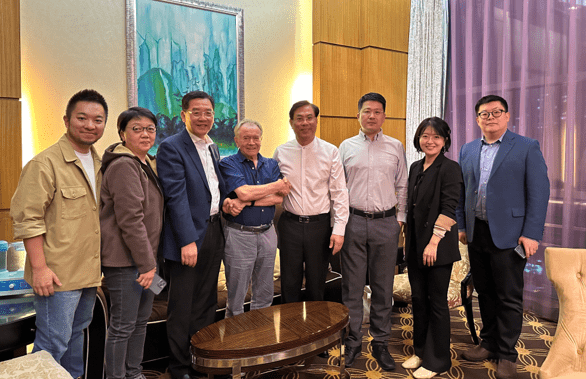
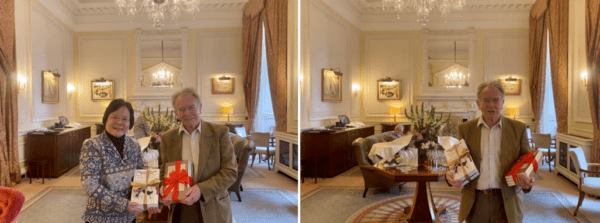
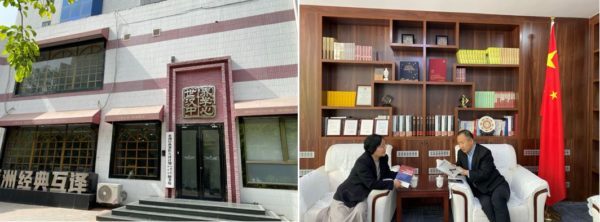
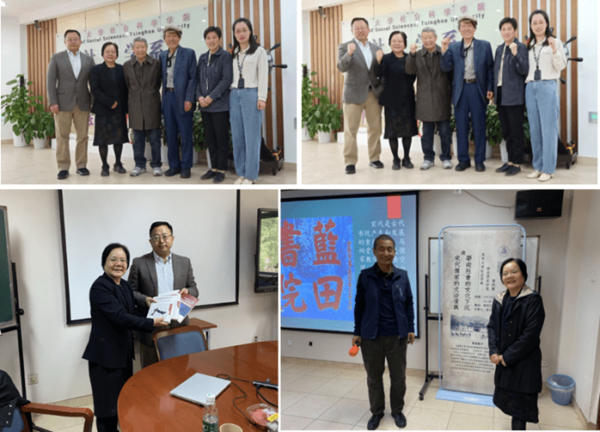
On the afternoon of April 21st, accompanied by DU Yichao, visits were made to two sponsors of the Global China Dialogues series. The first visit was to Xueshuzhi (学术志 Academic Unwavering), a brand under Scholar Education Ltd., an academic dissemination and education platform established by doctoral graduates from prestigious universities. Gathering over 2 million highly educated individuals, primarily university faculty, doctors, and masters, Xueshuzhi has been dedicated to supporting the research community’s growth. It aims to promote the dissemination and development of academic knowledge, enhance domestic researchers’ levels, and advance social sciences in China. During this visit, Dr SONG Yiping (right in the top photos), a founder of the company, recalled his initial encounter with Professor Chang approximately ten years ago, at which time he was employed as an editor at Renmin University Press. He conveyed his continued support for the Global China Dialogues.
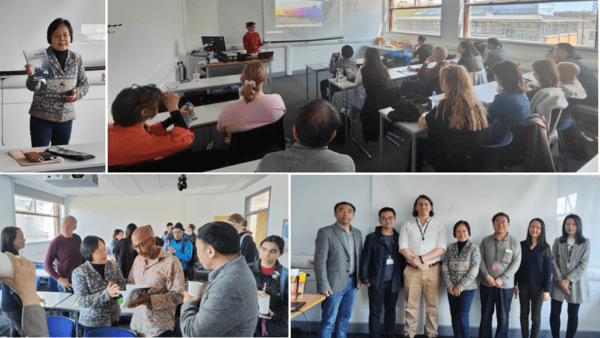
Following this, a visit was made to Xueshuwan (学术湾 Academic Harbour), a brand of M.Y.Union, a high-tech enterprise established in 2012 specializing in software development that integrates teaching, practice, and research. Focused on developing new technologies for the social service sector, Xueshuwan offers comprehensive IT solutions to educational, government, and social service organizations. With a commitment to rigorous and practical approaches, the company has achieved rapid and sustainable growth, supported by a team of skilled developers and expert advisors in sociology and social work. Its products, tailored for the modern technological landscape, are applied across various sectors, including universities and government agencies. The General Manager, Mr JIANG Biao (right in the bottom photos), who first met Professor Chang during her lecture at Changchun University of Science and Technology in 2019, provided a tour of the company and showcased projects developed during the COVID years.
Xueshuwan, Xueshuzhi, and the Wuxi Institute of New Culture, sponsors of the 6th, 7th, and forthcoming 8th Global China Dialogues, offer free services for live streaming or recorded broadcasting of the dialogues through their platforms in China. They also provide audio and video recordings for archives, transcriptions, translations, and dual-language subtitles for videos shown during the dialogues. Their willingness to sponsor the GCD series with their resources and expertise was expressed at the GCA’s founding ceremony. Click their names to watch the greeting videos by JIANG Biao, SONG Yiping and DU Yichao.
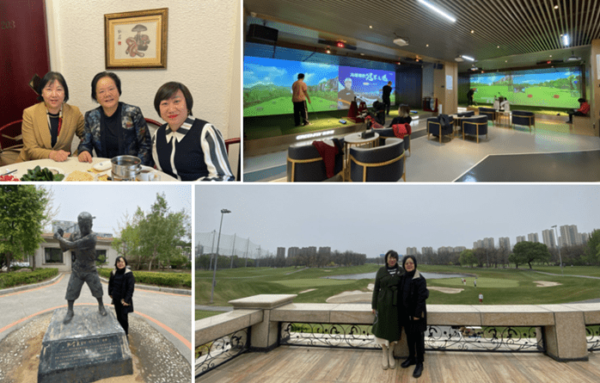
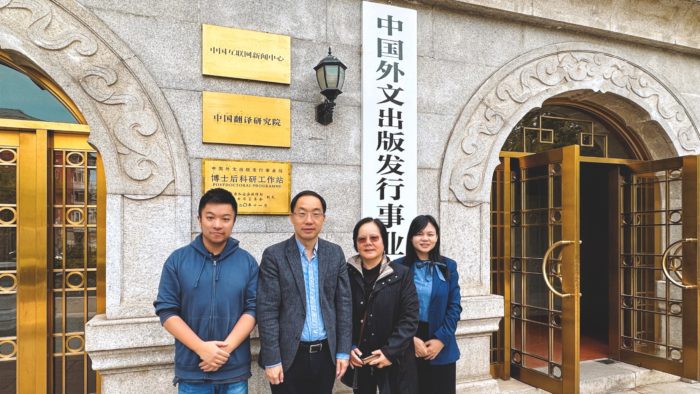
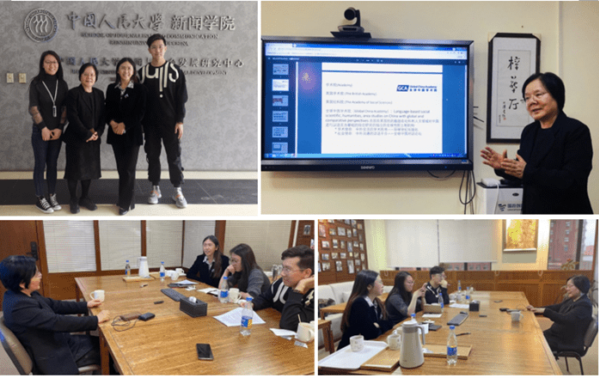
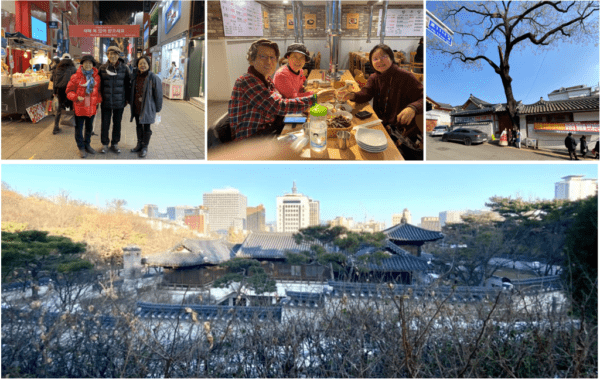
During the trip to Shenyang, where her mother resides, Professor Chang also visited places of interest, a consistent component of her fieldwork in China. Through a golf acquaintance, she was introduced to DAI Yanyan (to her left in the top left photo), Deputy Director of the Student Innovation and Entrepreneurship Development Centre at Shenyang Jianzhu University, and ZHANG Changyan (to her right in the top left photo), a chief lawyer. With their assistance, on the morning of April 27th, Yanyan and Professor Chang visited Shenyang Century Golf Club. This club features an 18-hole, 72-par course that spans 700,000 square meters and was inaugurated in 2006. Its design incorporates both Western and Asian elements, emphasizing environmental conservation with its abundant tree coverage and high-quality grass landscapes. The clubhouse is equipped with luxurious amenities and panoramic views, providing a diverse array of leisure and business facilities, such as restaurants, bars, a fitness centre, among others. Situated in the development zone of Tiexi District, close to the airport and highways, the club offers convenient access. It integrates sports, leisure, and business, delivering a premium experience for its members. The club’s viability is attributed to the Tiexi District hosting over 1,300 enterprises from 40 countries and regions, including 83 multinational corporations and 21 Fortune Global 500 companies.
Moreover, Shenyang is recognized as the cradle of golf in China. The statue shown in the bottom left photo is of Chang Hsueh-liang or Zhang Xueliang (张学良, 1901-2001), a warlord who ruled Manchuria from 1928 to 1936. Zhang, who was introduced to golf in Shenyang in 1917 after joining the Fengtian Christian Youth Association, founded China’s first golf team in 1920 with officials from China, Britain, France, America, and other countries. Initially planning to construct the first 18+1 hole golf course in Beidaihe in 1927, he instead established a nine-hole ‘mini-golf’ course, which was launched at the Shenyang Tongze Club in 1930.
On the afternoon of April 27th, Yanyan escorted Professor Chang to the Shenyang Aoyuehui City Golf Club, an indoor golf multifunctional centre. The owner, Mr. ZHAO Haixin, revealed that the facility occupies 1,200 square meters and features 6 public hitting bays, 3 VIP rooms, each equipped with a Greenjoy Hengtaixin golf simulator. Beyond these, the club boasts a water bar, rest area, and additional public entertainment facilities. It serves freshly ground imported coffee, fashionable beverages, imported red wine and beer, teas from various regions, and premium Chinese and Western snacks. According to Mr Zhao, these offerings have ensured him a stable income even through the COVID years, affording him a lifestyle comparable to the upper-middle class in Western nations.
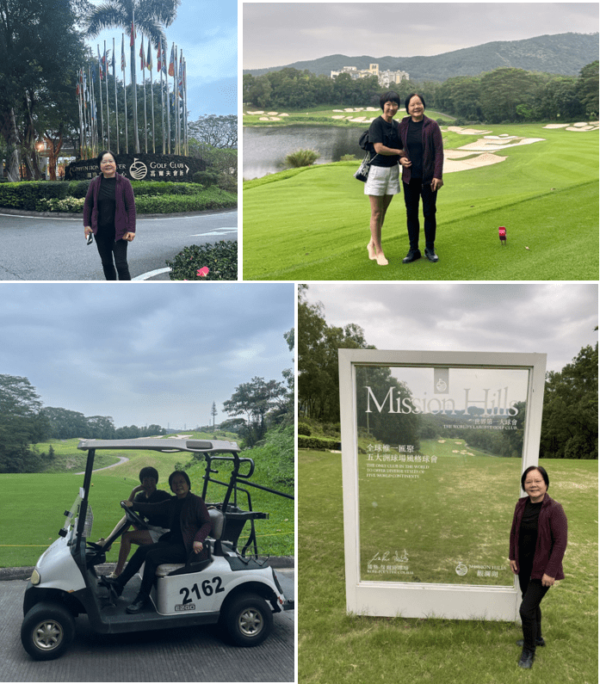
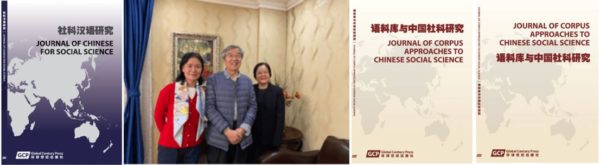
On the afternoon of April 30th, Professor Chang visited the Mission Hills Golf Club (观澜湖高尔夫球会), which is affectionately deemed the ‘home golf club’ of her friend Wang Jie due to its closeness to Wang’s residence. The disparity in the club’s Chinese and English names stems from ‘Guanlan’ (观澜), denoting a town surrounded by hills but without a lake (湖). Established in 1992 and inspired by its mission (使命) amid the hills (群山), the club has constructed numerous artificial lakes over an expansive area of 20 square kilometres across Shenzhen and Dongguan. Designed by twelve globally renowned golf figures, it comprises 12 courses, each with 18 holes (a total of 216 holes), distinctively integrating golf course styles from all five continents. This characteristic granted it the Guinness World Record for the ‘World’s Largest Golf Club’ in 2004. However, during the COVID years, the club experienced a downturn in business relative to the indoor golf multifunction centre in Shenyang, leading to job losses for numerous caddies.
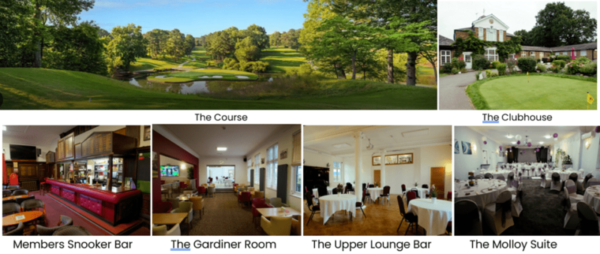
Back in the UK, the ‘home golf club’ for Professor Chang is the Mill Hill Golf Club, situated just a two-minute walk from her residence. Construction began in 1924, and the club opened in 1927. Occupying less than one square kilometre of woodland within Moat Mount Open Space and Scratchwood, it is part of section 16 of the London LOOP (The London Outer Orbital Path). This path nearly encircles Greater London, covering almost 150 miles (approximately 388.5 square kilometres) and divided into 24 sections. Moat Mount Open Space is home to the man-made Leg of Mutton Pond, and near Scratchwood within the golf course is Stoney Wood Lake, fed by Deans Brook, which flows through the northern edges of Edgware, merges with the Silk Stream, continues into the Brent River, and finally joins the Thames River in West London.
The Global China Academy pursues dual missions. Its academic mission focuses on deepening the global understanding of China and Chinese people through global and comparative perspectives, worldwide fellowships, and rigorous research. Supported by its subsidiary, Global Century Press, which publishes esteemed scholarly works, the academy aims to enhance global cooperation and understanding, preparing young leaders for societal contributions. The Global China Dialogues platform facilitates significant exchanges to cultivate a more inclusive global community, transforming research into tangible societal benefits. Nestled at the foot of Mill Hill, amid woodlands and a nearby lake, the Global China Academy is likened to a quaint ‘academic temple’, endearingly referred to as ‘Mission Hill Temple’.
During her visit to China in April 2023, Professor Xiangqun Chang’s interactions with key institutions and individuals highlighted the Global China Academy’s commitment to fostering global understanding and cooperation. Her fruitful meeting with the Academy of Contemporary China and World Studies (ACCWS) and her engagements with two key sponsors of the Global China Dialogues series—Xueshuzhi and Xueshuwan—underscored the collaboration with organizations dedicated to academic knowledge dissemination and providing technological solutions for social services, laying the groundwork for the 8th Global China Dialogue. Moreover, Professor Chang’s comparative perspective on golf clubs in China and the UK emphasized the sport’s global nature, transcending geographical and cultural boundaries. By aligning the cooperative spirit of golf with her academic and social missions, she showcased the potential convergence of personal interests and professional goals, promoting a more inclusive and interconnected world.
- Click here to view Global China Academy’s President Professor Xiangqun Chang’s Academic Activities in Beijing, 18-20 April 2023
- Click here to view Global China Academy’s President Professor Xiangqun Chang’s Academic Activities in Xiamen, Wuhan and Tianjin, 4-11 April 2023
- Click here to see the GCA Centre’s facilities: Driveway, Garden, Function Rooms, Libraries, Dining Area, Bedrooms, and more.
- Click here to explore the 5 ‘walk and talk’ routes, including tea and lunch. The PDF file can be downloaded.
- Click here to reach us including details on how to visit us.
- Click here to visit the GCA news section.

Global China Academy’s President Professor Xiangqun Chang’s Academic Activities in Beijing,18-20 April 2023
Introduction
On the occasion of being an invited speaker at the ‘International Conference: The Chinese Path to Modernization and the Pursuit of Humanity’s Common Values’ at Xiamen University from April 4-6, 2023, I visited China and conducted a series of lectures, seminars, and academic exchanges at various universities in Xiamen, Wuhan, Tianjin, and Beijing. In addition to fulfilling my academic responsibilities, I also participated in events and activities aligned with the social mission of the Global China Academy. This part includes only academic activities in Beijing from 18-20th April.
Timeline
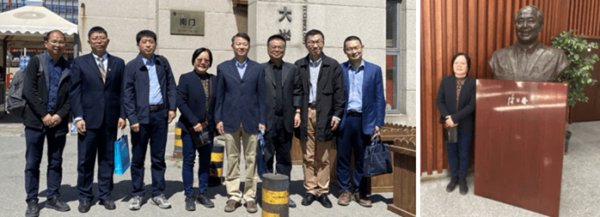
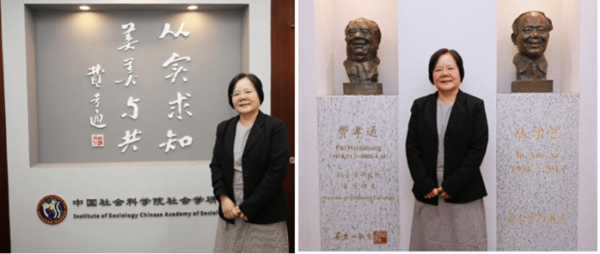
On the afternoon of April 18th, I visited the School of Humanities and Social Sciences at Beijing University of Technology (BUT). It was established by Professor LU Xueyi (1933-2013), the former Director of the Institute of Sociology at the Chinese Academy of Social Sciences (CASS) and former President of the Chinese Sociological Association. I paid tribute to Professor LU Xueyi’s statue (right photo), a reason that will be explained in the section on the CASS seminar. I also met Professor TANG Jun (one my left in the left photo), Dean of the School of Humanities and Social Sciences, and his colleagues. We knew each other since Professor Tang worked at CASS. Coincidentally, I also met Professor LI Xiaozhuang (on my right in the left photo), from the Institute of Sociology at the Beijing Academy of Social Sciences (BASS). He was Professor Lu’s PhD student. I met him in 2014 when he was working on sorting through Lu’s more than 1,000 diaries.

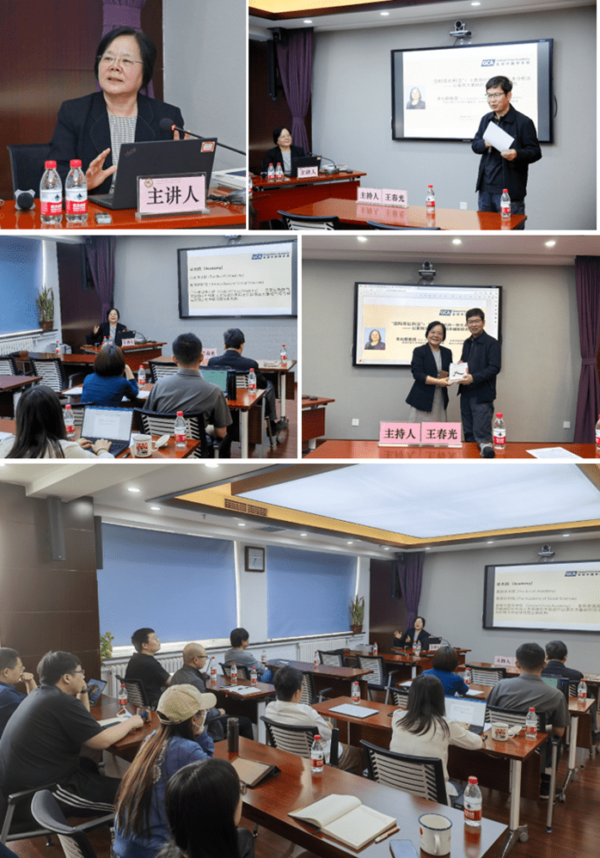
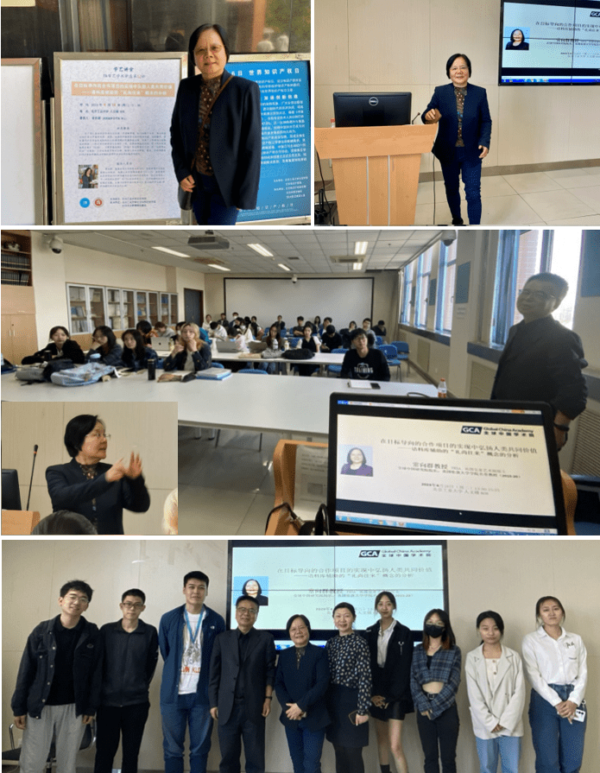
Professor LI Junfu (on my right in the bottom photo) chaired the lecture I delivered. He was a Visiting Fellow at the University of Oxford in 2019. He presented a paper titled ‘Society Building: Peacemaking with Chinese Characteristics’ at the 6th Global China Dialogue: Governance for World Peace, which I organized. The title of my lecture was ‘Realization of Goal-Oriented Cooperative Projects, Promoting the Common Value of Mankind: A Corpus-Assisted Analysis of ‘recipropriety’ (lishang-wanglai 互适). Dr CAO Feilian (on my left in the bottom photo), Associate Professor, joined the lecture. She acted as the interpreter for Professor LU Xueyi when he gave a seminar on society building at LSE in 2011, which I arranged when I worked there.

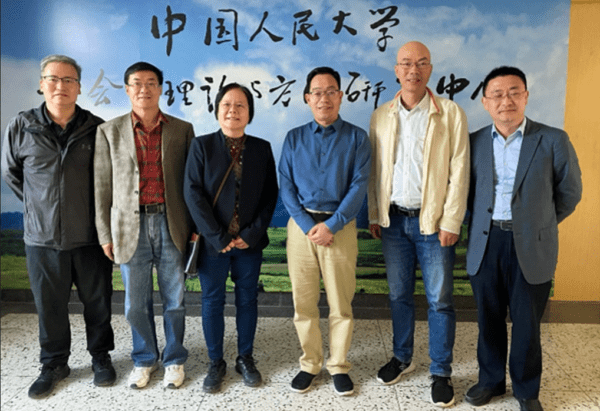
On the morning of Aprol 19th, I was invited by Professor XU Baofeng (right in left photo) for a meeting in his office at Beijing Language and Culture University (BLCU). He is Director of the Belt and Road Research Institute, Director of the World Sinology Center, Head of the Secretariat for the Asian Classics Inter-Translation Project, Leader of the National Project for the Chinese and Foreign Sinologists and Translators Talent Database and Chinese Culture Translation and Research Network. He was an invited speaker at the 6th Global China Dialogue: Governance for World Peace, where he delivered the paper ‘Can Confucian Ethics Help in the Elimination of Global Unilateralism, Extremism and Terrorism Based on a Comparison Between Countries and Regions with and without Influence from Confucius Ethics?’ in 2019. Professor Xu collaborated with the GCA in several ways. For instance, he published a paper titled ‘China’s Contribution to the Future of Governance’ by Professor Martin Albrow in the inaugural issue of the journal he founded, World Sinology Information (01), on April 28, 2020. He facilitated Professor Albrow’s participation and publication of the paper ‘The Prospects of the Belt and Road Initiative in the Post-pandemic Era: A Dialogue’ in the Guangming International Forum, which was published in the Guangming Daily on May 27, 2020. With his assistance, the Global Century Press published a book titled Witnessing China Combating COVID-19: My Story in China in both English and Chinese. Both Professor Albrow and I were invited speakers at the UN Chinese Language Day, discussing sinology and the Chinese language during the epidemic, and the Ceremony to Launch the International Cangjie Plan on April 19, 2020. In this meeting, we explored different possibilities of collaboration.

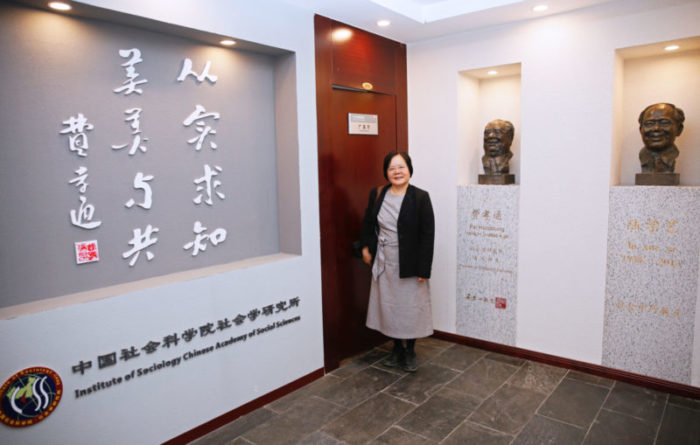
On the afternoon of April 19th, I was invited to give a lecture at the Institute of Sociology (CASS). I always feel at home there because my academic achievements are closely related to two great figures there: LU Xueyi (statue to my left in the right photo) and Fei Xiaotong (statue to my right in the right photo). I was introduced to LU Xueyi in 1987 by the successor of Fei Xiaotong, the then Director of the Institute of Sociology, Professor HE Jianzhang (1926-2004), when LU was serving as the Deputy Director there. It came at a time when the institute had just been granted the first major project on Marxist Sociology Theoretical Studies in China, funded by the National Social Science Foundation (NSSF) (1987-1991). Professor He offered me a position there before I graduated with my Master’s degree in 1987, as the application for the major project was likely to be successful. I was the only person in China who had received three years of training in Marxist sociology under Professor Ding Kequan at Northeast Normal University and was willing to work on this project. Professor Lu became the Director in 1988 and led the major project until 1991. As a team member, my book, On Marxist Sociology (1992) was a significant outcome of the project. I worked closely with Professor Lu and maintained a good relationship with him. After his passing, I wrote his obituary and published it in Network, the Magazine of the British Sociological Association, Winter 2013, p44.
Although my primary research focus was on Marxist sociology with CASS, I was a lecturer in Sociology at the People’s Public Security University of China (PPSUC). This role was a direct result of Fei Xiaotong’s efforts to promote sociology in public security universities in Nanjing and Beijing, starting in 1984. PPSUC recruited me right after I graduated in 1987, recognizing the unique position I held as a postgraduate from the only normal university in China offering an MA degree in sociology at the time. Coincidentally, shortly after becoming a Visiting Fellow at City University in 1991, I joined an ESRC-funded research project co-developed by Professor Stephan Feuchtwang and Professor SHEN Guanbao (1949-2016) when he was as a Visiting Fellow at LSE. Given that Shen was the only PhD student Fei Xiaotong supervised at CASS, Kaixiangong Village, Fei’s fieldwork site, naturally became a focal point in our project. My subsequent book, Guanxi or Li Shang Wanglai?: Reciprocity, Social Support Networks, Social Creativity in a Chinese Village (2010/2011 in both English and Chinese), was the result of extensive fieldwork in that village. Additionally, I served as a co-editor of FeiXiaotong Studies (3 volumes in both English and Chinese).

The title of my talk was ‘A Text Analysis Method in the Era of Big Data: Corpus-Assisted Research Based on Case Studies’. It was chaired by WANG Chunguang (pictured top right), Deputy Director of the Institute of Sociology at CASS and Deputy Secretary-General of the Chinese Sociological Association. The arrangement was facilitated by FU Xuejun, Director of the Research Office of the Institute of Sociology. Afterwards, we discussed the changes that have occurred over the past three decades at the Institute, as he is the only remaining individual from the time I worked there on the NSSF-funded major project who has yet to retire.
During my talk, I shared related corpora such as the collected works of Ding Kequan, a pioneer of Marxist sociology, Fei Xiaotong’s complete works, and Marx and Engels’ Complete Works. I learned that LU Xueyi’s complete works (10 volumes) have just been published to commemorate the 10th anniversary of Lu’s death. They would be a great addition to my collection of corpora. Dr YU Qin, an Assistant Research Fellow at the Anti-Corruption Research Office, informed me that she completed her PhD under the supervision of Professor SU Jinzhi at the Institute of Linguistics, CASS. Professor Su is the former President of the Chinese Social Linguistics Association. Dr Yu would like to collaborate with me to apply corpus approaches to her work. She also sent me some of her related published papers later.

On the late afternoon and evening of April 19th, after I finished my talk at CASS, I attended a short meeting at the Ministry of Education’s Research base — Centre for Sociology Theory and Methodology at Renmin University of China. It was founded by Professor ZHENG Huangsheng (1936-2014), former Vice-President of Renmin University and former President of the Chinese Sociological Association. My first meeting with Professor Zheng was at a sociology conference in Shenyang in 1985. He had been my mentor for about three decades because we shared common interests. In 2014 he chaired a lecture for me and signed a certificate of Professional Research Fellow with no time limit at the Centre, a few months before his passing. Afterwards, I wrote ‘Zheng Huangsheng: Life and Work’ and published it in Network, the Magazine of the British Sociological Association, in Spring 2015.
The meeting was chaired by Professor FENG Shizheng (to my left in the top photo), Dean of the School of Sociology and Demography (and was promoted to Vice-President of Renmin University in October 2023), Professor LU Yilong, Deputy Director of the Centre (to my right in the top photo), Associate Professor HUAN Pingqing (second from the right in the top photo), Associate Professor HUANG Jialiang (first on the right in the top photo), Deputy Dean of the School of Sociology and Demography, and LI Suocheng (first on the left in the top photo), Manager of the Centre Office.

The seminar was held in the evening, titled ‘A Text Analysis Method in the Era of Big Data: Corpus-Assisted Research Based on Case Studies.’ It was chaired by Dr Huan Pingqing (first right in the middle photo), who has conducted many studies on Fei Xiaotong. He was an invited speaker at the 6th Global China Dialogue: Governance for World Peace, where he delivered the paper ‘Confucius’ Thoughts on Ethnic Relations and Its Significance to World Peace’ in 2019. He then became a Visiting Fellow at the University of Oxford in 2020, a tenure that was interrupted by COVID-19.
Professor ZHAO Xudong (to my left in the bottom photo) attended the seminar. He is the Director of the Institute of Anthropology at Renmin University and was the last PhD student under Fei Xiaotong’s supervision at Peking University. During the Q&A session, we discussed how ChatGPT could influence corpus approaches to social scientific studies. This question emerged from all my lectures and seminars conducted in China. My explanation highlighted that ChatGPT is an excellent tool for generalizing answers to general questions, providing outlines for study topics, summarizing existing work of interest, drafting letters, copy editing, and performing bidirectional translations between English and Chinese, among other tasks. It poses a challenge to all electronic data-based analysis. While it complements the corpus-assisted method, it cannot replace it. This limitation stems from ChatGPT’s inability to provide specific words in related references and their contexts. Also without reading and reserach, one cannot formulate a scientific question to effectively engage ChatGPT in conversation and further studies.

On the morning of April 20th, I, along with GCA Life Fellow HAN Sang-jin (3rd from the right in the top photos), Professor Emeritus at the Department of Sociology, Seoul National University, Korea, had a meeting at the Department of Sociology, Tsinghua University. Professor LI Qiang (3rd from the left in the top photos) joined us. He is the former Dean of the School of Social Sciences at Tsinghua University and former President of the Chinese Sociological Association. He also serves as the Chinese President of the GCA Council and is a Founding Fellow of GCA. The top two photos showcase different styles of group photos: Chinese style and Korean style, provided by Professor Han afterwards along with a note expressing a determination to collaborate among the three parties. This sentiment was echoed in his video greetings at the GCA’s founding ceremony, as presented by Professor LI Qiang (click here to watch). Dr. ZHENG Lu (1st from the left in the top photos) chaired the meeting. He is Deputy Head and Associate Professor of Department of Sociology and the ‘RONG’ Professor of Data Sciences at Tsinghua University. I presented him with some publications published by Global Century Press (left photo in the bottom row), and he expressed a willingness to collaborate with GCA. He delivered a speech entitled ‘Good Finance and Good Society: Financial Institutional Reform’ at the 7th Global China Dialogue: Reforming Global Governance in 2021. Dr. ZHAO Yizhang (1st from the right in the photos) from the Department of Sociology and Dr. CHEN Yulin (2nd from the right in the photos) also attended the meeting. The right photo in the bottom row features Professor ZHANG Xiaojun and me beside a poster of his lecture. He is the former Director of the Institute of Anthropology at Tsinghua University. We met at a national sociological conference in Guangzhou 38 years ago and have maintained a good relationship since then.

On the afternoon of April 20th, I was invited by Professor ZHONG Xin (2nd from the left in the top photo), Deputy Director of the Institute of Public Communication at the School of Journalism, Renmin University of China. As mentioned in the above section at Wuhan University, media studies in Remin Uinversity is another major discipline among the top four universities in China. After she and her PhD students gave me a guided tour of the institution, centers, and school, she held a meeting for academic exchanges. She shared with me her involvement in a national social science project, one of whose sub-projects focuses on researching the persuasive power of China’s discourse on universal human values. I presented materials related to my talks and used the books published by GCP as examples.

On the evening of April 20th, I had a dinner meeting with Professor GU Yueguo (middle in the right photo) and his wife, Professor LAN Chun. Professor Gu is a Research Professor of Linguistics and the Head of the Contemporary Linguistics Department at the Chinese Academy of Social Sciences (CASS) and former Pro-Vice-Chancellor of Beijing Foreign Studies University (BFSU), China. He is also Life Fellow of the Global China Academy (click here to watch the greeting video at the GCA’s founding ceremony) and an Executive Editors of the Journal of Corpus Approaches to Chinese Social Science (JCACSS) in both English and Chinese Editions.I met Professor Gu at an International Colloquium on New Discourses in Contemporary China at Lancaster University in September 2007. He expressed interest in my talk on ‘Lishang-wanglai: a Chinese model of social relations and relatedness’. It was my attempt to cross into the discipline of social linguistics and learn about his related work. Professor LAN Chun (left in right photo) is the former Director of the Linguistics Center at the School of English, Beijing Foreign Studies University (BFSU). She also serves as the Executive Editor of the Journal of Chinese for Social Sciences (Chinese Edition), published by Global Century Press. She arranged a hybrid GCA meeting in Beijing in November 2022.
While I was in Beijing from April 18th to 20th, I participated in a series of meaningful academic activities involving some renowned institutions in the capital of China. Firstly, I delivered a speech at the School of Humanities and Social Sciences at Beijing University of Technology, founded by Professor LU Xueyi. Following that, during my visit to the Chinese Academy of Social Sciences, I revisited the foundations of Chinese sociology and reflected on the influences of Fei Xiaotong and LU Xueyi on my work. These visits underscored the advancements in social science research methods in the digital age. My experience at Renmin University of China emphasized the importance of interdisciplinary approaches in social sciences, collaborating with the Center for Sociological Theory and Methodology to explore complex social issues. Engaging with scholars from Tsinghua University, Renmin University’s School of Journalism, Beijing Language and Culture University, and Beijing Foreign Studies University was also fruitful. In conclusion, this academic journey in Beijing highlighted the vibrancy of intellectual exchange and the deep connections between Chinese social science and the global academic community, emphasizing the evolving nature of research fields and the collaborative spirit driving our understanding of social dynamics.
By Xiangqun Chang
- Click here to view Global China Academy’s President Professor Xiangqun Chang’s Academic Activities in Xiamen, Wuhan and Tianjin, 4th-11th April 2023
- Click here to view Social Mission Activities and Reflection of GCA President Xiangqun Chang in China, April 2023
- Click here to see the GCA Centre’s facilities: Driveway, Garden, Function Rooms, Libraries, Dining Area, Bedrooms, and more.
- Click here to explore the 5 ‘walk and talk’ routes, including tea and lunch. The PDF file can be downloaded.
- Click here to reach us including details on how to visit us.
- Click here to visit the GCA news section.

Global China Academy Council Chair Professor Tony McEnery’s Academic Activities in China, April-May 2023
Introduction
In 2023, the Global China Academy Council Chair, Professor Tony McEnery FAcSS, distinguished Professor of Lancaster University, had been appointed as a distinguished Chair Professor at Xi’an Jiaotong University (XJTU). As a renowned expert in corpus linguistics, he engaged in various academic activities in China. His contributions included inaugurating the ‘McEnery Corpus Research Center’ at XJTU and delivering insightful lectures at several universities. These lectures, covering topics such as ‘Language Matters,’ ‘Corpus Linguistics, Learner Corpora, and Second Language Acquisition,’ and the application of corpus linguistics in the era of big data, showcased his commitment to linguistic research and interdisciplinary study. His activities in China highlighted the dynamic and evolving nature of corpus linguistics and its potential to address complex social issues, emphasizing the importance of continuous innovation and critical evaluation in research methods.
Timeline
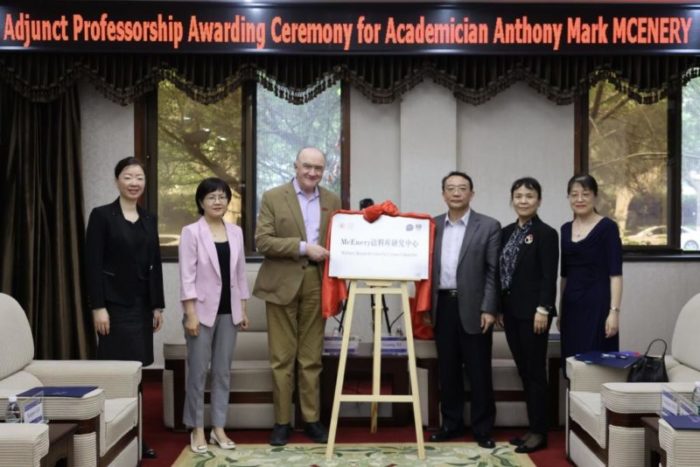
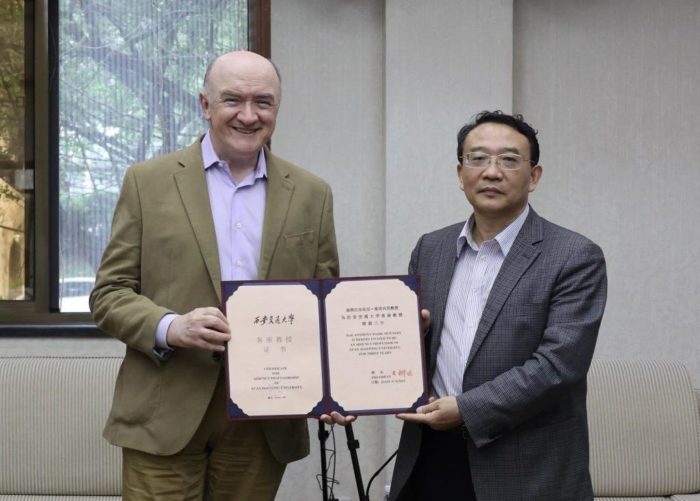
On the afternoon of April 17, 2023, Professor Tony McEnery was appointed as a Chair Professor at Xi’an Jiaotong University (XJTU). The Vice President of Xi’an Jiaotong University, XI Guang, met with Professor McEnery and presented him with a certificate, and adorned him with the XJTU badge. During the meeting, XI Guang and McEnery jointly unveiled the ‘McEnery Corpus Research Center’ at the School of Foreign Languages of XJTU.
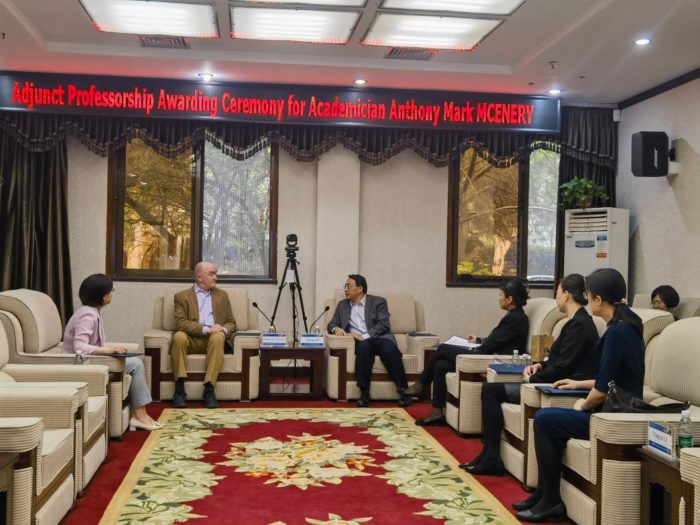
XI Guang expressed his hope that this appointment would serve as a starting point to build a cooperative bridge and further promote new achievements in inter-university collaboration. Professor McEnery stated his intention to fully leverage his personal capabilities to continue actively promoting cooperation between both parties and to embark on more substantive joint work.
After the meeting, Professor McEnery presented a lecture entitled ‘Language Matters’ to the faculty and students of Xi’an Jiaotong University (XJTU).
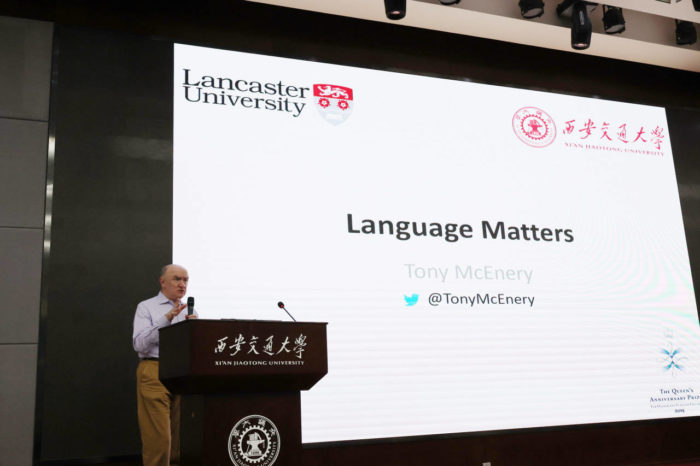
The lecture was divided into three parts: exploration, critical evaluation, and technological innovation. Professor McEnery used three classic studies from the ESRC-CASS Centre at Lancaster University, UK, as cases to illustrate the innovation in linguistic research methods to the audience, and sparked their thinking about interdisciplinary and cross-disciplinary research and technology in the era of big data. Professor McEnery emphasized that language itself and its role in different areas of social life are of undeniable importance. The use of large-scale text corpora is significant in linguistic research, and employing interdisciplinary research methods to analyze the relationship between language and society is of great importance. It enables researchers to analyze real language more deeply and in detail, providing new perspectives and methods for understanding social phenomena. During the question-and-answer session, the attending faculty and students engaged in discussions with Professor McEnery about parts of the lecture that interested them.
On the afternoon of April 19, Professor Tony McEnery gave a lecture at the School of Foreign Studies of Xi’an Jiaotong University titled ‘Corpus Linguistics, Learner Corpora, and Second Language Acquisition.’ Starting from perspectives such as research origins, corpus size, interdisciplinary interaction, and research objectives, he analyzed the relationship between learner corpora and second language acquisition research and offered research suggestions. The faculty and students present actively asked questions, engaging in more in-depth discussions and exchanges with Professor McEnery on topics such as language theory, foreign language learning, and the relationship with corpora.
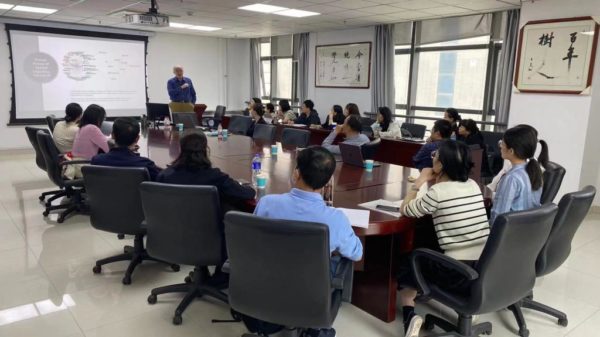
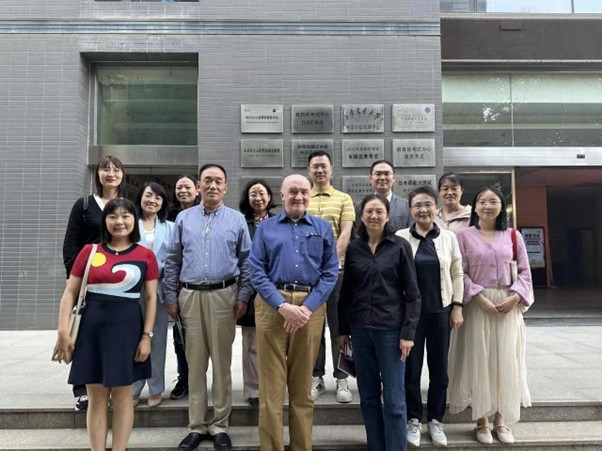
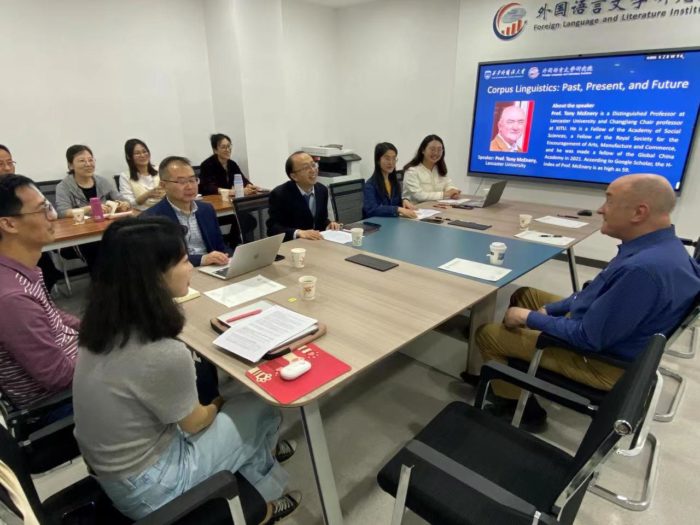
On the afternoon of April 20th, Professor Tony McEnery engaged in academic exchange at the Institute of Foreign Languages and Literatures of Xi’an International Studies University. He delivered an academic speech titled ‘Corpus Linguistics: Past, Present, and Future,’ in which he detailed the three important stages that corpus linguistics has undergone from its origins to its rapid rise, and discussed the future trends in the discipline in the context of the big data era.
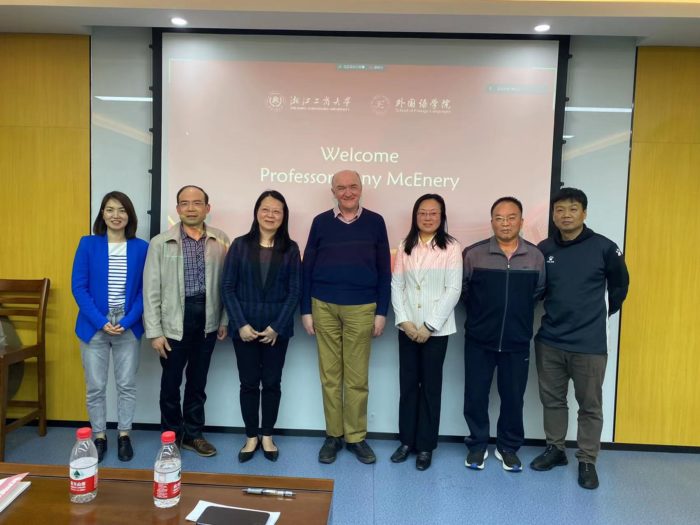
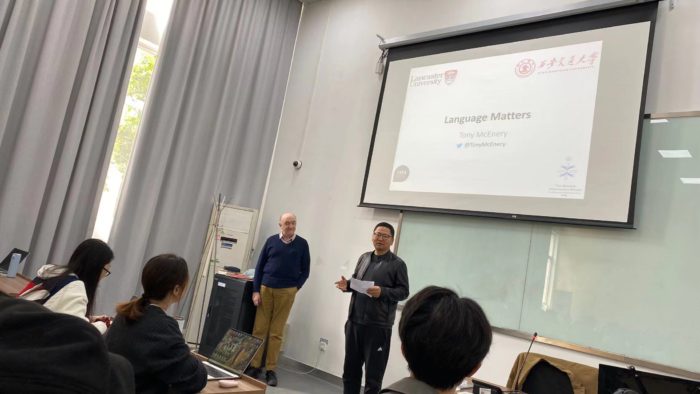
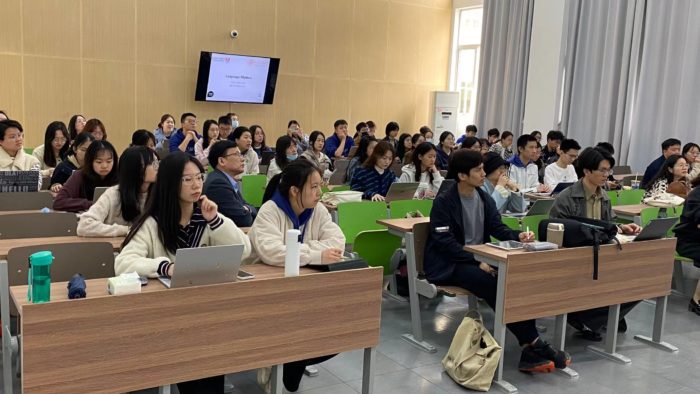
On the morning of April 23, Professor Tony McEnery gave an academic report titled ‘Language Matters’ at the School of Foreign Languages of Zhejiang Gongshang University, with the session chaired by Professor Qian Yufang.
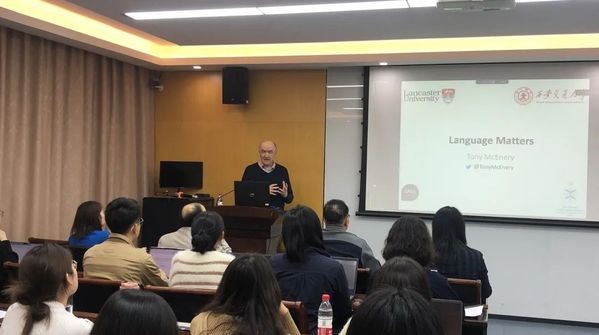
Professor McEnery discussed the role of language in different contexts and how linguists collaborate with other fields to explore issues related to their core subjects. Through ongoing cases at the ESRC Centre for Corpus Approaches to Social Science (CASS) at Lancaster University, he demonstrated how language research can innovate methodologies, thus fostering a critical evaluation of ‘big data’ technologies.
He emphasized that the methods used should be grounded in our identity as linguists and also evaluated by linguists. By analyzing cases such as 17th-century English, patient feedback in the UK National Health Service, and Islamophobia in British news media, he showed how to combine advanced corpus methods with linguists’ insights into language, thereby revealing the value of the research.
The significance of this lecture lies in demonstrating the potential for linguists to conduct interdisciplinary research in different social contexts and historical periods. By collaborating with other fields, linguists can uncover new insights into language and its impact on society. This interaction is not one-way, as linguists can also reflect on their own practices and find various explanatory frameworks through language analysis.
On April 24, Professor Tony McEnery delivered a lecture titled ‘Language Matters’ at Shanghai International Studies University, hosted by Professor HU Kaibao. This lecture had the same title as the one he delivered at XJTU on April 17.
On the afternoon of April 26th, Professor Tony McEnery gave an academic lecture titled ‘Discourse, Language Learning, and Learner Corpora’ at the School of Foreign Studies, Xi’an Jiaotong University, as part of the ‘High-End International Expert Masterclass Series’. Professor McEnery discussed the relationship between discourse, language learning, and learner corpora, and raised many thought-provoking questions and suggestions related to language acquisition research, using specific case studies. After the lecture, there was an in-depth exchange and discussion with the students and faculty on topics such as discourse structure annotation, the construction of new types of corpora, corpus-based pragmatics research, and the limitations of learner corpora.
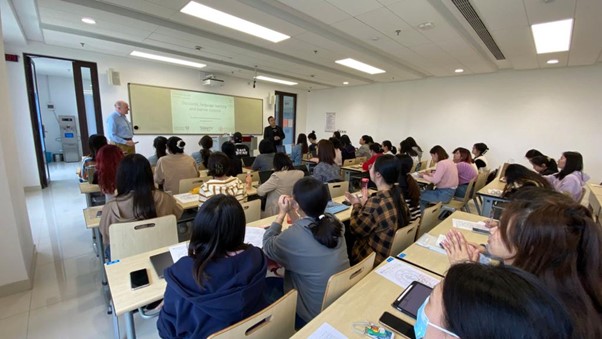
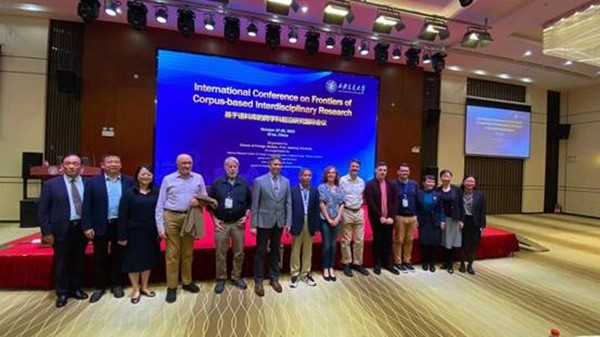
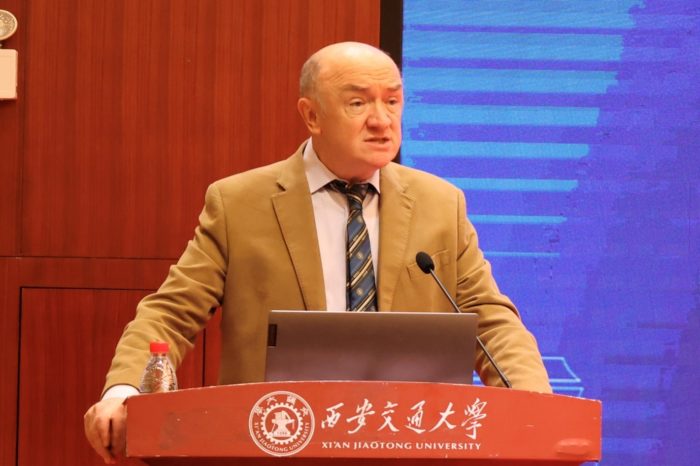
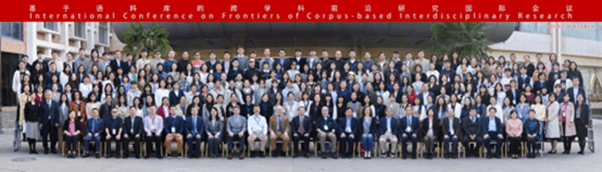
Professor Tony McEnery said that he had a highly enjoyable visit to China in April and May. His base was at Xi’an Jiaotong University, where he holds a prestigious Chair Professorship. During his stay, he engaged in providing valuable advice to staff, PhD candidates, and undergraduate students. Additionally, he delivered a series of lectures, highlighting the significant impact that studying large collections of language data, known as corpora, can have on the social sciences. Professor McEnery also had the opportunity to speak on the same topic at Xi’an International Studies University, Zhejiang Gongshang University, and Shanghai International Studies University. His interactions with numerous colleagues in China were not only enjoyable but also insightful, particularly in observing the keen interest in the study of language as a component of the social sciences in China. In October, Professor McEnery attended a conference at Xi’an Jiaotong University. This conference brought together scholars from around the world to discuss the intersection of language, data, and society. Before and after the October conference, Professor McEnery also participated in online forums.
Professor Tony McEnery’s academic activities in China, highlighted his prominent role in the field of corpus linguistics. His series of lectures, including ‘Language Matters’ and discussions on topics like discourse analysis, language learning, and learner corpora, showcased his commitment to advancing linguistic research, particularly in the context of big data. His interactions, spanning various universities and covering a range of linguistic topics, not only fostered academic exchange but also reflected the dynamic and evolving nature of corpus linguistics. McEnery’s visit was instrumental in demonstrating the potential of linguistics to address complex social issues and the importance of continuous innovation and critique in linguistic research methods.
Note: Photos and texts have been provided by the organizers of events.
- Click here to view Global China Academy Council Chair Professor Tony McEnery’s Academic Activities in Hong Kong and China, 2024.
- Click here to view Global China Academy Council Chair Professor Tony McEnery’s Academic Activities in China, September-November 2023.
- Click here to visit Professor Tony McEnery FGCA page.
- Click here to visit News and blog section.
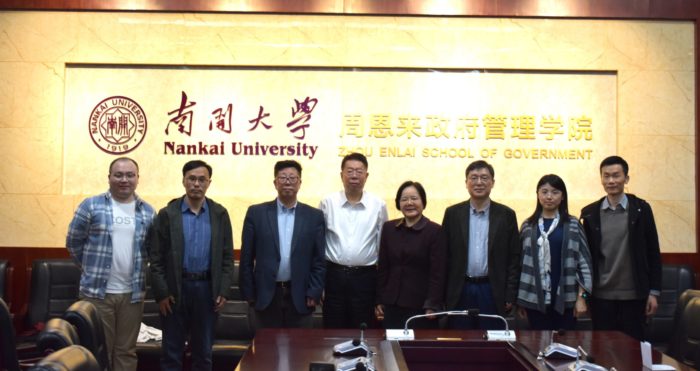
Global China Academy’s President Professor Xiangqun Chang’s Academic Activities in Xiamen, Wuhan and Tianjin, 4-11 April 2023
Introduction
On the occasion of being an invited speaker at the ‘International Conference: Chinese Path to Modernization and Pursuit of Humanity’s Common Values’ held at Xiamen University from April 4th to 6th, 2023, I visited China and engaged in a series of lectures, seminars, and academic exchanges at various universities in Xiamen, Wuhan, Tianjin, and Beijing. In addition to fulfilling our academic duties, I also participated in events and activities aligned with the social missions of the Global China Academy. This account does not include activities related to academic and social missions in Beijing.
Timeline
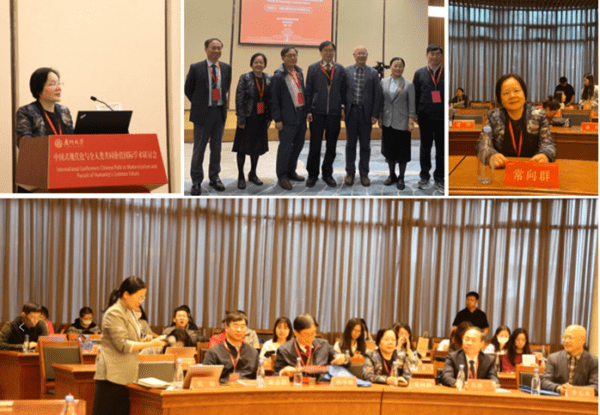
From April 4-6, I participated in a 3-day conference named ‘International Conference: Chinese Path to Modernization and Pursuit of Humanity’s Common Values’. It was organized by the newly established Institute of Chinese Path to Modernization and Division of Social Sciences at Xiamen University. The conference included three panels: Chinese Path to Modernization and Global Governance, Chinese Path to Modernization and International Communication, and Chinese Path to Modernization and Traditional Chinese Culture, with Panel 3 chaired by Professor ZHANG Yu, Deputy Director of the School of Taiwan Studies. My talk, titled ‘Realization of Goal-Oriented Cooperative Projects, Promoting the Common Value of Mankind: A Corpus-Assisted Analysis of ‘recipropriety’ (lishang-wanglai 互适),’ focused on global society governance, exploring humanity’s common values and differences through corpus-based texts and case analyses of cooperative projects using the concept of ‘recipropriety.’ I aimed to deepen mutual understanding and achieve common project goals by discussing different values and seeking common ground while preserving diversity.
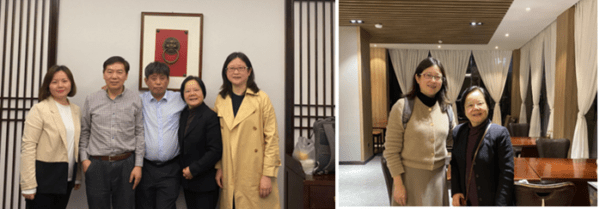
On the evening of April 4th, Professor HU Rong (2nd left in the left photo), Dean of the School of Sociology and Anthropology, hosted an academic exchange meeting. Attendees included myself, Professor Donggen Rui (in the middle of right photo) from Pukyong National University, South Korea, anthropologist Professor GONG Haoqun, and sociologist Associate Professor LU Wei. On afternoon of April 5th, Professor GONG Haoqun (right photo) and I had an in-depth discussion on anthropological issues from a comparative perspective, based on my work and that of some fellow anthropologists on comparing Chinese and non-Chinese societies.
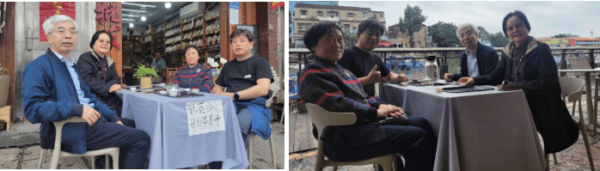
On the afternoon of April 6th, Professor Donggen Rui (right in the left photo) and I met with Professor LI Minghuan (left in the right photo) from the School of Sociology and Anthropology at Xiamen University. She is the Vice President of the Chinese Overseas History Society and was an invited speaker at a conference I organized in 2013 at LSE.Dr. HE Ruifu (left in the left photo) hosted the tea and lunch meeting. He obtained his PhD on family networks in a rural village in Fujian under Professor Stephan Feuchtwang at City University in 1993 when I worked there. He formerly served as the Deputy District Chief of Siming District, Xiamen City, the Deputy Director of the Research Office of the Xiamen Municipal Committee of the Chinese People’s Political Consultative Conference (CPPCC), and the Executive Vice Chairman of the Xiamen Federation of Social Science Associations. He is the editor of Gulangyu Island Studies, a series of research books. They cover various topics, including the history and cultural relations of Gulangyu Island with countries such as the UK, Germany, and Japan, as well as studies on overseas Chinese and women’s research.
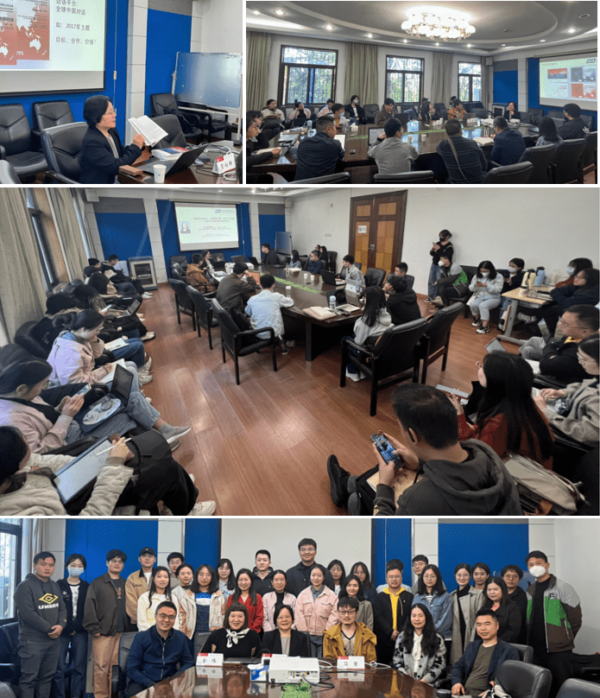
On the morning of April 9th, I delivered a lecture entitled ‘A Corpus-Assisted Social Scientific Approach: A Textual Analysis Methodology in the Era of Big Data’ at the Marxist School of Wuhan University. I shared the background of my involvement with this method. In the era of big data, with the overwhelming presence of massive electronic texts, the traditional quantitative and qualitative analysis methods in social sciences face significant challenges. The presentation by speakers from the ESRC Centre for Corpus Approaches to Social Science (CASS) at Lancaster University during the 3rd Global China Dialogue in 2016 showcased the effectiveness of the corpus approach in addressing social scientific issues related to climate changes. Inspired and guided by experts from the ESRC CASS, the Global China Institute, which later became the Global China Academy, organized the workshop on Corpus Approaches to Chinese Social Science (CACSS). Three years following the workshop, the Journal of Corpus Approaches to Chinese Social Science (JCACSS, Chinese Edition) was launched, published by Global Century Press and edited by Professor QIAN Yufang at Zhejiang Gongshang University.
To commemorate the 105th anniversary of the birth of China’s distinguished social scientist and pioneer of Marxist sociology, Professor Ding Kequan (1914-1989), and the 110th anniversary of the birth of our country’s famous sociologist, anthropologist, social activist, and Chinese national leader, Professor Fei Xiaotong (1910-2005), I, along with assistance from Professor QIAN Yufang and other colleagues, constructed three corpora. These include the Ding Kequan Collected Works (three volumes), Fei Xiaotong Complete Works (20 volumes), and the Marx and Engels Complete Works (50 volumes) corpus. My lecture aimed to share experiences and provide examples demonstrating how to bridge the disciplines of sociology and applied linguistics. Professor JIN Wei (to my right in the group photo) organized the lecture, and Professor JIAN Fan (to my left in the group photo), the Vice Dean of the Marxist School, chaired the lecture.
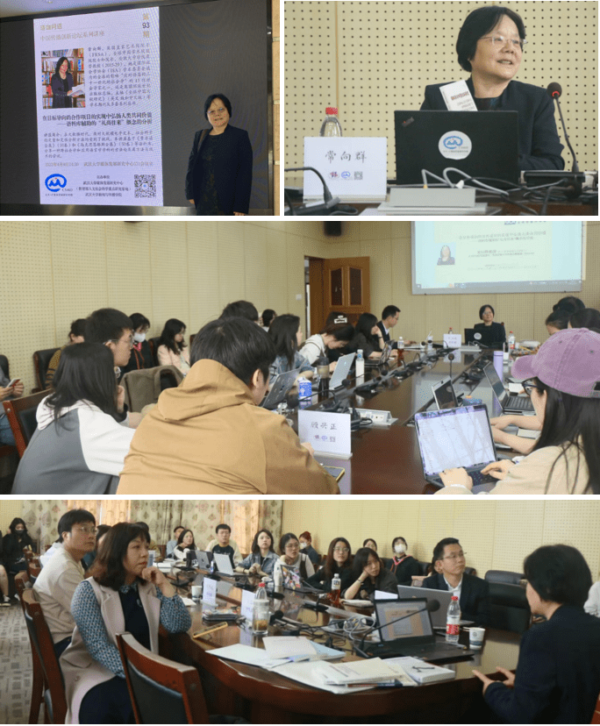
On the afternoon of April 9th, I gave a seminar at the Wuhan University Center for Media Development Studies, which is one of the four media studies bases of the Ministry of Education, alongside those at Tsinghua University, Renmin University of China, and Fudan University. The Wuhan University Center founded the Journal of Cross-Cultural Communication Research, where a comprehensive interview article titled ‘The Concept, Practice, and Production of Transculture from a Global Perspective’, conducted by Professor WANG Xin with me, was published in the journal (Vol. 5, 2022).
The seminar was chaired by Professor WU Shiwen (on my right in the bottom photo), Director of the Institute for Health Communication Research at the Wuhan University Center for Media Development Studies. The title of my seminar was Realization of Goal-Oriented Cooperative Projects, Promoting the Common Value of Mankind: A Corpus-Assisted Analysis of ‘recipropriety’ (lishang-wanglai 互适). This is the same title as the presentation I delivered at the Xiamen conference.
Professor XIAO Jun (on the left side of me in the bottom photo), the Deputy Director of both the Centre and Department of Internet Communication at the School of Journalism and Communication, Wuhan University, provided me with a guided tour of the Center, School, and University Campus before and after my talk. Immediately after visiting Xiamen University, I shared my comparative views on these two most beautiful university campuses in China. Both offer a rich blend of natural beauty and architectural elegance. The serene coastal vibes of XMU, combined with the blend of Eastern and Western architectural styles, provide a unique, tranquil environment for study and reflection. In contrast, the lush, blossoming landscapes of WHU, famous for their cherry blossoms and palatial architecture, offer a historically rich and aesthetically pleasing environment.
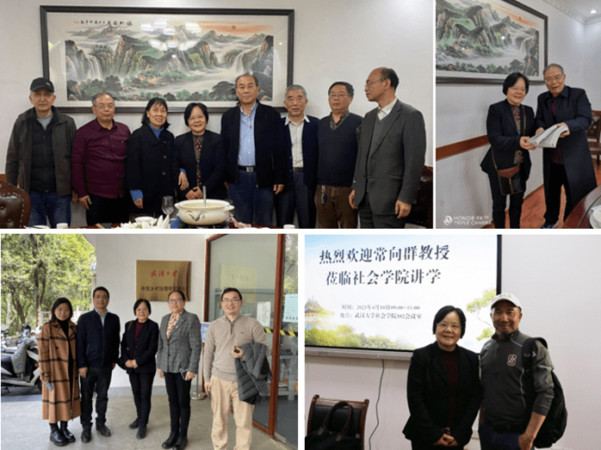
On the evening of April 9th, Professor LUO Jiaojiang (2nd left in the top left photo), who is the former Director of the Institute of Social Development at Wuhan University and also the former Vice President of the Global China Institute (the predecessor of GCA), arranged a meeting for me with some colleagues in Wuhan. Together with his colleague, Research Fellow LUO Jun (1st right in the top left photo), and myself, we were awarded the major research project ‘Emergence, Status, and Prospect of Computational Social Science in the Big Data Era’ by the National Social Science Fundation of China, undertaken by Wuhan University in 2016. Professor WANG Tie (on my left in the top left photo), the former Director of the Institute of Information at the Wuhan Academy of Social Science, also attended the meeting.
On the morning of April 10th, outside the building of the School of Sociology, I met with Professor WU Lin (on my right in the bottom left photo), Vice Dean of the School of Sociology, Dr CAI Lei, Associate Professor (1st left in the bottom left photo), and Dr GONG Weigang, Associate Professor (1st right in the bottom left photo). In the lecture room, Professor ZHOU Changcheng (right in the bottom right photo) popped in to meet me before the lecture. He was the Vice Dean of the School of Law, Deputy Director of the Department of Sociology, and President of the Wuhan Sociological Association. I was surprised to see him dressed in gold clothes and a hat on the university campus. We shared common interests during lunchtime.
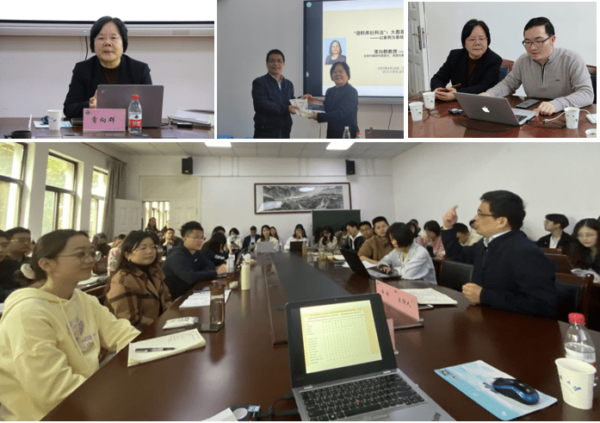
The lecture was chaired by Professor WU Lin (right in the bottom photo), Vice Dean of the School of Sociology. The title of the lecture was ‘A Corpus-Assisted Social Scientific Approach: A Textual Analysis Methodology in the Era of Big Data,’ the same as the one I delivered at the Marxism School. During the Q&A, Dr CAI Lei shared with everyone that she attended my lecture eight years ago in 2014, when she was a Master’s student in the Department of Sociology. She was very impressed and noted that I returned to the department with a very different topic.
Dr. GONG Weigang also shared with everyone that he was a team member of the aforementioned major research project on computational social science that I co-developed. His question caught my attention. After the lecture, I followed Dr Gong to his office. Gong showed me his collections of data resources (right in the top photo), for example, approximately 5 million volumes of English text corpora from 1800-1900, basic information of 2.1 million Twitter users, 5 billion historical tweets since 2019, 3 billion historical Twitter keyword data, 530 million basic user information on Facebook, 400 million basic user information on LinkedIn, 13TB of global online public opinion data, and 1.4 billion web page news headlines and text content. Based on analyzing the data, their team published some journal articles, such as ‘Media Hegemony, Cultural Circle, and the Global Dissemination of the Orientalist Discourse: Taking Public Opinion on China in GDELT as an Example,’ by GONG Weigang, ZHU Meng, ZHANG Sai, and LUO Jiaojiang, in Sociological Studies, vol. 5, 2019.

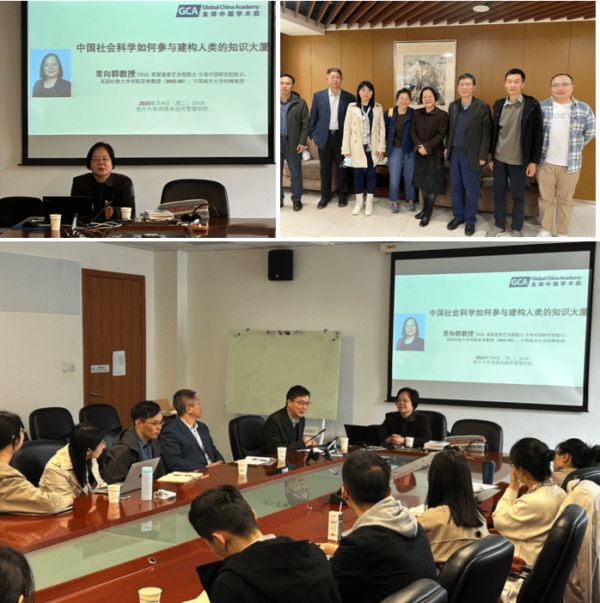
On the morning of April 11th, I delivered a seminar to the faculty of the Sociology Department at Nankai University, titled ‘How Chinese Social Sciences Contribute to the Construction of Humanity’s Edifice of Knowledge.’ Focusing on leveraging China’s academic contributions globally, I emphasized the importance of Chinese social sciences’ participation in constructing the global knowledge system. I highlighted significant milestones, such as the influential works published by Chinese scholars when China was the ‘market focus’ at the 2012 London Book Fair. I also reflected on my experiences and observations at academic forums, critiquing the neglect of methodological rigor in discussions about transforming Beijing into a global academic center. My talk presented the evolution of Chinese social sciences, emphasizing the challenges and opportunities presented by big data for qualitative and quantitative research, and spotlighted the emergence of computational social science and the application of corpus methodologies as innovative approaches to social science research. The goal was to showcase the evolving landscape of the social sciences in China and their impact on global academic discourse.
Professor ZHAO Wanli (on the right of me in the bottom photo), the Deputy Dean of the Zhou Enlai School of Government, chaired the seminar. In response to the challenges, he introduced some young generation scholars in the faculty who have received international training and expressed hope that future collaborations would be strengthened. Professor WANG Bingyu (on my right in the top right photo), obtained her PhD from the University of Auckland, New Zealand, and has been working as an Associate Editor of the Journal of Ethnic and Migration Studies (JEMS) since 2021. She expressed her willingness for further discussion and collaborations.

On the afternoon of April 11th, I delivered a lecture to the faculty and students of the Sociology Department at Nankai University. The lecture was titled ‘A Text Analysis Method in the Era of Big Data: Corpus-Assisted Research Based on Case Studies’. It explored the application of corpus methodology in the social sciences and humanities, specifically focusing on the Chinese context. The lecture provided an overview of ‘Corpus Approaches to Social Science’, demonstrating how large-scale electronic text analysis can reveal patterns, substantiate theories, and inform research direction. I detailed various types of corpora, analytical tools, and case studies, including the digitalization of Chinese medical classics and critical discourse analysis. It highlights the integration of corpus linguistics with social science methodologies, demonstrating the potential for deepening understanding of complex social phenomena through quantitative and qualitative analyses.
Professor ZHANG Wenhong, on my left in the top right photo, Dean of the Zhou Enlai School of Government, chaired the lecture. Professor ZHU Guanglei (on my right in the bottom right photo), former Vice-President of Nankai University, attended the lecture. He is Life Fellow of the Global China Academy (click here to watch greeting video at the GCA’s founding ceremony). Afterwards, among the many students who asked questions related to my lecture, a PhD student, LU Hanxu, brought my book, On Marxist Sociology (1992/2018), and asked for a signature. Lu is writing her PhD thesis entitled ‘The Study of the Sinicization of Marxist Sociology (1919-1949)’ under the supervision of Professor ZHAO Wanli, who is also the Director of the first national research Center for Marxist Sociology in China.

On the morning of April 13th, I was invited to deliver a lecture at the School of Art at Tianjin Polytechnic University. The title of the lecture was ‘Transculturality’ and Art Communication. As the global era quietly transitions into the digital age, cross-cultural discourse is increasingly challenged by ‘transcultural’ discourse. My lecture aimed to showcase the similarities and differences between ‘transcultural’ and both cross-cultural and intercultural communications through the examination of ‘transcultural’ products and practices in different art forms during the cultural exchange process between China and other countries, mainly the UK. It was intended to introduce case practices of ‘transculturality’, the vitality of its concept in cultural communication, and the analytical power of related research. However, due to a personal matter, the lecture was canceled. Professor ZHANG Qiugui (left in the left photo), who was scheduled to chair the lecture, is seen seeing me off from Tianjin West Station.
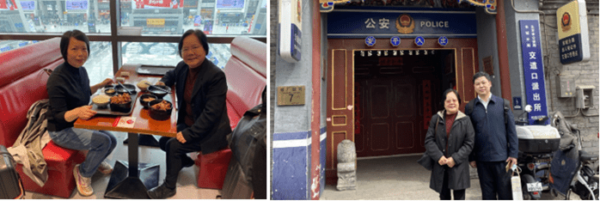
Two hours later, I arrived at the Beijing Jiaodaokou Police Station, where I met Professor ZHOU Yunwei (in the right photo), Deputy Dean of the School of Police Information Engineering and Cybersecurity at the People’s Public Security University of China (PPSUC). It was our first meeting since I interviewed him in his hometown, Xianning County of Hubei Province, in 1990. At that time, I worked at PPSUC and represented both PPSUC and PPUC (People’s Police University of China, which merged with PPSUC in 1998), for student recruitment in Hubei Province. Zhou was among those admitted to PPUC from an ordinary family background. In the ‘Postscript’ of his book, Principles of Electromagnetic Wave Evidence, Zhou expressed his gratitude to me for changing his life (PPSUC Press, 2021, p334). Learning that I needed official proof of my previously canceled Beijing Resident Certificate (hukou) to apply for a Foreigner’s Residence Permit, Zhou quickly offered his help. He arranged a meeting at the police station to accommodate my busy schedule, ensuring I could visit my 92-year-old mother in China without the need for a visa in the coming years. During lunchtime, we also discussed possible collaboration with colleagues at the PPSUC in related fields from a global and comparative perspective.
In theory, my academic activities should have concluded at Nankai University. The two incidents on April 13th serve as records of my experiences in China. I was scheduled to give a lecture on ‘Transculturality and Art Communication’ at Tianjin Polytechnic University, but it was canceled due to personal reasons. This is because I learned that a Foreigner’s Residence Permit in China can facilitate my future visa-free visits to my mother in China, and obtaining official documentation for my canceled Beijing Resident Certificate fit into my very busy schedule.
* * * *
By participating in the three-day ‘International Conference: The Chinese Path to Modernization and the Pursuit of Humanity’s Common Values’ from April 4th to 6th, as well as subsequent academic exchanges and visits, I deeply felt the diversity and complexity of China’s exploration in the process of modernization. This conference not only provided me with a platform to present and discuss the application of the concept of ‘recipropriety’ in global social governance but also gave me the opportunity to engage in in-depth exchanges and discussions with scholars from different disciplinary backgrounds. These activities emphasized the contributions of Chinese social sciences to the construction of the global knowledge system, and the importance of interdisciplinary research and international cooperation in driving innovation in social sciences and understanding complex social phenomena.
Anyway, through a series of lectures and seminars at higher education institutions such as Xiamen University, Wuhan University, and Nankai University, I profoundly understood the importance that both China and the global academic community place on social science methodologies, as well as the potential and challenges of corpus methods in social science research in the era of big data. These experiences not only enriched my academic perspective but also provided new ideas and directions for future research explorations in the interdisciplinary fields of social sciences and applied linguistics. This series of academic activities not only showed China’s active role in global academic discussions but also reflected the high attention and recognition of the international academic community towards Chinese social science research. I look forward to more such exchanges and cooperation in the future, collectively advancing the development and innovation of social sciences, and offering new perspectives and solutions for addressing global issues.
By Xiangqun Chang
- Click here to view Global China Academy’s President Professor Xiangqun Chang’s Academic Activities in Beijing,18-20 April 2023
- Click here to view Social Mission Activities and Reflection of GCA President Xiangqun Chang in China, April 2023
- Click here to see the GCA Centre’s facilities: Driveway, Garden, Function Rooms, Libraries, Dining Area, Bedrooms, and more.
- Click here to explore the 5 ‘walk and talk’ routes, including tea and lunch. The PDF file can be downloaded.
- Click here to reach us including details on how to visit us.
- Click here to visit the GCA news section.

GCA Life Fellow Korean Sociologist Professor HAN Sang-Jin Meeting Professor Xiangqun Chang at Seoul, January 2023

In early January, during her trip to Seoul, GCA’s President, Professor Xiangqun Chang, met with GCA Life Fellow Korean sociologist Professor HAN Sang-Jin from Seoul National University, and his wife, Professor Shim Young-Hee from Hanyang University (left photo above), at Dongmyeong. Professor Han, who is also the Chairman of the Joongmin Foundation for Social Theory (JMF) and the Europe–Asia Research Network (EARN). During the COVID-19 pandemic, Professor Han led a research project that conducted three rounds of global survey questionnaires related to COVID-19 and citizens’ lives, covering 33 metropolitan cities in the world.
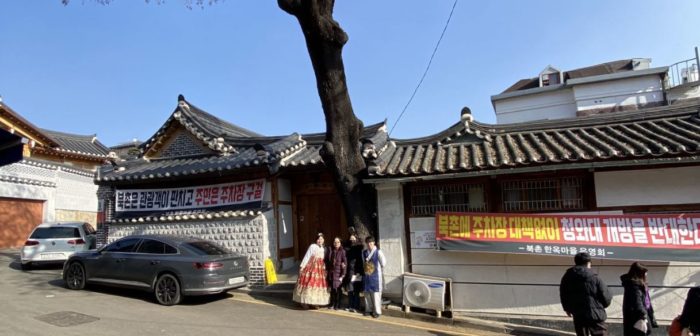
Professor Shim made suggestions for places of interest that they normally recommended to their academic guests, such as Gyeongbokgung Palace, the Folk Museum, Bukchon Hanok Village, Insadong, and other places. Professor Han immediately arranged for his PhD student, Jiang Meishan (second from the right in the top right photo), to accompany Professor Chang during her visit to Seoul. The photos in the top right and bottom are of Bukchon Hanok Village and Namsangol Hanok Village.
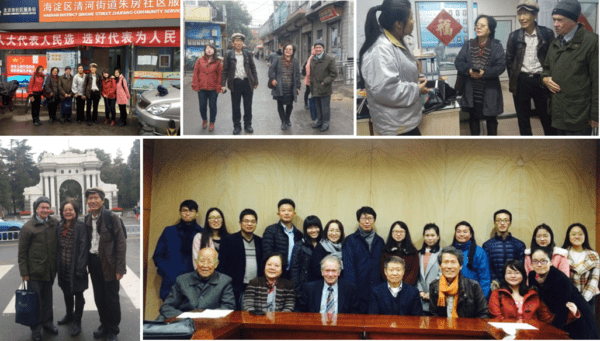
Professor reminisced about their productive field visit to the Qinghe Community (top row of photos) in Beijing in October 2016, alongside Professor Martin Albrow, Founding and Past Honorary President of the Global China Academy (GCA). This visit was organized by the GCA Council’s former Chinese Chair, Professor Li Qiang (1949–2023), who was then the Dean of the School of Social Sciences at Tsinghua University and President of the Chinese Sociological Association. The group photo at the bottom right was taken after Professor Martin Albrow’s lecture. Professor Chang was to Professor Albrow’s left, Professor Li was to his right, and Professor Han was to Professor Li’s left. The title of Albrow’s lecture was ‘The Challenge of Transculturality for the USA and China’, which was published in China’s Role in a Shared Human Future: Towards Theory for Global Leadership, by Martin Albrow and published by Global Century Press, London, in 2018.
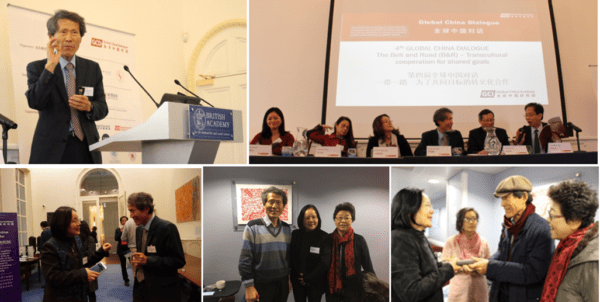
At the 4th Global China Dialogue ‘the Belt and the Road: Transcultural Cooperation for Shared Goals’ in 2017, Professor Han presented a paper titled ‘A Cosmopolitan Interpretation of Fei Xiaotong’s Study of Chinese Culture: How Companies Can Work for the Cultural Project of the Belt and Road’ at Panel III, ‘What are the theoretical and legal bases of the B&R?’ The plenary panelists from left to right in the top right photo are: Dr Linda Yueh CBE, Fellow in Economics at St. Edmund Hall, Oxford University, and Adjunct Professor of Economics at London Business School; Dr Xiaobai Shen, Senior Lecturer in International and Chinese Business at the University of Edinburgh Business School; Dr Yuka Kobayashi, Lecturer in China and International Politics, SOAS, University of London; Professor Han; Professor Jiaming Sun, Professor in the Department of Sociology and Criminal Justice at Texas A&M University-Commerce, USA; and Dr Tan Khee Giap, Co-Director of the Asia Competitiveness Institute (ACI) and Associate Professor at the Lee Kuan Yew School of Public Policy, National University of Singapore (Panel Chair). The photos in the bottom row from left to right show Professor Xiangqun Chang in conversation with Professor Han at the British Academy during the Dialogue, and with Professor Han and Professor Shim at King’s College London at the Post-Dialogue workshop: Chinese for Social Science (CSS) at King’s College London on December 2. The second photo from the left in the bottom right features Professor Ann Lee, an adjunct professor at New York University, an internationally recognized leading authority on China’s economic relations, and the CEO of Coteri, USA, jointed the conversation.
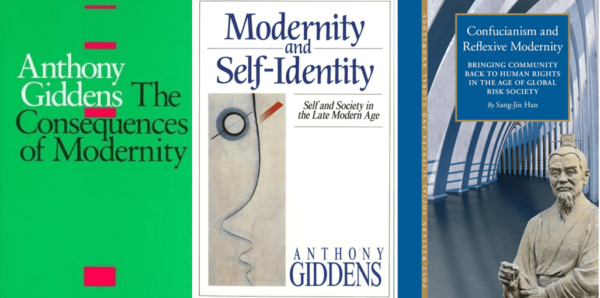
While in London, Professor Han and Professor Shim conducted an interview with Professor Lord Anthony Giddens, their third interview with Giddens over the past three decades. These interviews were all published in Confucianism and Reflexive Modernity (2019). From the book title and the author’s name, people might assume it was written by Chinese, especially since the concept of ‘modernization’ has been a keyword in social sciences discourse in China, whereas the world has been using globalization in different forms. Professor Han said that his work was influenced by Giddens’s two early books, The Consequences of Modernity (1990) and Modernity and Self-Identity (1991), and by Ulrich Beck’s books on risk, such as Risk Society: Towards a New Modernity (1992) and Reflexive Modernization (1994).
Han’s book critiques the Asian Value Debate paradigm and advocates for a balance between individual empowerment and community flourishing within the framework of a global risk society, from an enlightened post-Confucianism perspective.
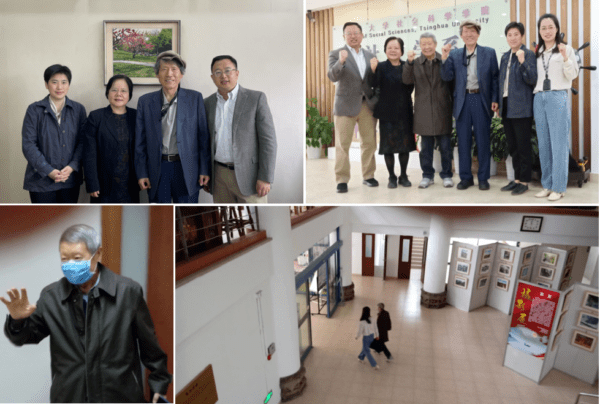
During the meeting in Seoul, Professor Chang told Professor Han that she would visit China in April. Professor Han also planned to visit China in April. They agreed in principle that they should meet again at Tsinghua University if their schedules allowed. On the morning of April 20th, Professor Han and Professor Chang joined a meeting at the Department of Sociology, Tsinghua University. Dr ZHENG Lu chaired the meeting. He is the Deputy Head and Associate Professor of the Department of Sociology and the ‘Rong’ Professor of Data Sciences at Tsinghua University. From left to right in the top right photo are: Dr ZHENG Lu, Professor Chang, Professor LI Qiang, Professor Han, Dr ZHANG Yizhang from the Department of Sociology, and Dr CHEN Yulin from the School of Architecture. In this photo, everyone clenched their fists, a gesture suggested by Professor Han, to express a determination to collaborate among the three parties. This sentiment was echoed in his video greetings at the GCA’s founding ceremony, as presented by Professor LI Qiang (click here to watch). Shortly afterwards, Professor Li waved goodbye to everyone, and Dr Zhao accompanied him as they disappeared from our sight (in the two bottom photos)—a farewell that became eternal……
Note: The photos and text below were updated following Professor Li Qiang’s passing in December 2023.
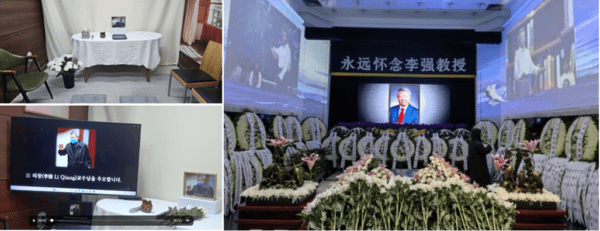
On 12 December, Professor Xiangqun Chang shared the aforementioned memorial webpage with Professor Han Sang-jin of Sociology from Seoul National University. Immediately, Professor Han set up a small altar at his home to honour the memory of Professor Li Qiang, placing a bunch of white chrysanthemums in front to symbolize his distant remembrance. Furthermore, he held a funeral parlor open all day on Saturday at his institute on the December 16 when LI Qiang’s farewell ceremony was held in Babaoshan, Beijing. He also forwarded us his memorial article written in English. The Chinese-translated version has been published on the Tsinghua University website. The photo on the bottom right, showing the farewell ceremony hall for Li Qiang, was received from Professor Han Sang-jin. This gesture of remembrance and respect from colleagues and friends underscores the profound impact Professor Li had on those around him.
Professor Xiangqun Chang’s reflections on conversations with Professor HAN Sang-Jin, from Seoul to Beijing and then to London, alongside the commemorative gestures in memory of Professor Li Qiang, weave a tapestry of academic solidarity, respect, and mutual learning. The enduring legacy of scholars like Professor Li Qiang, remembered through acts of remembrance and the continuing dialogue among academics, echoes the spirit of global collaboration and intellectual curiosity that defines the Global China Academy. These narratives, captured in photographs, lectures, and shared memories, continue to inspire and guide the path toward a more interconnected and understanding global academic community.
- Click here to view the page ‘Global China Academy’s President Professor Xiangqun Chang’s Academic Activities in Beijing,18-20 April 2023’.
- Click here to view the page ‘The Chinese Chair of the Global China Aacademy Council, Professor LI Qiang, passed away on the 12 December, 2023’.
- Click here to watch a video of Professor LI Qiang’s greeting for the launch of the Global China Academy as an academy at the 7th Global China Dialogue, on December 10th, 2021, at the British Academy.
- Click here to visit the GCA news & Blog section.
Global China Academy’s President Professor Xiangqun Chang’s Academic and Professional Activities in China After COVID-19, 02/09-12/11/2022
Introduction
On her trip to accompany her mother returning to China and to help her settle there, Professor Xiangqun Chang visited China from early September to mid-November 2022. During this period, she participated in a series of meetings and activities with related parties there. The description of the activities below aims to enable our global colleagues to meet some of our Chinese colleagues and contacts in China for the purpose of sharing information and networking.
Timeline
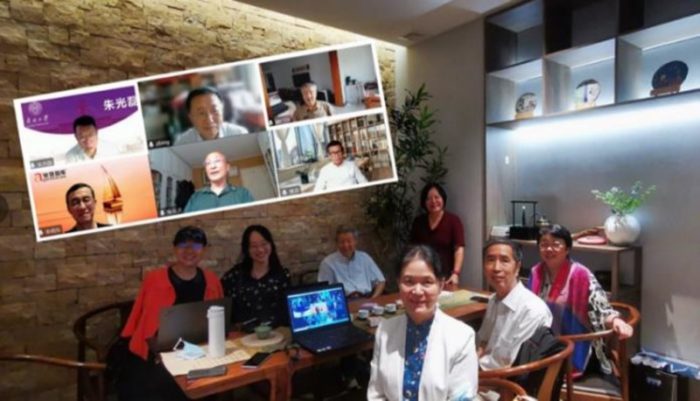
On the 17th September, a meeting was held in the Tsinghua Science and Technology Building at Tsinghua University, Beijing. It was organized by GCA Trustee Dr Yuan Cheng (front right), Country Manager of Greater China, Russell Reynolds Associates (UK), and Professor LAN Chun of Beijing Foreign Studies University, Executive Editor of the Journal of Chinese for Social Science (JCSS, front left). All the GCA Founding Fellows and Life Fellows participated in the meeting online and offline.
The above photo shows participants in person or online. In-person participants included Professor LI Qiang (rear 2nd right), Professor XIE Lizhong (front 2nd right) and Professor Xiangqun Chang (rear right). Online participants (inset) included Professor BING Zheng (top centre), Professor ZHU Guanglei (top left), Professor GU Yueguo (top right), Professor ZHANG Xiaodong (bottom left), Professor ZHANG Letian (bottom centre), former Dean of School of Social Development at Fudan University, former Chinese President of GGPN Global and Global China Institute (GCA’s predecessors) and Honorary Editor of JCACSS (Chinese edition); Dr Qing Cao (bottom right). Many important issues were discussed in the meeting.
Left: In morning of the 18th September, Professor Chang met Ms ZHANG Haiou (left), former Editor-in-chief of the New World Press, one of GCP’s Chinese partners. The topic of metaverse was discussed.
Right: In the afternoon, Professor Chang had a productive meeting with Professor CHEN Guangjin (left), Director of Institute of Sociology, and Professor FANG Ning (right), Deputy Director of Institute of Political Science, Chinese Academy of Social Sciences (CASS).

On 19th September, Professor Chang visited the headquarters of Learning without Borders (LwB, also known as UVIC) in Changsha City, Hunan Province. UVIC funded the first three Global China Dialogues and has been one of the most faithful supporters of GCDs. In the meeting, Philip Hao (3rd left and far right in the above photos), CEO of the LwB and UVIC, and his colleagues discussed issues for further collaboration with GCA.

On 21st September, three meetings were held at Kingswell Hotel at Tongji University.
Left: The first meeting was with Professor WANG Xin (right) and Dr DING Fan (left). Professor Wang interviewed Professor Chang in London in 2018 when she was visiting fellow at University of Westminster and published the interviews in both English and Chinese. Wang is Head of Department of Communication, School of Arts and Media, Tongji University.
Centre: Meeting with Ms ZHANG Yanli (2nd left), General Secretary of the School, Professor WANG Jianmin (right), Deputy Dean of the School, and Dr DING Fan (left), Head of the Academic Development Division of the School. Ms Zhang showed some photos of the International Conference on Comparative Media Studies, jointly organized by the School and CCPN Global, on the occasion of the Centenary of Tongji University in 2017, when Professor Chang delivered greetings at the Opening session. She accepted the School’s invitation to give a speech at an international conference in person in mid-October.
Right: Meeting with Professor LI Linxue (3rd right), Dean of the School, Dr WANG Zhili (left) and others. Three meetings covered a total of 10 topics, including collaborations in organizing events, research projects, building a corpus for specific purposes and publications.
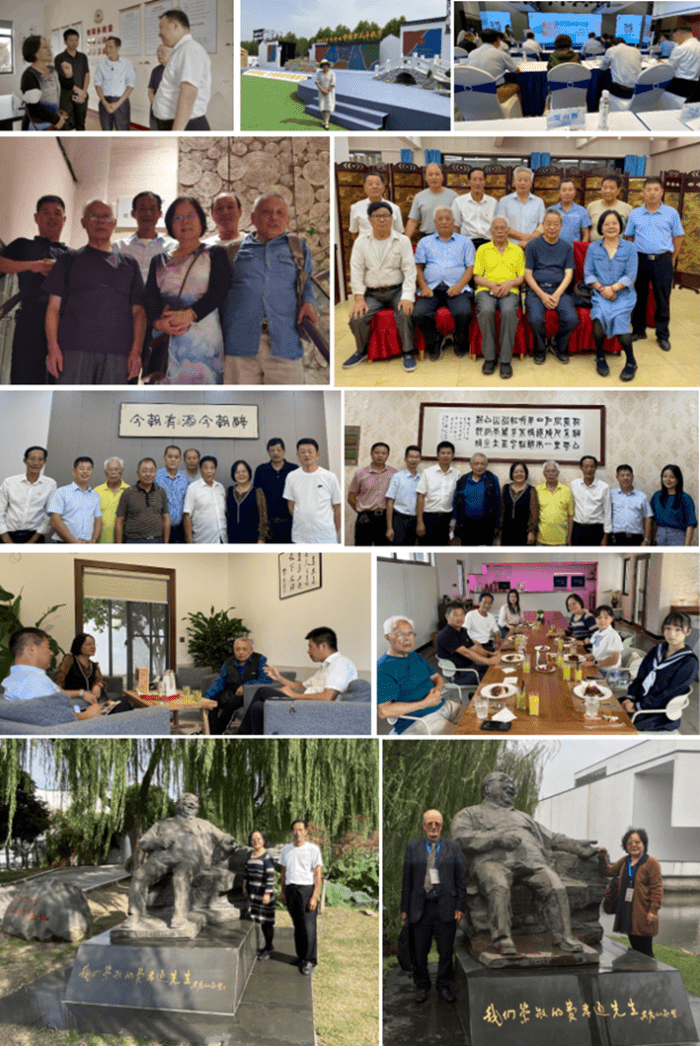
In the evening of 21st September, Professor Chang arrived in Kaixiangong Village, Qidu Township, Wujiang County, Suzhou City. The renowned Chinese anthropologist and sociologist Fei Xiaotong conducted his fieldwork in the village in 1936, which resulted in his book Peasant Life in China (1938). Based on her thorough fieldwork in the same village, Professor Chang published Guanxi or Li Shang Wanglai ?: Reciprocity, Social Support Networks, Social Creativity in a Chinese Village (in English and Chinese, 2010 and 2011). She has been developping the concept of ‘recipropriety’ and testing it in and outside China. Photos are numbered 1–10 from top to bottom, left to right. Photo 1: Profesor Chang talked to Mr CAI Jianzhong, the General Sectotaery of Qidu Township. Photo 2: Enjoying the Chinese Farmers’ Harvest Festival (CFHF) in the village, the first such festival created by the state. Photo 3: Participating in a Rural Development Forum during the CFHF. Photo 4: Meeting Professor LIU Haoxing, School of Social Development, Fudan University (front left), Dr HUI Haiming, Fomer Director of Policy Studies of Suzhou City (front right), ZHOU Yuguan (rear right), a non-party member who was officially designated ‘General Secretary’ of the village; YAO Fukun (rear centre), Head of both Fei Xiaotong Museum and the village’s Folk Museum and related affairs; XU Guoqi (rear left), former Deputy General Secretary of the village, currently a member of a Special Working Group (zhuanban 专班) that is in charge of major development projects of the village. Photo 5: Professor Liu (front centre) arranged a meeting with former heads of the village and some village groups. Photo 6: SHEN Zhirong (rear right, in black), former General Secretary of the village, who helped Professor Chang conduct her first fieldwork in the village in 1996. Photo 7: An official meeting arranged by the current General Secretary XIA Zhiyao (3rd left). Photo 8: A discussion about the ‘Special Working Group’ in its office in the village. Photo 9: Dining in Jiangchun Club (江村西餐厅), a Western-style canteen in the village. Photo 10: With YAO Fukun by the Fei Xiaotong statue. Photo 11: With Professor Stephan Feuchtwang, LSE, by Fei’s statue in 2016, when they participated in the international conference to mark the 80th anniversary of Fei Xiaotong’s fieldwork in the village.
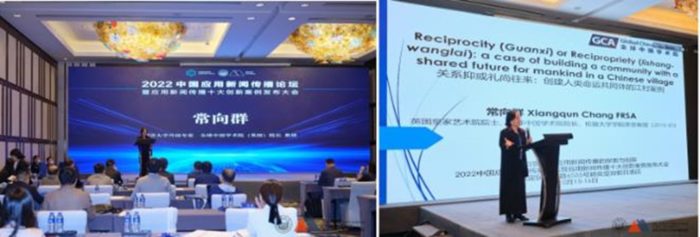
Based on the above fieldwork, on 15th October, Professor Chang delivered a speech entitled ‘Reciprocity (Guanxi) or recipropriety (lishang-wanglai): a case of building a community with a shared future for mankind in a Chinese village’, at the international conference ‘China and the World: Exploration and Innovation of Applied Journalism and Media Studies’, Tongji University, Shanghai.
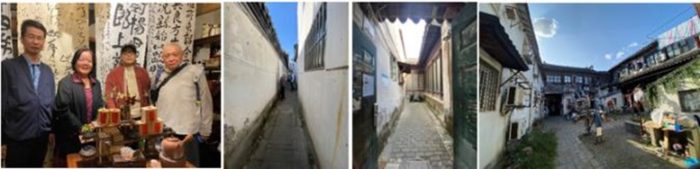
On 16th–17th October, Professor Chang visited Suzhou City, the ‘Heaven City’ in China. She had an enjoyable visit to a Cantonese tea house, Chaoren Fang, which mixed different styles of Chinese calligraphy including ‘kung fu calligraphy’, a kind of performative art, accompanied by Dr HUI Haiming (right). The owner, Mr WANG Kai (2nd right), believed this is a good way to communicate with people from different cultural backgrounds. They also walked in underdeveloped original residential places in Ming Dynasty in Suzhou City. One wonders if Heaven City can get any better!

On 18th–21st October, Professor Chang visited Wuxi City, a historic city over 3,200 years old, with its Grand Canal. A UNESCO World Heritage site, it now has the highest per capita GDP in China.
The visit was arranged by Mr DU Yichao (3rd right in green, left photo, with his colleagues), PhD candidate in anthropology at University College London. He is also Director of Wuxi New Culture Research Institute.
Centre: Officials and experts from Liangxi District accompanied Professor Chang on visits to places of interest.
Right: For COVID tests and to obtain different codes, Professor Chang’s UK passport was checked everywhere throughout her visit to China. This one was in Wuxi, which was designated a zero-risk city at that time.
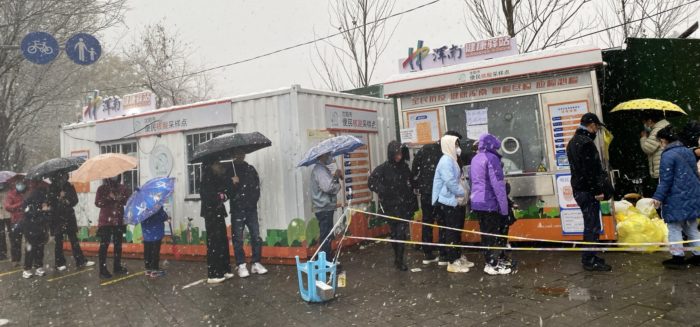
The photo on the left was taken on 12th November 2022 in Shenyang City, while Professor Chang was queueing for a COVID test or nucleic acid testing (核酸检测) on a snowy day. The term ‘doing nucleic acid tests’ (做核酸) has become a catchphrase in people’s daily lives, and the action of ‘doing nucleic acid tests’ has become a way of life in their everyday routines. The nucleic acid testing sites were well-built and well-located. Even a small site was easier to find than a well-known residential area (小区) on a digital map.
Professor Chang’s experiences and skills in learning and using different kinds of health codes became a special memory: from international health codes to provincial, regional, or city-specific ones, and from English to Chinese versions. For non-Chinese passport holders entering Beijing, the English version of the health code (Health Kit) is required. There were different names for health codes, such as Liaoshitong (辽事通) for Liaoning Province, Shengshitong (盛事通) for Shenyang City (Shengjing 盛京 was the capital of the Manchu state during the Qing Dynasty period, which later became the city of Shenyang), Suishenma (随申码) for Shanghai City (Shanghai known as ‘Hu沪,’ also referred to as ‘Shen 申’), Sukangma (苏康码) for Jiangsu Province, and Xikangma (锡康码) for Wuxi City. These codes were necessary for entry at airports and stations. Within any given location, whether it be a hospital, office, shop, restaurant, or any place of interest, the ‘Changsuoma’ (场所码) had to be presented. All the above codes must be dynamic and cannot be photos or screenshots of codes that were prepared earlier. The diversity and ingenuity of these health codes reflect the Chinese people’s adaptive strategies in dealing with COVID-19.
The above tests and codes have ensured that both the virus and people are tightly controlled. Everyone seems to have adapted to this kind of lifestyle. It is truly remarkable how the COVID-19 situation changed dramatically two weeks after she left China. ‘Understanding China and the World,’ one of GCP’s book series, is clearly important and will continue to be so.
President of the Chinese Sociological Association, Professor LI Qiang, and His Wife’s Visit to the UK (20-25 July 2014)
On July 20, 2014, Professor LI Qiang (1950-2023), then Dean of the School of Social Sciences at Tsinghua University, traveled to the UK for a vacation with his wife, Zhang Hua [Note 1]. As a friend, I had arranged their 10-day itinerary in advance and accompanied them in London. Unfortunately, due to Mrs. Zhang catching a cold and developing a fever, they had to cut their vacation short and rescheduled their return flight on the afternoon of the 24th. This left many regrets but also provided me with unforgettable and wonderful memories. The following is a record of some of their visit.
On July 20th (Sunday), the Li couple arrived at London Heathrow Airport at 15:10 on flight BA38, then proceeded to check in at the Hilton London Hotel (located on Edgware Road but quite far from Edgware Station, which is near my home). A BBC Prom concert was arranged at 19:30 at the Royal Albert Hall, where the World Peace Orchestra, consisting of musicians from around the world, performed classical pieces by composers such as Beethoven and Mozart, as well as some music themed around world peace, expressing the harmonious coexistence of different cultures and nations through various famous pieces. Unfortunately, due to jet lag and fatigue, the Lis were unable to attend, so I and other friends appreciated it on their behalf.
On July 21st (Monday), we took a day trip to Wisley Gardens. On this day, the Li couple joined an activity that I had previously arranged with two friends. Wisley Gardens, part of the Royal Horticultural Society (RHS), is located 23 miles southwest of the Royal Botanic Gardens, Kew, in Surrey. It is one of the gardens owned and managed by the RHS and is considered one of the most influential horticultural gardens in the world. With its diverse plant collections, exquisite garden designs, and deep horticultural traditions, it has become a sanctuary for garden enthusiasts both in the UK and globally.

The first set of photos features some flowers I had never seen before (from left to right): Artichoke (Cynara cardunculus), a member of the thistle family originally from the Mediterranean region. The unopened flower buds are edible, and the open flowers are bright purple, valued for both their ornamental and economic qualities; Vanda, renowned for its large, colorful flowers, with this particular Vanda sporting purple spots, making it highly ornamental; Bird of Paradise (Strelitzia reginae), known for its unique shape and vibrant colors, with this plant displaying a combination of red, yellow, and green, making it very eye-catching; Spider Orchid (Brassia), named for its unique flower shape, with long, spidery petals and sepals; Spiral Ginger (Alpinia zerumbet), noted for its unique spiral stems and decorative leaves, widely used for ornamental purposes.
The next set of photos (from left to right): We encountered a Chinese pavilion called the ‘Butterfly Lovers Pavilion’ in Wisley Gardens. It was built in 2005 through a collaboration between the Shanghai Botanical Garden in China and the RHS. Initially designed for the Hampton Court Palace Flower Show that year, where it won a silver medal, the pavilion was later donated to Wisley Gardens as a permanent feature. The pavilion’s design was inspired by the classic Chinese love story ‘The Butterfly Lovers’ (Liang Shanbo and Zhu Yingtai). The design and construction were led by Professor LIU Tingfeng from the Landscape Design Department at Tianjin University, China. To commemorate the story, the pavilion’s six pillars are carved with butterfly motifs, symbolizing the transformation of the lovers into butterflies at the end of the legend. The construction materials were sourced from Zhejiang to ensure the pavilion’s authentic Chinese architectural style. The pavilion was built to celebrate Sino-British cooperation in horticulture and to introduce traditional Chinese garden art to Wisley Gardens, offering visitors a unique blend of Eastern and Western cultural experiences. The pavilion was designed and built by Chinese horticulturists and craftsmen who ensured that it seamlessly blended into Wisley Gardens’ natural environment.
As we were leaving Wisley Gardens, we took commemorative photos with my friends and Professor Li and his wife respectively.
On July 22nd (Tuesday), we spent a day touring central London.
We had arranged to meet Professor Martin Albrow, former president of the British Sociological Association, for lunch at 12:30, so our schedule was quite tight. Early in the morning, we took the Tube to the Tower of London and Tower Bridge. Due to time constraints, we didn’t enter but toured the area before boarding a sightseeing boat along the Thames towards Westminster (see following photos).
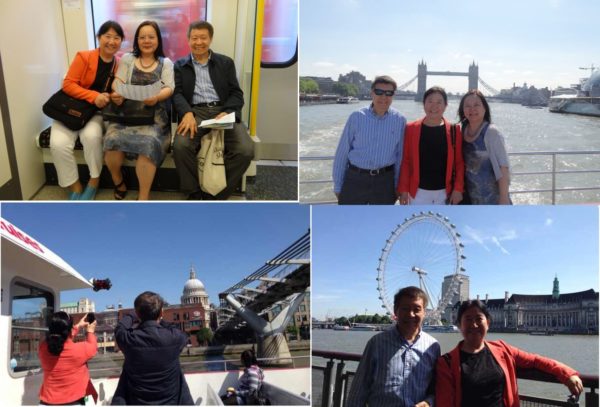
At Westminster Pier, we walked along Downing Street (with No. 10 being the official residence of the British Prime Minister), passing by Horse Guards Parade, Horse Guards Arch, and other sites, where we witnessed the Changing of the Guard (see following photos).
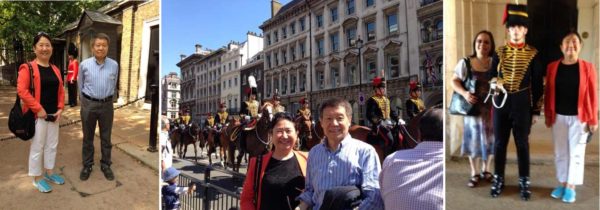
Afterward, we arrived at Trafalgar Square. Professor Li was particularly interested in the four bronze lion statues at the base of Nelson’s Column, one of Trafalgar Square’s most iconic features. He asked me to take a photo of him and his wife with one of the lions as the background. The contrast between the massive lion and the ‘small’ figures of the Lis in the photo led me to reflect. The lion, a symbol of strength, courage, and dignity in many cultures, perhaps served as a confirmation of self-identity and pride.
We were also intrigued by the blue rooster sculpture on the Fourth Plinth in the square. The Fourth Plinth was originally designed for a statue of King William IV, but due to funding issues, the statue was never completed. In 1999, the Fourth Plinth Project was launched, turning it into a platform for displaying contemporary art, with a new piece being installed every few years. The sculpture, titled ‘Hahn/Cock,’ was created by German artist Katharina Fritsch. Its bold color and form sparked widespread discussion and interest. The blue rooster symbolizes male strength and courage, while also carrying a satirical tone that questions the solemnity of traditional monuments. Fritsch described it as a humorous satire, challenging the gravity of other traditional statues in the square, making it a prime example of contemporary art in public spaces (see following photos).
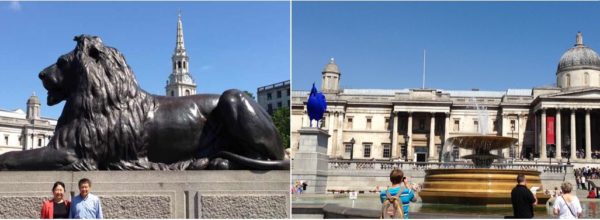
After leaving the square, Professor Li suggested visiting The British Academy. Founded in 1902, The British Academy is a national academic institution established to promote and support research in the humanities and social sciences. Its primary goal is to promote high standards of academic research, encourage scholarly debate, and support research that enhances understanding of human and social issues. The Academy is not open to the public, and one can only enter by attending an event or participating in a meeting. After taking a photo at the entrance, Professor Li suggested that we should organize events here in the future. [Note 2].
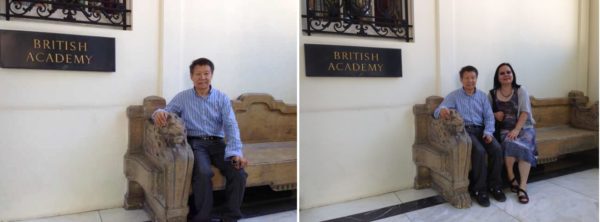
Our lunch with Martin Albrow was held at the Royal Automobile Club (RAC). This is one of Britain’s top private members’ clubs, offering dining, accommodation, fitness facilities, social events, and business meeting spaces. The RAC’s dining services are renowned for their high quality and exquisite cuisine, making it a key part of London’s high-end social life. Martin accompanied Professor Li and his wife on a tour of the club, where we exchanged ideas in the garden. After lunch, Martin presented Professor Li with his award-winning book, The Global Age (see following photos) [Note 3].
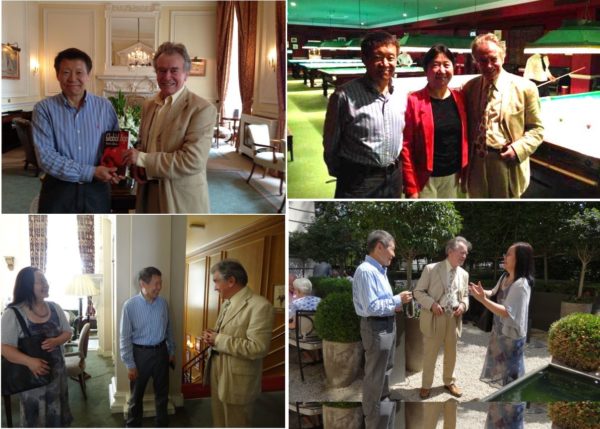
After lunch, we strolled through London and visited the London School of Economics, where we met with Dr. LIU Jiayan, a visiting fellow from Tsinghua University’s School of Architecture. She was conducting postdoctoral research under Professor Li’s supervision (see following photos). [Note 4]
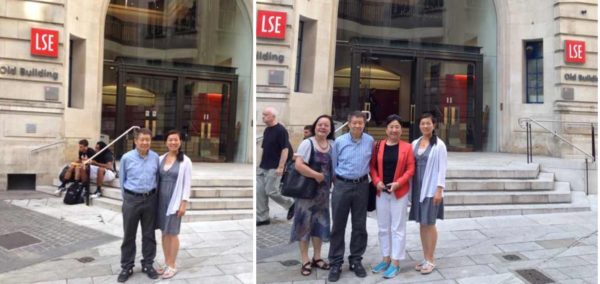
We managed to be among the last visitors admitted to the British Museum before closing at 4 p.m. Professor Li asked me to take another photo of them in front of a large Assyrian lion relief. This famous Assyrian stone relief, likely from the ancient city of Nineveh, depicts scenes from the ‘Assyrian Lion Hunt,’ symbolizing the power and majesty of the Assyrian Empire. This photo again illustrates Professor Li’s identification with the symbolic attributes of the lion.
In the China Collection, we saw a large scroll painting (unfortunately, we did not photograph the exhibit label). The painting depicted landscapes, featuring mountains, rivers, and pine trees, intended to convey the artist’s reverence for nature and to express a sense of tranquility and harmony. In passing, I mentioned the idea of expanding the ‘China in Comparative Perspective’ approach at the London School of Economics to include a global perspective. This would not only involve comparing China with other countries and regions on a global scale but also conducting a comprehensive comparative study of China’s social transformations from past to present within a historical context. Methodologically speaking, the essential difference between the social science research conducted by Chinese scholars and that of their Western counterparts can be understood by grasping the essence of a Chinese scroll painting. [Note 5]
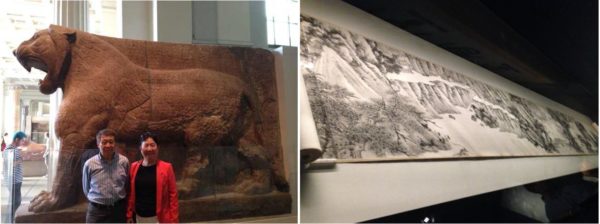
On July 23rd (Wednesday), the Li couple took a day trip to Windsor on their own, departing from Waterloo Station. They conducted a detailed tour of Windsor Castle. After their return to London, Mrs. Zhang developed a fever, and they decided to reschedule their flight to return to China early.
On July 24th (Thursday), the original plan was to go on a walk in the woods near my home and have an academic discussion, but due to their flight departing from Heathrow Airport at 16:45, we skipped the walk. Instead, we had a morning tea chat and lunch. The following photos were taken by Professor Li. At that time, taking photos and shared via WeChat was not very common, so we didn’t take a group photo, but there were individual photos of Mrs Zhang with my mother and me.
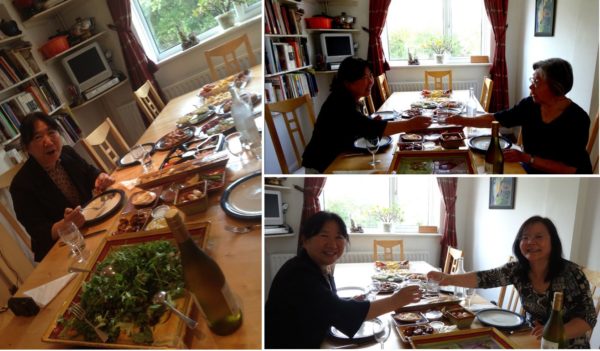
At around 2 pm., we met with LIU Jiayan and her son at Heathrow Airport’s Terminal 2. The child happily and proactively pushed the luggage cart, which everyone admired as a good educational approach. Before parting, we took a group photo in front of a colorful painting advertisement. Reflecting later, this photo carried profound and personal significance, symbolizing academic exchange, friendship, educational inheritance, and family bonds. It recorded an important moment in the scholars’ professional and personal lives, demonstrating their commitment to knowledge, nurturing students, and cherishing family.
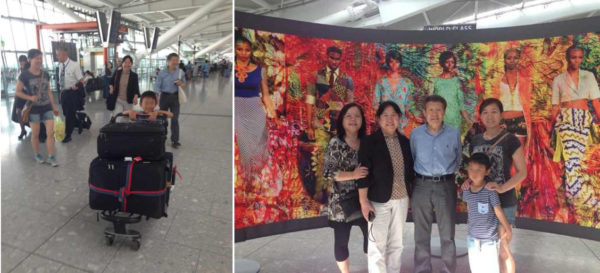
Notes:
- [1] In July 2014, Li Qiang was elected President of the Chinese Sociological Association. He was the sixth president since the association’s founding in 1979, following Fei Xiaotong, YUAN Fang, LU Xueyi, ZHENG Hangsheng, and LI Peilin. This blog was updated after visits by Tsinghua University’s School of Social Sciences and other universities in Beijing and Shanghai to the UK in July-August 2024.
- [2] Starting in 2015, the second to the eighth Global China Dialogue series were all held at this location until 2023.
- [3] Li Qiang also served as the Honorary Chinese President of the Global China Institute (alongside Martin). After the institute was renamed the Global China Academy and restructured into a worldwide fellowship, Li Qiang served as the Chinese chair of the Academy’s Council, alongside Professor Tony McEnery, former Interim Chief Executive of the UK’s Economic and Social Research Council (ESRC), which is equivalent to China’s National Philosophy and Social Sciences Foundation.
- [4] Professor Li, together with Mr. LI Tie, former Director of the China Center for Urban Development and Small Towns Reform, co-edited the ‘China Urbanization Studies Series,’ published by Global Century Press, with Dr. Liu serving as the Executive Editor.
- [5] Xiangqun Chang, Guanxi or Li shang wanglai? Reciprocity, Social Support Networks, & Social Creativity in a Chinese Village (Scholarly Publishing Business, Airiti Press Inc. 2010; Chinese editions 2009 and 2010): ‘In 2005 there was an exhibition of “China: Three Emperors (1662–1795)”. David Hockney, the Fellow of The Royal Academy of Arts, commented that the Chinese paintings deployed multiple perspective points in a single painting, which is different from the single perspective point in Western painting. For him, Western history of art has long neglected the beauty and sophistication of the Chinese scroll painting (A typical example is the Qingming Riverside Painting)’. From Hockney’s point of view, the scroll painting ‘bears close resemblance to cinema pictures by offering a sense of pleasure at being part of the painting. As the Chinese painting has no vanishing point, its viewer has to assume a participatory approach, rather than a static posture, through which to engage him or herself, including eyes, body and psyche into the story-telling and moving with the scroll part by part” (David Hockney, “A Difference of Perspective”, in “Three Emperors, 1662–1795”, RA Magazine, Winter, 2005). Chang believes that western social science is more focused on a detailed analysis of specific issues, while the Chinese way is to offer a combined approach to several issues together. Her ‘book is an attempt to present to its readers a huge scroll painting of the complicated relationships in the everyday life of a Chinese village. It is nonetheless not totally Chinese, just as sometimes in the West a few miniatures can be presented on one big wall. In this case they are embedded in the Chinese scroll. Hockney’s prescription of how to appreciate Chinese painting might be helpful for readers in their approach to this book’ (Chang, 2010, p42-43).
Xiangqun Chang, originally posted on July 30, 2014; updated on August 30, 2024.
Related pages:
- Click here to the Chinese page.
- Click here to view the page ‘GCA Life Fellow Korean Sociologist Professor HAN Sang-Jin Meeting Professor Xiangqun Chang at Seoul, January 2023.’
- Click here to the news ‘The Chinese Chair of the Global China Aacademy Council, Professor LI Qiang, passed away on the 12 December, 2023’.
- Click here to watch a video of Professor LI Qiang’s greeting for the launch of the Global China Academy as an academy at the 7th Global China Dialogue, on December 10th, 2021, at the British Academy.
- Click here to visit News and Blog.

华人思维方式与一般社会科学方法之比较
2011年,林毅夫的《本体与常无:经济学方法论对话》(亚马逊Kindle版本,见封面中间图)出版。作者是北京大学教授,时任世界银行首席经济学家和高级副行长。这是其中文著作《论经济学方法,与林老师对话》(2005年由北京大学出版社出版)的翻译版本(左侧为原版封面;右侧为2012年出版的第二版封面)。此书的重要的见解,尤其是书名“本体与常无”引起了伦敦政治经济学院(LSE)中国比较研究网(CCPN)的关注,因为该书融入了多种中国传统文化元素,尤其是“本体与常无”这一中国哲学概念。该概念是道家哲学的核心,体现了“无”的思想,代表着一种虚静和无限的状态,反映了东方文化对世界的理解与探索。
中国比较研究网(CCPN)决定邀请林毅夫教授做一次华人思维方式与一般社会科学方法比较的对话。2012年3月6日(星期二),伦敦政治经济学院(LSE)理事会批准了授予林毅夫荣誉博士学位的提议。他将被授予2012年度LSE荣誉学位的科学博士(经济学),该荣誉每年授予一人。此次提名由CCPN主任邓肯博士提出,并得到了经济史系主任珍妮特·亨特Janet Hunter 教授和经济系教授兼中国比较研究网(CCPN)管理委员会主席柯成兴Danny Quah教授的支持。林毅夫教授计划于12月18日在LSE出席颁授典礼。中国比较研究网(CCPN)联席主任常向群博士策划并组织了一场题为“华人思维方式与一般社会科学方法之比较”的研讨会。
林教授要求所有研讨会的参与者从亚马逊购买Kindle版本的书籍,并在研讨会前阅读。这本书是林教授在2003年和2004年于北京大学教授转型经济学课程期间,与研究生进行的对话集,并附有三篇期刊文章作为附录。该书以问答形式呈现,讨论了如何创造性地进行经济研究,并基于现象的深入分析构建自己的理论框架和模型。作者还强调了中国经济学家在研究中采用国际公认规范的重要性,同时聚焦本土问题,并对现有新古典理论在解释发展中国家发展与转型时的局限性进行了批判性反思。
主要特点
- 由中国最知名的经济学家之一撰写
- 采用教授与学生之间简单的问答形式编写
- 讨论如何创造性地进行经济研究,
- 并基于深入的现象分析构建自己的模型 对现有新古典理论在解释发展中国家的发展与转型时的局限性进行批判性反思
目录
- 主流原则与前提
- (不)适用于中国
- 经济学的理论创新
- 附录1. 本土化、规范化与国际化——纪念《经济研究》创刊40周年
- 附录2. 经济研究方法与中国经济学科的发展
- 附录3. 自生能力、经济转型与对新古典经济学的反思

CCPN提出了一些问题供林教授讨论:
- Benti and changwu (本体与常无): 你说’理性是经济学的共同基础前提,核心或本体’,……人都是理性的,到处都是一样的,但决策者有非常不同的约束和机会成本 (15-16%; 9-10页)。 常无是一个不断变化的社会和经济现象的思维定式,即从任何现有的理论约束中解放出来 (20-21%)。 你也说“一个逻辑的和内部一致的理论体系可以在一个基本不变的前提下建立,例如儒家哲学是建立在维持不变的仁的美德之上。符合仁的行为是义,而判断哪些行为是义的及可以达到仁是智(智慧)或礼和信(信任)。环境和条件不同,因此实现仁的方式可能有所不同 (29-30%; 37-38页)。问题:本体和常无这对中文词汇是否只是给了经济学一个方法论或它们也可以被伸展到其他社会科学方法论?例如中国有句话“以不变应万变” (保持不变以应对所有变化 – 通过坚持一个固定的原则或政策来应对一个不断变化的情况)。这里不变的是本体,那么是不是所有的变化都是常无?
- 中国比较研究: 在回答 ‘为什么强调方法论 (13-14% Kindle; 5-6页 中文版)’的问题中, 你比较中国与‘亚洲四小虎’的快速发展, 提到‘后发优势’及前苏联及东欧的无秩序过渡的‘震荡治疗’: 你用中国作为一个比较对象与其它国家和地区比较的方法与我们用的‘中国比较研究’相似。 你可不可以用两个例子去显示你的工作中有那些理论直接得益于应用这个方法?
- 严格的或超越逻辑证明: 一方面,你同意“数学是为了使经济理论更严格”而这是很重要的; 另一方面,你说“有时要为严谨牺牲相关性”。当你讨论经济方法论的时候你提到中国古典文学,语言,诗歌形式,烹饪,绘画,艺术,及能够从数以千计的可能因素中发现最重要的变数的本能等 (17-19%; 8,13-14页)。 问题: 这与中国学者的风格很相似, 像费孝通。费孝通的《乡土中国》的译者韩格理 Gary Hamilton用这本书作为一个例子去显示“费孝通是他研究那些超出了逻辑证明的一个同情的理解” (2011), 虽然严格来说这本书并不像一本社会科学研究的著作。你觉得中国社会科学家的这种写作风格是中国社会科学方法论的一个特点吗?
- 当地人研究他们自己的社会的优点或缺点: 一方面,你说“大多数人将理论看作真理和认为当一个理论适用于一个地方, 它必定是普遍适用的’, 当一种理论适合所有, 强调理论的创新性和实用性的时候 (20%; 18页)。另一方面,你说“21世纪是一个中国经济学家的世纪”, 因为从18世纪工业革命到第一次世界大战, 世界上最大和最强的经济体是英国。英国经济学家享有一个有利的位置去观察和研究在那里发生了什么。英国是世界经济研究中心及大多数世界级的经济学家在那里出现, 像一句中国说话 ‘近水楼台先得月’ (60-62%; 90-91页)。问题: 这与费孝通强调本地人研究本地社会的好处的方法论相似。但是, Edmund Leach (1982) 批评一些中国学者的工作, 包括费孝通在开弦弓的工作, 因为他们对他们的本地文化太了解及在他们的工作中不正当地利用了它们; Leach还批评了简单地基于一个本地的研究而推广到全中国及一个很长的中国历史的企图。什么是当地人研究当地社会的优势?
- 多重现象的结合: 你总结你的方法为“一个分析和三个归纳”。三个归纳包括一个横向的方法, e.g. 与一些采用计划经济的社会主义国家, 及与并非社会主义国家的印度和很多拉丁美洲国家作比较; 及一个垂直的方法, e.g. 从一个历史的纵向的角度来看, 计划经济是在1929年在前苏联推出的; 第三个归纳方法是‘综合多种现象’, 经济学家在既定的时间和地点对很多现象进行一个综合分析, 并期待他们背后有一个共同的原因, 而不是逐一分析它们 (35-36%; 45-47页). 问题: 这像很多中国学者, 如《黄河边的中国》的作者 曹景清 (2000); 常向群 (关系或礼尚往来? — 在一个中国乡村的互惠, 社会支持网络和社会创造性, 2010) 在她的田野调查中发现通常有多个标准适用于判断任何一个关系, 使满足它们的全部或尽可能多, 一个同时被社会赋予价值和那些行使它的人享受的挑战性任务。你认为你的‘三个归纳’, 特别是第三个, 是中国的思维方法吗?
- 学问之道: 这是书的英文版其中一个被遗漏的附件。你解释‘道’是做好人(个人行为), 做好事及专注做学问的目标, 标准和方法。根据道, 学者应该有广博的知识及深入和小心地思考。大师应该从他们的心底关心人和社会, 将社会的兴衰当作自己使命, 有历史和全球视野, 高尚精神等 (129-145页)。 问题: 从古代中国开始这已经是一个非常流行的思想。为什么你在英文版中遗漏了这个思想? 这个中国的思想和做研究方法怎样影响它们的结果?
由中国比较研究网(CCPN)联席主任常向群博士组织的研讨会于2012年12月18日上午8:30至10:00在人类学系的塞利格曼图书馆顺利举行。研讨会由CCPN创始主任王斯福Stephan Feuchtwang 教授主持。主讲人概述了他在经济和发展研究领域的理论贡献,这些贡献源于他对中国的广泛研究,并在方法论上受到华人思维方式的丰富启发,这在其创新的教学方法中有所体现,详见《本体与常无:经济学方法论对话》(2012)。此书是原版中文著作(《与林老师对话:论经济学方法论》,2005)的英文版。在概述之后,主讲人与LSE的学者和学生展开了一场富有见地的对话。研讨会作为一次思想探索,展示了华人思维方式如何从经济学扩展到其他社会科学学科,强调了这种方法的跨学科相关性。此次活动吸引了多位知名学者参与,包括中国比较研究网(CCPN)高级研究员、英国社会学协会前会长马丁·阿尔布劳 Martin Albrow 教授,以及英国全球政策研究所副主任兼英国未来项目负责人、《马克斯·韦伯研究》期刊主编萨姆·惠姆斯特Sam Whimster 教授。

林毅夫博士介绍
林毅夫博士是世界银行的首席经济师及副行长。他是银行有史以来第一个来自一个发展中国家的首席经济师。此前,林博士曾任北京大学中国经济研究中心创办主任,北京大学和香港科技大学经济学教授。林博士的学术贡献在两个不同的领域。其中第一项是中国经济发展的机制,林博士已经展示了中国的非竞争性产业结构如何与中国的企业的技术能力建设互动。 他已经展示了这种互动如何运作去推动中国的快速增长和技术进步,并有助于解释中国的品牌产业政策的成功。
林教授贡献的第二个方面是中国在全球经济中的角色。这超出了传统经济学而是一个结合国际关系和国际政治经济学的经济研究。林博士在他于其中一个全球政策制定中心的现在位置及作为一个经济学者对这方面贡献了他的批判性想法。林博士对中国经济的持续崛起将继续改变全球经济的不同层面作出了严谨的分析, 并澄清了在什么地方危险但是机会也会不断涌现。
林毅夫是一系列书的作者, 包括: 经济发展与转型的提纲和要点: 思想, 战略和自生能力 (2008); 解密中国经济 (2011) 和新结构性经济: 一个重新思考发展和政策的框架 (2012)。林博士的书籍和文章, 其中很多是在顶级期刊发表的, 在越来越多的中国现代经济发展课程的阅读书目找到一个位置。他在2007/8年度在剑桥大学的经济学院发表了有名的 Marshall 讲座, 题为低发展国家的发展策略, 机构和经济表现, 显示他的专长已经远伸延到中国之外。
伦敦经济学院 经济学部 柯成兴Danny Quah 教授
著作选
书籍
- 2012. The Quest for Prosperity: How Developing Economies Can Take Off, Princeton University Press
- 2012. New Structural Economics: A Framework for Rethinking Development Policy, Washington, World Bank.
- 2012. Demystifying the Chinese Economy, Cambridge University Press (English edition) [Special Topics in Chinese Economy, Beijing: Peking University Press, 2008, Chinese Edition]
- 2012. Benti and Changwu: Dialogues on Methodology in Economics, Cengage. (Dialogue with Professor Lin: On Economic Methodology, Peking University Press, 2005, Chinese edition)
- 2010. Selected Works of Lin Yifu, Taiyuan, Shanxi Province: Shanxi Economics Press.
- 2009. The Chinese Economy: Reform and Development, New York: McGraw Hill (with Cai Fang and Yong Cao).
- 2009. Economic Development and Transition: Thought, Strategy and Viability, Beijing: Peking University Press, 2008 (Chinese edition); Cambridge: Cambridge University Press (English edition).
- 2008. Inclusive Growth toward a Harmonious Society in China, Manila: ADB (with Juzhong Zhuang, Min Tang)
- 2007. There Is No Textbook Paradigm for Understanding Chinese Economy, Beijing: China’s Social Sciences Literature Press.
- 2005. Lessons of China’s Transition from a Planned Economy to a Market Economy, Leon Kozminski Academy of Entrepreneurship and Management, Distinguished Lecture Series No. 16.
- 2005. Dialogue with Professor Lin: On Development Strategy, Peking University Press.
- 2004. Viability, Economic Development and Transition, Peking University Press.
- 2004. Development Strategy and Economic Reform, Peking University Press.
- 2004. Development Strategy and Economic Development, Peking University Press.
- 2003. The Chinese Economy, Beijing: China Finance and Economics Publishing House (with Fang Cai).
- 2001. China’s Integration with the World Economy: Repercussions of China’s Accession to the WTO, Seoul, Korea: Korea Institute for International Economic Policy (edited jointly with Kyung Tae Lee and Si Joong Kim).
- 2000. Institution, Technology and Agricultural Development in China, II, Beijing: Peking University Press.
- 2000. China’s State-owned Enterprise Reform (Zhongguo Guoyou Qiye Gaige), Taipei: Linking Press (with Fang Cai and Zhou Li), Chinese University of Hong Kong Press, 2001, English edition.
- 1999. The China Miracle: Development Strategy and Economic Reform, revised and expanded. Shanghai People’s Publishing House and Shanghai Sanlian Shudian (for Mainland China); and Seoul: Baeksan Press, 2001 (Korean edition): Moscow: Far Eastern Institute Press, Russian Academy of Sciences, 2001, Hong Kong, Chinese University Press, 2003 (English edition).
- 1998. Contemporary Economic Issues, Volume 1: Regional Experience and System Reform (Proceedings of the 11th World Congress of IEA, Tunis, IEA Conference Volume No. 121), London: MacMillan Press and New York: St. Martin’s Press.
- 1998. How Did China Feed Itself in the Past? How Will China Feed Itself in the Future? Second Distinguished Economist Lecture, Mexico, D.F.: CIMMYT.
- 1997. Sufficient Information and State Enterprise Reform in China《充分信息与国有企业改革》,中文简体字版,上海人民出版社 , Shanghai: People’s Press and Sanlian Press; Hong Kong: Chinese University Press, Chinese Edition; Hong Kong: Chinese University Press, English edition 1999; Tokyo: Nihon Hyo Ron Sha, Japanese Edition 1998. (with Fang Cai and Zhou Li).
- 1996. Agricultural Research Priorities: A Demand and Supply Analysis of Grain Technology in China, Beijing: Agriculture Press (《中国农业科研优先序》中国农业出版社Chinese with Minggao Shen and Hao Zhou. Book was awarded First Prize, Fifth Scientific Research Award, Peking University).
- 1994. The China Miracle: Development Strategy and Economic Reform, Shanghai People’s Publishing House and Shanghai Sanlian Sudian (for Mainland China); The Chinese University of Hong Kong Press (for overseas1995年 中文繁体字版,香港中文大学出版社), The Chinese University of Hong Kong Press English edition英文版,香港中文大学出版社),Tokyo: Nihon Hyo Ron Sha (Japanese edition日文版,东京日本评论社);Seoul: Baeksan Press (Korean edition文版,汉城白山书社);Ho Chi Minh City: Saigon Times (Vietnamese edition越文版,胡志明市,西贡时报出版社);1998/2000. Paris: Economica (French dition) (with Cai Fang and Li Zhou) 法文版,巴黎Economica出版社;Shanghai People’s Publishing House and Shanghai Sanlian Shudian ( revised version, Mainland China).
- 1994. Nature and impact of hybrid rice in China, IRRI; LRPI, Manila (Philippines)
- 1992. Institution, Technology and Agricultural Development in China, Shanghai: Shanghai Sanlian Shudian (Awarded 1993 Sun Yefang Prize). 《制度、技术和中国农业发展》,上海人民出版社和三联出版社。
- 1991, Economic Development and Transition: Thought, Strategy and Viability, Peking University Press
期刊 (英文)
- “Beyond Keynesianism: Global Infrastructure Investments in Times of Crisis,” Journal of International Commerce, Economics and Policy, forthcoming.
- “From Flying Geese to Leading Dragons: New Opportunities and Strategies for Structural Transformation in Developing Countries,” Global Policy, forthcoming.
- “China’s Integration with The World: Development as A Process of Learning and Industrial Upgrading,” China Economic Policy Review, Vol. 1, No. 1 (March 2012): 1-33.
- “A Pro-Growth Response to the Crisis,” Intereconomics: Review of European Economic Policy, 46(6), Nov/Dec 2011: 321-326.
- “Global Imbalances, Reserve Currency and Global Economic Governance,” Journal for Money and Banking, 60, 11, Nov 2011:2-7.
- “Shocks, Vulnerability and Therapy,” African Development Review, 23 (4), 2011: 371-379.
- “The Coming Multipolar World Economy,” The International Economy, 25 (3), Summer 2011: 30-31.
- “China and the Global Economy,” China Economic Journal, 4(1), Oct 2011: 1-14
- “The Coming Multipolar World Economy: Is the Developed World Prepared?” The International Economy, Summer 2011: 30-31 (with Mansoor Dailami)
- “New Structural Economics: A Framework for Rethinking Development,” World Bank Research Observer, 26 (2), Sep 2011: 193-221.
- “Finding a Path to Growth,” This is Africa: A Global Perspective, Jun 8, 2011: 50-51.
- “Understanding Urbanization and Urban-Rural Inequality in China: A New Perspective from Government’s Development Strategy,” Frontier of Economics in China” 2011, 6(1): 1–21 (with Binkai Chen).
- “Growth Identification and Facilitation: the Role of State in the Process of Dynamic Growth,” Development Policy Review, Vol. 29, No. 3 (May 2011), pp. 264-290; “Rejoinder”: 304-309.
- “A Comment on Professor Robert Wade’s Rebuttal,” Global Policy, 2(2), May 2011: 231-2.
- “Beyond Keynes,” World Policy Journal, 28(1), Spring 2011: 35-40.
- “Tiere des lecons du passé pour imagier le future: Opening Remarks: Learning from the past to reinvent the future,” Revue D;’Economie du Developpement,” 2010/4 Decembre, Numero special, Lecons de L’asie de l’est et crise finaniere mondiale: 5-20.
- “Shocks, Crises and Their Determinants,” Middle East Development Journal, 2(2), Dec 2010: 159-76.
- “Six Steps for Strategic Government Intervention,” Global Policy, 1(3), Oct 2010: 330-31.
- “US-China external imbalance and the global financial crisis,” Chinese Economic Journal, 3 (1), Jun 2010): 1- 24 (with Hinh Ding and Fernando Im).
- “Policy Responses to the Global Economics Crisis,” Development Outreach, 11(3), Dec 2009: 29-33.
- “Beyond Keynesianism: the Necessity of a Globally Coordinated Solution,” Harvard International Review, 31(2), Summer 2009:14-17.
- “DPR Debate: Should Industrial Policy in Developing Countries Conform to Comparative Advantage or Defy it?” Development Policy Review, 27 (5), Sep 2009: 483-502 (with Ha-Joon Chang).
- “Innovative R&D and Optimal Investment under Uncertainty in High-Tech Industries: An Implication for Emerging Economies,” Research Policy, 38, 2009:1388-95 (with Yingyi Tsai and Luica Kurekova).
- “Economic Thoughts from an East Asian Perspective: a Conceptual Framework of Viability and Development strategy,” China Economic Journal, 1(3), 2008: 245-74.
- “Policy Burden, Privatization and Soft Budget Constraint,” Journal of Comparative Economics, 36, 2008: 90-102 (with Zhiyun Li).
- “The Needham puzzle, the Weber Question, and China’s Miracle: Long-term Performance since the Sung dynasty,” China Economic Journal, 1, 1, 2008: 63 – 95.
- “Inclusive Growth toward a Harmonious Society in the People’s Republic of China: An Overview,” Asian Development Review, 25 (1-2), 2008:1-14 (with Juzhong Zhuang, Min Tang and Tun Lin).
- “Achieving Equity and Efficiency Simultaneously in the Primary Distribution Stage in the People’s Republic of China,” Asian Development Review, 25 (1-2), 2008: 3457 (with Peilin Liu).
- “Deflationary Expansion: An Overshooting Perspective to the Recent Business Cycle in China,” China Economic Review, 19, 2008: 1-17 (with Gang Gong).
- “Prospect for China-Korea economic relations,” China & World Economy, 14(1), 2006: 57-70.
- “Late Marketisation versus Late Industrialization in East Asia,” Asian-Pacific Economic Literature, 19 (1), May 2005: 42-59 (with Keun Lee and Ha-Joon Chang).
- “Viability, Economic Transition, and Reflection on Neoclassical Economics,” Kyklos, 58 (2), 2005: 239-64.
- “Development Strategies for Inclusive Growth in Developing Asia,” Asian Development Review, 21(2), 2004: 1-27.
- “Rural Taxation and Government Regulation in China,” Agricultural Economics, 31 (2-3), Special Issue, Dec. 2004: 161-68 (with Ran Tao and Mingxing Liu).
- “Reform and Development in China: A New Institutional Economics Perspective,” Seoul Journal of Economics, 17 (3), Fall 2004: 335-81 (with Yingyi Tsai).
- “Viability and the Development of China’s Capital Markets” China & World Economy, 12 (6), 2004: 3-10.
- “Is China’s Growth Real and Sustainable?” Asian Perspective, 28 (3), 2004: 5-29.
- “An Everlasting Inspiration: In Memory of Professor D. Gale Johnson,” Journal of Asian Economics, 15, 2004: 457-60.
- “Regional Inequality and Labor Transfers in China,” Economic Development and Cultural Change, Vol. 52, No. 4 (Jul 2004): 587-603 (with Gewei Wang and Yaohui Zhao).
- “The Causes of China’s Great Leap Famine, 1959-1961,” Economic Development and Cultural Change, 52(1), Oct 2003: 51-74 (with James K.S. Kung).
- “Development Strategy, Viability, and Economic Convergence,” Economic Development and Cultural Change, 51(2), Jan 2003: 277-308.
- “Is China Following the East Asian Model? A ‘Comparative Institutional Analysis’ Perspective,” China Review, 2(1), Spring 2002: 85-120 (with Keun Li and Donghoon Han).
- “WTO Accession and Financial Market Reform in China,” Cato Journal, 21(1), Spring/Summer 2001: 13-9.
- “The Current Deflation in China: Causes and Policy Options,” Asian Pacific Journal of Economics and Business, Vol. 4, No. 2 (Dec 2000): 4-21.
- “The Development of the Information Industry and the Principle of Comparative Advantage,” World Economy and China, 8 (4), Aug 2000: 3-9.
- “WTO Accession and China’s Agriculture,” China Economic Review, 11(4), 2000: 405-8.
- “Fiscal Decentralization and Economic Growth in China,” Economic Development and Cultural Change, 49 (1), Oct 2000): 1-20 (with Zhiqiang Liu).
- “Food Availability, Entitlements and the Chinese Famine of 1959-61,” Economic Journal, 110 (460), Jan 2000: 136-158 (with Dennis Tao Yang).
- “Consequences des Reformes Economicques sur les Disparites Regionales en Chine” Revue d’Economie du Development, 1-2, 1999: 7-32.
- “Policy Burdens, Accountability, and the Soft Budget Constraint,” American Economic Review: Papers and Proceedings, 89 (2), May 1999: 426-31 (with Guofu Tan).
- “Technological Change and Agricultural Household Income Distribution: Theory and Evidence from China,” Australian Journal of Agricultural and Resource Economics 43(2), Jun 1999: 179-194.
- “Fair Competition and China’s State-owned Enterprises Reform,” MOCT-MOST: Economic Policy in Transitional Economies, 9 (1), 1999: 61-74 (with Fang Cai and Zhou Li).
- “On the Causes of China’s Agricultural Crisis and the Great Leap Famine,” China Economic Review, 9 (2), Fall 1998: 125-40.
- “Competition, Policy Burdens, and State-owned Enterprise Reform,” American Economic Review: Papers and Proceedings, 88 (2), May 1998: 422-27.
- “Institutional Reforms and Dynamics of Agricultural Growth in China,” Food Policy, 22 (3), 1997: 201-12.
- “China Miracle: Development Strategy and Economic Reform,” Asia-Pacific Development Journal, 4(1), Jun 1997: 165-69. (with Fang Cai and Zhou Li).
- “The Lessons of China’s Transition to a Market Economy,” Cato Journal, 16 (2), Fall, 1996: 201-31.
- “Current Issues in China’s Rural Areas,” Oxford Review of Economic Policy, 11 (4), Jan 1996: 85-96.
- “China’s Regional Grain Self-sufficiency Policy and Its Effect on Land Productivity,” Journal of Comparative Economics, 21, 1995: 187-206 (with Q. James Wen).
- “Endowments, Technology and Factor Markets: A Natural Experiment from China’s Rural Institutional Reform,” American Journal of Agricultural Economics, 77 (2), May 1995: 231-242.
- “Can China’s Mini-bang Succeed?” Contemporary Economic Policy, 13, January 1995: 10-14.
- “The Needham Puzzle: Why the Industrial Revolution Did Not Originate in China?” Economic Development and Cultural Change, 41, January 1995: 269-92.
- “The Impacts of Hybrid Rice on Input Demand and Productivity: An Econometric Analysis,” Agricultural Economics, 10, 1994: 153-64.
- “Exit Rights, Exit Costs, and Shirking in the Theory of Cooperative Team: A Reply,” (a reply to 1990 JPE article for symposium) Journal of Comparative Economics, 17, Jun 1993: 504-20.
- “The Determinants of Farm Investment and Residential Construction in Post-Reform China,” Economic Development and Cultural Change, 41, Oct 1992: 1-26 (with Feder, Lau, and Luo).
- “Hybrid Rice Innovation in China: a Study of Market-Demand Induced Innovation in a Centrally-Planned Economy,” Review of Economics and Statistics, 74, Feb 1992:14-20.
- “On the Development Strategy of an Externally Oriented Economy,” Chinese Economic Studies, 25 (Spring 1992): 53-66.
- “Rural Reforms and Agricultural Growth in China,” American Economic Review, 82, Mar 1992: 34-51.
- “Public Research Resource Allocation in Chinese Agriculture: A Test of Induced Technological Innovation Hypotheses,” Economic Development and Cultural Change, 40 (1), Oct 1991: 55-74.
- “Supervision, Peer Pressure, and Incentives in a Labor-Managed firm,” China Economic Review 2, Oct 1991: 213-29.
- “Education and Innovation Adoption in Agriculture: Evidence from Hybrid Rice in China,” American Journal of Agricultural Economics, 73, Aug 1991: 713-24.
- “The Household Responsibility System Reform and the Adoption of Hybrid Rice in China,” Journal of Development Economics, 36, Jul 1991: 353-72.
- “Prohibition of Factor Market Exchanges and Technological Choice in Chinese Agriculture,” Journal of Development Studies, 27, July 1991: 1-15.
- “Collectivization and China’s Agricultural Crisis in 1959-1961,” Journal of Political Economy, 98, Dec 1990: 1228-52. (Journal of Comparative Economics,17, Jun 1993; a six-article symposium on this paper).
- “The Relationship between Credit and Productivity in Chinese Agriculture: An Application of a Microeconomic model of Disequilibrium,” American Journal of Agricultural Economics, 72, Dec 1990(with Feder, Lau, and Luo).
- “An Economic Theory of Institutional Change: Induced and Imposed Change,” Cato Journal, 9, Sep 1989: 1-33.
- “Agricultural Credit and Farm Performance in China,” Journal of Comparative Economics, 13, 1989: 508-26 (with Feder, Lau, and Luo).
- “The Household Responsibility System in China’s Agricultural Reform: A Theoretical and Empirical Study,” Economic Development and Cultural Change, 36, Apr 1988: S199-S224.
- “The Household Responsibility System Reform in China: A Peasant’s Institutional Choice,” American Journal of Agricultural Economics, 69, May 1987: 410-15.
期刊 (中文)
- “Capital Accumulation and Optimal Bank Size,” China Economic Quarterly, 7 (2), 2008.
- “Debates on East Asian Development Model Revisited,” Jinji yanjiu (Economic Research), Aug 2007 (with Ruoen Ren).
- “Over Response: An Explanation for China’s Deflationary Growth,” Jingji yanjiu (Economic Research), Apr 2007 (with Gang Gong).
- “Wave Phenomenon and the Reconstruction of Macroeconomics in Developing Countries,” Jinji yanjiu (Economic Research), Jan 2007.
- “Needham Puzzle, Weber Question, and China’s Miracle,” Peking University Bulletin, 44 (4), Jul 2007.
- “Reflection and Proposal on the Exchange Rate Issue of Chinese Yuan,” Guoji jingji pinglun (International Economic Review), 5-7, 2007.
- “Appropriate Technology, Technology Choice and Economic Development in Developing Country,” Jingjixue Jikan (China Economics Quarterly), 5 (4), 2006 (with Pengfei Zhang).
- “Technology Choice, Institution, and Economic Development,”Jingjixue Jikan (China Economics Quarterly) 5(3), 2006 (with Pengfei Zhang).
- “Advantage of backwardness, Borrowed Technology, and Economic Development in Developing Countries,” Jingjixue Jikan (China Economics Quarterly) 5 (1), 2005 (with Pengfei Zhang).
- “On the Reform of China’s State-owned Enterprise and Financial System,” Jingjixue Jikan (China Economics Quarterly), 4(4), 2006 (with Zhiyun Li).
- “Economic Structure, Banking Structure and Economic Development: Empirical Evidence from China’s Province Level Panel Data,” Jingrong yanjiu (Financial Research), 1, 2006 (with Ye Jiang).
- “Development Strategy, Economic Structure, and Banking Structure: Empirical Evidence from China,” Guanli shijie (Management World), 12, 2005 (with Ye Jiang).
- “New Village Construction Is A Mean and An End As Well,” Gaige (Reform) Mar 2006.
- “Reflection on the New Village Construction,” Zhongguo jingji guancha, (China Economic Observer) 1, 2006.
- “Trend of Economic Development and Cooperation Across the Taiwan Straits,” Guoji maoyi wenti (International Trade Issue), Feb 2006.
- “China’s Employment Issue and Policy Option,” Jingjixuejia (Economist), Jan, 2006.
- “China’s Regional Disparity and Labour Migration,” Zhongguo laodongli jingjixue (China Labour Economics), 3, 2005.
- “China’s State-owned Enterprise Reform and Financial System Reform,”Jingjixue Jikan (China Economics Quarterly), 4 (4), 2005. (with Zhiyun Li).
- “Advantage of backwardness, Borrowed Technology, and Economic Growth in Developing Countries,” Jingjixue Jikan (China Economics Quarterly), 5(1), Nov 2005 (with Pengfei Zhang).
- “Whither is China’s Economics?” 21 shiji jingji baodao (21st Century Economic Herald), Sep 2005.
- “Information, Informal Credit and Small and Medium Firm’s Finance,” Jingji Yanjiu (Economic Research), Jul 2005. (with Xifang Sun)
- “Poverty, Growth and Equity: China’s Experience and Challenge,” Zhongguo guoqing guoli (State Condition and Strength of China), 8, 2004 (with Peilin Liu)
- “Policy Burdens and Soft Budget Constraint: Empirical Evidence from China,” Guanli shijie (Management World), 8, 2004 (with Qi Zhang and Mingxing Liu)
- “Development Strategy and China’s Industrialization,” Jingji yanjiu (Economic Research), 7, 2004 (with Mingxing Liu).
- “Policy Burden, Moral Hazard and Soft Budget Constraint,” Jingji yanjiu (Economic Research), 2, 2004.
- “Ten Strategic Issues for the Eleven Five-year Plan,” Hongguan Jingji Yanjiu (Macroeconomic Research), 1, 2004.
- “The International Comparison and Empirical Analysis of Banking Structure,” zhongguo jinrongxue (China Financial Economics), 2(1), 2004 (with Qi Zhang and Mingxing Liu).
- “WTO Accession and China’s Grain Security and Rural Development,” Nongcun jingji wenti (Rural Economic Issues), 1, 2004.
- “The Comparative Advantage Strategy in Economic Development: A Comment on the Review of China’s Foreign Trade Strategy and Trade Policy,” Guoji jingji pinglun (International Economics Review), 11-2, 2003 (with Xifang Sun)
- “Comparative Advantage Strategy and the Revival of Old Industrial Base in Northeast,” Jingji yaocan (Economic Reference), 74, 2003.
- “Economic Growth, Convergence and Income Distribution in China,” Shijie jingji (World Economy), 8, 2003 (with Peilin Liu).
- “Comparative Advantage, Competitive Advantage and Developing Countries’ Economic Development,” Guanli shijie (Management World), 7, 2003.
- “China’s Economy and Education in the Transition Period,” Zhongguo jiaoyu guoji luntan (China International Education Forum) 2, 2003.
- “The Impact of Economic Development Strategy on Per Capita Capital Accumulation and Technological Progress,” Zhongguo shehui kexue (China Social Science), 4, 2003.
- “Economic Development Strategy, Equity and Efficiency,” Jingjixue jikan (Economics Quarterly), 2(2), 2003.
- “Financial Structure and Economic Growth: the Example of Manufacturing Industries,”Zhongguo shehui kexue pinglun (China Social Science Review), 2, 2003.
- “Economic Development Strategy and Regional Income Disparities,” Jingji Yanjiu (Economic Research), 3, 2003.
- “Economic Development and Chinese Culture,” Zhanlue yu Guangli (Strategy and Management), 2, 2003.
- “Rural Problems and Future Rural Development in China,” Nongye Jingji Wenti, (Issues in Agricultural Economics),1, 2003.
- “Economic Development Strategy, Equity, and Efficiency,” Jingjixue Jikan (China Economic Quarterly), 2(2), Jan 2003.
- “Viability, Transition, and Reflection of Neo-classical Economics,” Jingji Yanjiu (Economic Research), 2002 No. 12.
- “How to Develop Small and Medium Banks,” Caijing (Finance), Nov. 5, 2002.
- “New Thoughts Are Needed for Solving Rural Poverty,” Beijing Daxue Xuebao (Peking University Bulletin), 5, 2002.
- “China’s Urban Development and Rural Modernization,” Beijing Daxue Xuebao (Peking University Bulletin), 4, 2002.
- “China’s Development and the Future of Asia,” Xueshu Yuekan (Academic Monthly), Oct. 2002.
- “Comparative Advantage and Poverty Reduction,” Liaowang (Perspective), Apr 8, 2002.
- “Development Strategy, Viability and Economic Convergence,” Jingjixue Jikan (China Economic Quarterly), 1(2), 2002.
- “Viability and the Root of Transition Problems,” Jingji Shehui Bijiao (The Economic and Social System Comparison), 2, 2002.
- “On the Future of Second Board in China’s Stock Market, II,” Gaige (Reform), 2, 2002.
- “A Centennial Review of Economics in China,” Jingjixue Jikan (China Economic Quarterly), 1(1), Oct 2001.
- “The Impact of WTO Accession on China’s Manufacture Sectors,” Hongguan Jingji Yanjiu (Research on Macro Economics), 9, 2001.
- “Viability and State-own Enterprise Reform,’ Jingji Yanjiu (Economic Research), 9, 2001.
- “The Prospect of Second Board in China’s Stock Market,” Ziben Shichang (Capital Market), 2001 No. 8.
- “New Economy and Traditional Industry,” Zhongguo Guoqing Guoli (State Condition and Strength in China),” 5, 2001.
- “The Marketization of State Asset,” Ziben Shichang (Capital Market), 5, 2001.
- “Research Methodology and the Development of Economics in China,” Jingji Yanjiu (Economic Research), 4, 2001.
- “Models of Financial Development,” Ziben Shichang (Capital Market) 3, 2001.
- “WTO Accession and State-owned Enterprise Reform,” Guanli Shijie (Management World) 2, 2001.
- “The Development of Small and Medium Financial Institutions and the Finance of Small and Medium Enterprises,” Jingji Yanjiu (Economic Research) 1, 2001.
- “The Impact of Globalization and Biotechnology in Asia-Pacific Regions,” Nongye Jingji Wenti (Issues in Agricultural Economics) 1, 2001.
- “Development Strategy and Financial Crisis in East Asia,” Gaige (Reform), 2001 No. 1 (with Yongjun Li).
- “Why Do Deflation and High Growth Happen Simultaneously?” Shehui Kexue Zhanxian (Social Sciences Frontier), 2000 No. 6.
- “Financial Integration and Asian Financial Crisis,” Yuandong Jingji Huabao (Far Eastern Economics) 2000 No. 12.
- “An Overview of China’s Economic Research in 1999” Jingji Yanjiu (Economic Research) No. 11.
- “WTO and Mainland Economics,” Zhongguo Shiwu (China Affairs) 2000 No. 2.
- “Comparative Advantage and the Development of Information Industry in China,” Shanghai Jingji Yanjiu (Shanghai Economic Research) 2000 No. 9.
- “Viability, Policy Burden, Accountability and Soft-budget Constraints,” Jingji Shehui Tizhi Bijiao (Comparison of Economic and Social Systems) 2000 No. 4.
- “The Prospect of Complete Circulation of State Stocks,” Ziben Shichang (Capital Market) 2000 No. 8.
- “Price Cartel Should Be Prohibited,” Renmin Ribao (People’s Daily) Jul 17, 2000.
- “Rural Infrastructure Development and the Rural Market,” Nongye Jingji Wenti (Issues in Agricultural Economics) 2000 No. 7.
- “Small and Medium Banks and Financial Development,” Zhongguo Jingmao Daokan (China Herald of Economy and Trade) 8, 2000.
- “WTO Accession: Challenges and Opportunities,” Guoji Jingji Pinglun (International Economic Review), 5, 2000.
- “Suggestions for Sustainable Development,” Gaige Neican (Internal Reform Reference) 8, 2000.
- “New Rural Movement,” Zhongguo Nongcun (China’s Villages) 4, 2000.
- “Debt-Stock Swap and State-owned Enterprise Reform,” Ziben Shichang (Capital Market), 4, 2000.
- “The Current Deflation in China: Causes and Options,” Ziben Shichang (Capital Market), 2, 2000.
- “The Direction of China’s Financial System Reform,” Zhongguo Jingmao Daokan (China Herald of Economy and Trade), 17, 1999.
- “Comparative Advantage and Economic Development: A Reinterpretation of East Asian Miracle,” Zhongguo Shehui Kexue (China Social Sciences) 5, 1999.
- “Problems in China’s Long-term Development,” Zhongguo Jingmao Daokan (China Herald of Economy and Trade) 5, 1999.
- “Self Regulation in Price is Inappropriate,” Zhongguo Gaige (China Reform) 1, 1999.
- “Chinese Economy in the New Millennium,” the Twenty-first Century, 51, Feb 1999: 139-47.
- “Reform and Development: Lessons from East Asian Transition.” Chinese Social Sciences Quarterly (Hong Kong) Autumn Issue, Aug 1998.
- “China’s Grain Supply Capacity in the Past and Future,” Strategy and Management, 4, 1998: 82-90.
- “China’s Regional Income Disparity: Trend and Causes,” Jingji yanjiu (Economic Research), 6, 1988.
- “Experiences and Lessons from Southeastern Asian Financial Crises and Industrial Development Policy of China,” Economic Science, 2 (106), 1998.
- “On the problems of and policy options for China’s State-owned Enterprise: A Response to the Critiques,” Chinese Social Sciences Quarterly, Winter 1997.
- “On the Relationship between the Connotation of Modern Enterprise System and the Aim of State-owned Enterprise Reform,” Jingji Yanjiu (Economic Research), 3, 1997.
- “On the Relationship between future Supply and Demand of China’s Grain,” Liaowang Zhoukan (Outlook Weekly), 35, 1996.
- “Localization, Formalization, and Internationalization: Celebration for the 40th Anniversary of Jingji Yanjiu,” Jingji Yanjiu (Economic Research), 10, 1995.
- “The Current Problems and Policy Options in China’s Rural Economy,” Jingji Yanjiu (Economic Research), 6, 1995.
- “The Core for State Enterprise Reform is to Create A Fair Competition,” Gaige (reform), 5, 1995.
- “A Study on Grain Yield Potential and Research Priority,” Zhongguo Nongcun Guancha (Chinese Rural Observation), 2, Mar 1995.
- “Grain’s Yield Potential and Prospect for Output Increase in China,” People’s Daily, Mar 10, 1995.
- “The Choice of Development Strategy is the Key to the Success of Reform and Development,” Jingji Kexue (Economic Science), No. 3, 1994. (also appeared in the Xinhua Digest, no. 9, 1994).
- “State, Industrial Policy and Economic Development,” China Industrial and Commercial Time, Apr 5, 1994.
- “Some Theoretical Issues Related to Current Market Economy Reforms in Rural China,” Economics News, Mar 3, 1994.
- “Let’s Work Together to Build Chinese Economist’s Century,” Economics News, Jan 27, 1994.
- “An Analysis of the Situation of Grain Market in 1993 and the Policy of Liberalizing the Price While Guaranteeing the Quantity of Purchase,” Economics News, Jan 20, 1994.
- “Changing the Strategic Goal is China’s Key to the Road of Giant Dragon,” Mingbao, Jan 13, 1994.
- “A Lesser-making Power for the State-owned Enterprises and Guarding Against Encroachment by Management Power on Ownership,” Economic Herald, 6, 1993.
- “On China’s Gradual Approach to Economic Reform,” Jingji Yanjiu (Economic Research), 9, 1993.
- “The Comparison and Selection of Direct Finance by Stocks and Indirect Finance by Bank,” Jinrong Yanjiu (Journal of Financial Research) 5, 1993.
- “Reforming the Financial Policy and System So As to Put the Economy on a Virtual Circle,” Gaige (Reform), 3, 1993.
- “The Main Issues and Solutions of the Current Economic Reforms,” Liaowang Zhoukan (Outlook Weekly, overseas ed.), 10, 1993.
- “The Precondition for Market Development: Changing the Functions of Government,” Zhongguo Nongmin (Chinese Peasant), 2, 1993.
- “Reforms and Development in China’s Socialist Economy,” China Social Sciences Quarterly (Hong Kong), 1, 1, Nov. 1992.
- “On the Relationship between Share-holding System and Reforms of Large and Medium State-owned Enterprises,” Jingji Yanjiu (Economic Research, monthly), 9, 1992.
- “Market Development: The Mainline of Rural Reforms in 1990s,” Nongye Jingji Wenti (Agricultural Economic Problems), 9, 1992.
- “Building Socialism with Chinese Characteristics by Reforms and Development,” Lilun Cankao (Theoretical Reference), 5, 1992.
- “Making the Correct Strategic Choices is the Key to Economic Development,” Jingji Shehui Tizhi Bijiao (Journal of Comparative Social and Economic System, Bimonthly) 1, 1992.
- “China’s Agricultural Mechanization Movement,” Nongye Jingji (Journal of Agricultural Economics) (Taiwan), Spring 1991.
- “Technological Choice and Innovation in Chinese Agriculture,” Jingji Shehui Tizhi Bijiao (Journal of Comparative Social and Economic System, Bimonthly), 2, 1990.
- “The Major Economic Issues and the Way out in China’s Economic Reform,” Zhongguo: Gaige Yu Fazhan (China: Development and Reform, Monthly), 7, 1989.
- “On the Rational Sequences and Breakthrough Point of Economic Reform in China,” Jingji Shehui Tizhi Bijiao (Journal of Comparative Social and Economic System), 3, 1989.
- “Plight and Choice: on the Development Strategy and Economic Reform in China,” Jingji Yanjiu (Economic Research), 3, 1989.
- “On Inflation and Its Way out in China,” Fazhan Yanjiu Tongxun (Bulletin of Development Studies) 2, 1989.
- “A Survey of Western General Theory of Agricultural Development,” Nongye Jingji Wenti (Problems of Agricultural Economy) 11, 1988.
- “On the Grain Policy,” Jingji Yanjiu (Economic Research, Monthly), 6, 1988.
- “On the Outward-Oriented Development Strategy,” Jingji Shehui Tizhi Bijiao (Journal of Comparative Social and Economic System), 4, 1988.
- “Small Peasant and Economic Rationality,” Nongcun Jingji yu Shehui (Rural Society and Economy), 3, 1988.
- “On Institution and Institutional Changes” Zhongguo: Gaige Yu Fazhan (China: Development and Reform) 4, 1988.
- “Trade Policy and Economic Development: On China’s Development Strategy,” Jingji Cankao (Economic Reference), Mar 8, 1988.
- “Resource Allocation and Incentive Mechanism in a Labor-managed Firm,” The Chinese Intellectual, 3 (2), winter 1987): 54 – 59.
- “Theodore W. Schultz,” in Nobel Laureates in Economics. Sichuan: People’s Press, 1986.
- “A Marxian Approach to the Theory of Interest,” Jinrong Yanjiu (Journal of Financial Research) Nov 1984.
- “The Mechanism of Resource Allocation in a Socialist Economy,” Jingji Yanjiu Cankao (Journal of Economic Research Reference), Mar 1982.
- “On Market Socialism,” Jingji Dongtai (Journal of Development in Economics), Feb 1981.
- “On Oskar Lang’s Socialist Model,” in Economic Thoughts: Papers in Honor of Professor Chen Daisun, Peking University Press, 1981.
书中章节 (英文) 等见英文版
相关资料
(韩志豪译)
点击这里进入英文网页

Chinese way of thinking and general social scientific methodologies in comparison
In 2011, Benti and Changwu: Dialogues on Methodology in Economics (Amazon Kindle version, see the middle image of the covers) by Justin Yifu Lin was published. The author is a Professor at Peking University and then Chief Economist and Senior Vice President at the World Bank. The English version is a translation of his Chinese book On Economic Method, Dialogue with Professor Lin, published by Peking University Press in 2005 (see the cover on the left; the cover on the right is the second edition, published in 2012). This book offered significant insights, and the main title, Benti & Changwu, attracted the attention of the China in Comparative Perspective Network (CCPN) at LSE. The book incorporates multiple elements of traditional Chinese culture, particularly the Chinese philosophical concept of ‘Ontology and Wu.’ This concept, central to Daoist philosophy, embodies the notion of ‘wu’ (non-being), representing a state of tranquility and infinity, and reflects the Eastern cultural approach to understanding and exploring the world.
CCPN decided to engage Professor Justin Lin in a dialogue titled ‘A Comparison between Chinese Ways of Thinking and General Social Science Methodology.’ On Tuesday, 6 March 2012, the LSE Council approved the recommendation to award Justin Yifu Lin an Honorary Doctorate of the School. He was to be awarded the Doctor of Science (Economics) as LSE’s honorary degree for 2012 (one awarded per year). The nomination was made by Dr. Kent Deng, CCPN Director, with the support of Professor Janet Hunter, Head of the Department of Economic History, and Professor Danny Quah, of the Department of Economics and Chair of the CCPN Management Committee. Professor Justin Yifu Lin was scheduled to attend the presentation ceremony at LSE on 18 December. Dr. Xiangqun Chang, Co-Director of CCPN, planned and organized a seminar titled ‘Chinese Ways of Thinking and General Social Science Methodologies in Comparison.’
Professor Lin requested that all seminar participants purchase a copy of the Kindle version from Amazon and read it before the seminar. This book is a collection of Professor Lin’s dialogues with his postgraduate students during a course on transition economics conducted in 2003 and 2004 at Peking University and includes three journal articles as appendices. Presented in a question-and-answer format, the book discusses how to conduct economic research creatively and construct one’s own theoretical framework and model based on in-depth analysis of phenomena. The author also emphasizes the importance of Chinese economists adopting internationally accepted norms in their research while focusing on indigenous problems, and he critically reflects on the limitations of existing neoclassical theories in interpreting the development and transition of developing countries.
Key Features
- Authored by one of the best-known Chinese economists
- Written in a simple question-and-answer format between the professor and his students
- Discusses how to conduct economic research creatively and construct one’s own model based on in-depth analysis of phenomena
- Critically reflects on the limitations of existing neoclassical theories for interpreting the development and transition of developing countries
Table of Contents
- Mainstream Principles and Premises
- (In)applicability to China
- Theoretical Innovations in Economics
- Appendix 1. Indigenization, Normalization, and internationalization: Celebration of the 40th Anniversary of Economic Research
- Appendix 2. Economic Research Methodology and the Development of Economics in China
- Appendix 3. Viability, Economic Transition, and Reflections on Neoclassical Economics

CCPN posed some questions for Professor Lin for discussion:
- Benti and changwu (title of the book): you said ‘rationality is the common foundational premise, the core, or benti (本体) of economics’,… people are rational, everywhere is the same, but decision-makers have very different constraint and opportunity costs (15-16%; p9-10). Changwu is a mind-set of ever-changing social and economic phenomena, namely, to be freed from the constraints of any existing theories’ (20-21%). You also said ‘a logical and internally consistent theoretical system can be built when there is a fundamental unchangeable premise, e.g., Confucian philosophy is built on the virtue of ren (benevolence) which remains unchanged. The behaviour conforming to ren is yi (righteousness), and the ability to judge what behaviour is righteous and can achieve ren is zhi (wisdom), [or li (propriety), xi (trust)]. Circumstances and conditions are different so ways to achieve ren may vary (29-30%; p37-38). Question: Does the pair of Chinese terms benti and changwu just give a methodology for economics or can they be extended to other social scientific methodology? E.g., there is a Chinese saying ‘Yi bubian ying wan bian’ (meeting all changes by remaining unchanged – coping with a constantly changing situation by sticking to a fixed principle or policy). Here unchanged is benti, so are all the changes changwu?
- China in comparative perspective: In answering the question ‘why emphasize methodology (13-14% Kindle; p5-6 Chinese version)’ you compare China with the fast development of ‘four Asian tigers’ when mentioning the ‘advantage of backwardness (后发优势)’, and the ‘shock therapy’ of the chaotic transition of the former Soviet Union and East Europe. Question: The way in which you use China as a comparator to compare with other countries and regions is similar to ‘China in comparative perspective’ that we use. Can you use two examples to demonstrate which theory or theories from your work benefit directly in applying this method?
- Rigorous or beyond logical proof: On the one hand you agreed ‘mathematics was intended to make economic theories more rigorous’ which is important; on the other hand you said ‘sometimes relevance is sacrificed for rigor’. When you discussed economic methodology you mentioned Chinese classical literature, language, poetic forms (shi or ci诗or词), cooking, painting, the arts, and the instinct of being able to discover the most important variables from thousands of possible factors, etc. (17-19%; p8,13-14). Question: This is very similar to a Chinese scholar’s style, e.g. Fei Xiaotong. Gary Hamilton, translator of Fei’s From the Soil (《乡土中国》), uses this book as an example showing ‘what Fei had was a sympathetic understanding of those he studied which went beyond logical proof’ (2011), although strictly speaking this book looks unlike a production of social scientific research. Do you think this writing style by Chinese social scientists is a characteristic of Chinese social scientific methodology?
- Advantage or disadvantage of natives studying their own native societies: On the one hand, you said ‘most people view a theory as the truth and believe that once a theory works in one place, it must be applicable universally’, as one theory fits all, when stressing theoretical innovation and usefulness (20%; p18). On the other hand, you said ‘the 21st century is a century for economists in China’, because from the industrial Revolution in the 18th century to World War I, the largest and strongest economy in the world was the UK. Economists in the UK enjoyed a favourable position to observe and study what happened there. The UK was the world centre for economic research and most world-class economists emerged there, as in a Chinese saying, ‘A waterfront pavilion gets the moonlight first’ (60-62%; p90-91). Question: This is similar to Fei’s Xiaotong’s methodology when he stressed the ‘advantage of natives studying of native societies’. However, Edmund Leach (1982) was critical of some Chinese scholars’ work including Fei Xiaotong’s work in Kaixiangong, as they knew their native culture too well and illegitimately took advantage of it in their work; Leach also criticized the attempt to generalise to the whole of China, and to a long Chinese history, based simply on one local study. What is the advantage of natives studying native societies?
- Synthesis of multiple phenomena: You summarised your methods as ‘one analysis and three inductions’. The three inductions include a horizontal approach, e.g. comparison with some socialist countries which adopted the planned economic system, with Indian and many Latin American countries, which are not socialist countries; and a vertical approach, e.g. from a historical longitudinal perspective, the planned economy was initiated in 1929 in former Soviet Union; the third method of induction is the ‘synthesis of multiple phenomena, in which economists conduct a comprehensive analysis of many phenomena at a given time and place and expect a common cause behind them rather than analysing them one by one’ (35-36%; p45-47). Question: This is similar to many Chinese scholars, e.g. Jingqing Cao (2000), author of Along with the Yellow River (《黄河边的中国》); Xiangqun Chang (Guanxi or Li shang wanglai ? — Reciprocity, Social Support Networks, & Social Creativity in a Chinese Village, 2010), found in her fieldwork that there are usually multiple criteria for judgment appropriate to any one relationship, which makes satisfying all of them, or as many as possible, a challenging task both valued by society and enjoyed by those who exercise it. Do you think your ‘three inductions’, in particular the third one, is the Chinese way of thinking?
- ‘Royal road to study’ (学问之道): this is one of the Appendices that was omitted in the English version of the book. You explained the ‘royal road’ (dao) is the goal, and the standard and method of being a good person (做人self-conduct), doing good things (做事) and indulging in profound scholarship (做学问). According to the dao scholars should have extensive knowledge and think both deeply and carefully. The great masters should from the bottom of their hearts take care of human beings and society; treat the world’s rise and fall as one’s own mission; have historical and global views, Noble spirit, etc. (p129-145). Question: this has been a very popular idea for Chinese scholars since ancient China. Why did you omit this one from the English version? How does THIS Chinese way of thinking and in doing research affect the outcome of their results?
The seminar was held at the Seligman Library, Department of Anthropology, from 8:30 to 10:00 am on 18th December 2012. It was organized by Dr. Xiangqun Chang, Co-Director of CCPN. The seminar was chaired by Professor Stephan Feuchtwang, the Founding Director of CCPN.
The speaker provided an overview of his theoretical contributions to economic and development studies, drawing from his extensive research on China. These contributions are methodologically enriched by the Chinese way of thinking, as demonstrated in his innovative teaching approach, detailed in Benti and Changwu: Dialogues on Methodology in Economics (2012). This work is the English edition of the original Chinese publication (《与林老师对话:论经济学方法论》, 2005). Following this outline, the speaker engaged in an insightful dialogue with LSE academics and students. The seminar served as an intellectual exploration of how the Chinese way of thinking can extend from economics to other social scientific disciplines, highlighting the cross-disciplinary relevance of this approach.
The event saw the participation of distinguished academics, including Professor Martin Albrow, Senior Research Associate of CCPN at LSE and former President of the British Sociological Association, and Professor Sam Whimster, Deputy Director and Head of the UK Future Programme at the Global Policy Institute (UK) and Editor of the journal of Max Weber Studies.

Some participants of the seminars.
Dr Justin Yifu Lin’s biography
Dr Justin Yifu Lin is Chief Economist and Senior Vice President at the World Bank.
He is the Bank’s first ever chief economist from a developing country. Previously, Dr Lin had served as Founding Director of the China Center for Economic Research at Peking University, Professor of Economics at Peking University and the Hong Kong University of Science and Technology. Dr Lin’s intellectual contributions rest in two distinct areas. The first of these is the mechanics of China’s economic development, Dr Lin has shown how non-competitive industrial structures in China have interacted with technological capacity-building in China’s enterprises. He has shown how this interaction has worked to facilitate China’s rapid rate of growth and technological advancement, and helps explain the success of China’s brand of industrial policy.
The second area of Professor Lin’s contribution is the role of China in the global economy. This steps outside of conventional economics but instead is an area of economic research that engages with the fields of international relations and international political economy. Dr Lin, both in his current position at one of the centers of global policy-making and in his guise as economic scholar, has contributed critical thinking in this area. Dr Lin has provided rigorous analysis of the different dimensions where the on-going rise of China’s economy will continue to shift the global economy, and clarified where dangers but also opportunities continue to emerge.
Justin Lin is the author of a number of books, including: Outlines and Highlights for Economic Development and Transition: Thought, Strategy and Viability (2008); Demystifying the Chinese Economy (2011) and New Structural Economics: A Framework for Rethinking Development and Policy (2012). Dr Lin’s books and articles, many of them in top journals, find a place on reading lists for the growing number of courses on modern Chinese economic development. He gave the prestigious Marshall Lectures for the Economics Faculty at Cambridge in 2007/8, entitled Development Strategy, Institutions and Economic Performance in Less Developed Countries, demonstrating that his expertise extended far beyond China alone
By Professor Danny Quah, Economics Department, LSE
Selected Publication
Books
1. 2012. The Quest for Prosperity: How Developing Economies Can Take Off, Princeton University Press
2. 2012. New Structural Economics: A Framework for Rethinking Development Policy, Washington, World Bank.
3. 2012. Demystifying the Chinese Economy, Cambridge University Press (English edition) [Special Topics in Chinese Economy, Beijing: Peking University Press, 2008, Chinese Edition]
4. 2012. Benti and Changwu: Dialogues on Methodology in Economics, Cengage. (Dialogue with Professor Lin: On Economic Methodology, Peking University Press, 2005, Chinese edition)
5. 2010. Selected Works of Lin Yifu, Taiyuan, Shanxi Province: Shanxi Economics Press.
6. 2009. The Chinese Economy: Reform and Development, New York: McGraw Hill (with Cai Fang and Yong Cao).
7. 2009. Economic Development and Transition: Thought, Strategy and Viability, Beijing: Peking University Press, 2008 (Chinese edition); Cambridge: Cambridge University Press (English edition).
8. 2008. Inclusive Growth toward a Harmonious Society in China, Manila: ADB (with Juzhong Zhuang, Min Tang)
9. 2007. There Is No Textbook Paradigm for Understanding Chinese Economy, Beijing: China’s Social Sciences Literature Press.
10. 2005. Lessons of China’s Transition from a Planned Economy to a Market Economy, Leon Kozminski Academy of Entrepreneurship and Management, Distinguished Lecture Series No. 16.
11. 2005. Dialogue with Professor Lin: On Development Strategy, Peking University Press.
12. 2004. Viability, Economic Development and Transition, Peking University Press.
13. 2004. Development Strategy and Economic Reform, Peking University Press.
14. 2004. Development Strategy and Economic Development, Peking University Press.
15. 2003. The Chinese Economy, Beijing: China Finance and Economics Publishing House (with Fang Cai).
16. 2001. China’s Integration with the World Economy: Repercussions of China’s Accession to the WTO, Seoul, Korea: Korea Institute for International Economic Policy (edited jointly with Kyung Tae Lee and Si Joong Kim).
17. 2000. Institution, Technology and Agricultural Development in China, II, Beijing: Peking University Press.
18. 2000. China’s State-owned Enterprise Reform (Zhongguo Guoyou Qiye Gaige), Taipei: Linking Press (with Fang Cai and Zhou Li), Chinese University of Hong Kong Press, 2001, English edition.
19. 1999. The China Miracle: Development Strategy and Economic Reform, revised and expanded. Shanghai People’s Publishing House and Shanghai Sanlian Shudian (for Mainland China); and Seoul: Baeksan Press, 2001 (Korean edition): Moscow: Far Eastern Institute Press, Russian Academy of Sciences, 2001, Hong Kong, Chinese University Press, 2003 (English edition).
20. 1998. Contemporary Economic Issues, Volume 1: Regional Experience and System Reform (Proceedings of the 11th World Congress of IEA, Tunis, IEA Conference Volume No. 121), London: MacMillan Press and New York: St. Martin’s Press.
21. 1998. How Did China Feed Itself in the Past? How Will China Feed Itself in the Future? Second Distinguished Economist Lecture, Mexico, D.F.: CIMMYT.
22. 1997. Sufficient Information and State Enterprise Reform in China《充分信息与国有企业改革》,中文简体字版,上海人民出版社 , Shanghai: People’s Press and Sanlian Press;
- Hong Kong: Chinese University Press, Chinese Edition;
- Hong Kong: Chinese University Press, English edition 1999;
- Tokyo: Nihon Hyo Ron Sha, Japanese Edition 1998. (with Fang Cai and Zhou Li).
23. 1996. Agricultural Research Priorities: A Demand and Supply Analysis of Grain Technology in China, Beijing: Agriculture Press (《中国农业科研优先序》中国农业出版社Chinese with Minggao Shen and Hao Zhou. Book was awarded First Prize, Fifth Scientific Research Award, Peking University).
24. 1994. The China Miracle: Development Strategy and Economic Reform, Shanghai People’s Publishing House and Shanghai Sanlian Sudian (for Mainland China);
- 1995. The Chinese University of Hong Kong Press (for overseas1995年 中文繁体字版,香港中文大学出版社),
- 1996. The Chinese University of Hong Kong Press (English edition英文版,香港中文大学出版社),
- 1996. Tokyo: Nihon Hyo Ron Sha (Japanese edition日文版,东京日本评论社);
- 1996. Seoul: Baeksan Press (Korean edition韩文版,汉城白山书社);
- 1999. Ho Chi Minh City: Saigon Times (Vietnamese edition越文版,胡志明市,西贡时报出版社);
- 1998/2000. Paris: Economica (French edition) (with Cai Fang and Li Zhou) 法文版,巴黎Economica出版社;
- 1999. Shanghai People’s Publishing House and Shanghai Sanlian Shudian ( revised version, for Mainland China).
25.1994. Nature and impact of hybrid rice in China, IRRI; LRPI, Manila (Philippines)
26. 1992. Institution, Technology and Agricultural Development in China, Shanghai: Shanghai Sanlian Shudian (Awarded 1993 Sun Yefang Prize). 《制度、技术和中国农业发展》,上海人民出版社和三联出版社。
27. 1991, Economic Development and Transition: Thought, Strategy and Viability, Peking University Press
Journals (English)
1. “Beyond Keynesianism: Global Infrastructure Investments in Times of Crisis,” Journal of International Commerce, Economics and Policy, forthcoming.
2. “From Flying Geese to Leading Dragons: New Opportunities and Strategies for Structural Transformation in Developing Countries,” Global Policy, forthcoming.
3. “China’s Integration with The World: Development as A Process of Learning and Industrial Upgrading,” China Economic Policy Review, Vol. 1, No. 1 (March 2012): 1-33.
4. “A Pro-Growth Response to the Crisis,” Intereconomics: Review of European Economic Policy, 46(6), Nov/Dec 2011: 321-326.
5. “Global Imbalances, Reserve Currency and Global Economic Governance,” Journal for Money and Banking, 60, 11, Nov 2011:2-7.
6. “Shocks, Vulnerability and Therapy,” African Development Review, 23 (4), 2011: 371-379.
7. “The Coming Multipolar World Economy,” The International Economy, 25 (3), Summer 2011: 30-31.
8. “China and the Global Economy,” China Economic Journal, 4(1), Oct 2011: 1-14
9. “The Coming Multipolar World Economy: Is the Developed World Prepared?” The International Economy, Summer 2011: 30-31 (with Mansoor Dailami)
10. “New Structural Economics: A Framework for Rethinking Development,” World Bank Research Observer, 26 (2), Sep 2011: 193-221.
11. “Finding a Path to Growth,” This is Africa: A Global Perspective, Jun 8, 2011: 50-51.
12. “Understanding Urbanization and Urban-Rural Inequality in China: A New Perspective from Government’s Development Strategy,” Frontier of Economics in China” 2011, 6(1): 1–21 (with Binkai Chen).
13. “Growth Identification and Facilitation: the Role of State in the Process of Dynamic Growth,” Development Policy Review, Vol. 29, No. 3 (May 2011), pp. 264-290; “Rejoinder”: 304-309.
14. “A Comment on Professor Robert Wade’s Rebuttal,” Global Policy, 2(2), May 2011: 231-2.
15. “Beyond Keynes,” World Policy Journal, 28(1), Spring 2011: 35-40.
16. “Tiere des lecons du passé pour imagier le future: Opening Remarks: Learning from the past to reinvent the future,” Revue D;’Economie du Developpement,” 2010/4 Decembre, Numero special, Lecons de L’asie de l’est et crise finaniere mondiale: 5-20.
17. “Shocks, Crises and Their Determinants,” Middle East Development Journal, 2(2), Dec 2010: 159-76.
18. “Six Steps for Strategic Government Intervention,” Global Policy, 1(3), Oct 2010: 330-31.
19. “US-China external imbalance and the global financial crisis,” Chinese Economic Journal, 3 (1), Jun 2010): 1- 24 (with Hinh Ding and Fernando Im).
20. “Policy Responses to the Global Economics Crisis,” Development Outreach, 11(3), Dec 2009: 29-33.
21. “Beyond Keynesianism: the Necessity of a Globally Coordinated Solution,” Harvard International Review, 31(2), Summer 2009:14-17.
22. “DPR Debate: Should Industrial Policy in Developing Countries Conform to Comparative Advantage or Defy it?” Development Policy Review, 27 (5), Sep 2009: 483-502 (with Ha-Joon Chang).
23. “Innovative R&D and Optimal Investment under Uncertainty in High-Tech Industries: An Implication for Emerging Economies,” Research Policy, 38, 2009:1388-95 (with Yingyi Tsai and Luica Kurekova).
24. “Economic Thoughts from an East Asian Perspective: a Conceptual Framework of Viability and Development strategy,” China Economic Journal, 1(3), 2008: 245-74.
25. “Policy Burden, Privatization and Soft Budget Constraint,” Journal of Comparative Economics, 36, 2008: 90-102 (with Zhiyun Li).
26. “The Needham puzzle, the Weber Question, and China’s Miracle: Long-term Performance since the Sung dynasty,” China Economic Journal, 1, 1, 2008: 63 – 95.
27. “Inclusive Growth toward a Harmonious Society in the People’s Republic of China: An Overview,” Asian Development Review, 25 (1-2), 2008:1-14 (with Juzhong Zhuang, Min Tang and Tun Lin).
28. “Achieving Equity and Efficiency Simultaneously in the Primary Distribution Stage in the People’s Republic of China,” Asian Development Review, 25 (1-2), 2008: 3457 (with Peilin Liu).
29. “Deflationary Expansion: An Overshooting Perspective to the Recent Business Cycle in China,” China Economic Review, 19, 2008: 1-17 (with Gang Gong).
30. “Prospect for China-Korea economic relations,” China & World Economy, 14(1), 2006: 57-70.
31. “Late Marketisation versus Late Industrialization in East Asia,” Asian-Pacific Economic Literature, 19 (1), May 2005: 42-59 (with Keun Lee and Ha-Joon Chang).
32. “Viability, Economic Transition, and Reflection on Neoclassical Economics,” Kyklos, 58 (2), 2005: 239-64.
33. “Development Strategies for Inclusive Growth in Developing Asia,” Asian Development Review, 21(2), 2004: 1-27.
34. “Rural Taxation and Government Regulation in China,” Agricultural Economics, 31 (2-3), Special Issue, Dec. 2004: 161-68 (with Ran Tao and Mingxing Liu).
35. “Reform and Development in China: A New Institutional Economics Perspective,” Seoul Journal of Economics, 17 (3), Fall 2004: 335-81 (with Yingyi Tsai).
36. “Viability and the Development of China’s Capital Markets” China & World Economy, 12 (6), 2004: 3-10.
37. “Is China’s Growth Real and Sustainable?” Asian Perspective, 28 (3), 2004: 5-29.
38. “An Everlasting Inspiration: In Memory of Professor D. Gale Johnson,” Journal of Asian Economics, 15, 2004: 457-60.
39. “Regional Inequality and Labor Transfers in China,” Economic Development and Cultural Change, Vol. 52, No. 4 (Jul 2004): 587-603 (with Gewei Wang and Yaohui Zhao).
40. “The Causes of China’s Great Leap Famine, 1959-1961,” Economic Development and Cultural Change, 52(1), Oct 2003: 51-74 (with James K.S. Kung).
41. “Development Strategy, Viability, and Economic Convergence,” Economic Development and Cultural Change, 51(2), Jan 2003: 277-308.
42. “Is China Following the East Asian Model? A ‘Comparative Institutional Analysis’ Perspective,” China Review, 2(1), Spring 2002: 85-120 (with Keun Li and Donghoon Han).
43. “WTO Accession and Financial Market Reform in China,” Cato Journal, 21(1), Spring/Summer 2001: 13-9.
44. “The Current Deflation in China: Causes and Policy Options,” Asian Pacific Journal of Economics and Business, Vol. 4, No. 2 (Dec 2000): 4-21.
45. “The Development of the Information Industry and the Principle of Comparative Advantage,” World Economy and China, 8 (4), Aug 2000: 3-9.
46. “WTO Accession and China’s Agriculture,” China Economic Review, 11(4), 2000: 405-8.
47. “Fiscal Decentralization and Economic Growth in China,” Economic Development and Cultural Change, 49 (1), Oct 2000): 1-20 (with Zhiqiang Liu).
48. “Food Availability, Entitlements and the Chinese Famine of 1959-61,” Economic Journal, 110 (460), Jan 2000: 136-158 (with Dennis Tao Yang).
49. “Consequences des Reformes Economicques sur les Disparites Regionales en Chine” Revue d’Economie du Development, 1-2, 1999: 7-32.
50. “Policy Burdens, Accountability, and the Soft Budget Constraint,” American Economic Review: Papers and Proceedings, 89 (2), May 1999: 426-31 (with Guofu Tan).
51. “Technological Change and Agricultural Household Income Distribution: Theory and Evidence from China,” Australian Journal of Agricultural and Resource Economics 43(2), Jun 1999: 179-194.
52. “Fair Competition and China’s State-owned Enterprises Reform,” MOCT-MOST: Economic Policy in Transitional Economies, 9 (1), 1999: 61-74 (with Fang Cai and Zhou Li).
53. “On the Causes of China’s Agricultural Crisis and the Great Leap Famine,” China Economic Review, 9 (2), Fall 1998: 125-40.
54. “Competition, Policy Burdens, and State-owned Enterprise Reform,” American Economic Review: Papers and Proceedings, 88 (2), May 1998: 422-27.
55. “Institutional Reforms and Dynamics of Agricultural Growth in China,” Food Policy, 22 (3), 1997: 201-12.
56. “China Miracle: Development Strategy and Economic Reform,” Asia-Pacific Development Journal, 4(1), Jun 1997: 165-69. (with Fang Cai and Zhou Li).
57. “The Lessons of China’s Transition to a Market Economy,” Cato Journal, 16 (2), Fall, 1996: 201-31.
58. “Current Issues in China’s Rural Areas,” Oxford Review of Economic Policy, 11 (4), Jan 1996: 85-96.
59. “China’s Regional Grain Self-sufficiency Policy and Its Effect on Land Productivity,” Journal of Comparative Economics, 21, 1995: 187-206 (with Q. James Wen).
60. “Endowments, Technology and Factor Markets: A Natural Experiment from China’s Rural Institutional Reform,” American Journal of Agricultural Economics, 77 (2), May 1995: 231-242.
61. “Can China’s Mini-bang Succeed?” Contemporary Economic Policy, 13, January 1995: 10-14.
62. “The Needham Puzzle: Why the Industrial Revolution Did Not Originate in China?” Economic Development and Cultural Change, 41, January 1995: 269-92.
63. “The Impacts of Hybrid Rice on Input Demand and Productivity: An Econometric Analysis,” Agricultural Economics, 10, 1994: 153-64.
64. “Exit Rights, Exit Costs, and Shirking in the Theory of Cooperative Team: A Reply,” (a reply to 1990 JPE article for symposium) Journal of Comparative Economics, 17, Jun 1993: 504-20.
65. “The Determinants of Farm Investment and Residential Construction in Post-Reform China,” Economic Development and Cultural Change, 41, Oct 1992: 1-26 (with Feder, Lau, and Luo).
66. “Hybrid Rice Innovation in China: a Study of Market-Demand Induced Innovation in a Centrally-Planned Economy,” Review of Economics and Statistics, 74, Feb 1992:14-20.
67. “On the Development Strategy of an Externally Oriented Economy,” Chinese Economic Studies, 25 (Spring 1992): 53-66.
68. “Rural Reforms and Agricultural Growth in China,” American Economic Review, 82, Mar 1992: 34-51.
69. “Public Research Resource Allocation in Chinese Agriculture: A Test of Induced Technological Innovation Hypotheses,” Economic Development and Cultural Change, 40 (1), Oct 1991: 55-74.
70. “Supervision, Peer Pressure, and Incentives in a Labor-Managed firm,” China Economic Review 2, Oct 1991: 213-29.
71. “Education and Innovation Adoption in Agriculture: Evidence from Hybrid Rice in China,” American Journal of Agricultural Economics, 73, Aug 1991: 713-24.
72. “The Household Responsibility System Reform and the Adoption of Hybrid Rice in China,” Journal of Development Economics, 36, Jul 1991: 353-72.
73. “Prohibition of Factor Market Exchanges and Technological Choice in Chinese Agriculture,” Journal of Development Studies, 27, July 1991: 1-15.
74. “Collectivization and China’s Agricultural Crisis in 1959-1961,” Journal of Political Economy, 98, Dec 1990: 1228-52. (Journal of Comparative Economics,17, Jun 1993; a six-article symposium on this paper).
75. “The Relationship between Credit and Productivity in Chinese Agriculture: An Application of a Microeconomic model of Disequilibrium,” American Journal of Agricultural Economics, 72, Dec 1990(with Feder, Lau, and Luo).
76. “An Economic Theory of Institutional Change: Induced and Imposed Change,” Cato Journal, 9, Sep 1989: 1-33.
77. “Agricultural Credit and Farm Performance in China,” Journal of Comparative Economics, 13, 1989: 508-26 (with Feder, Lau, and Luo).
78. “The Household Responsibility System in China’s Agricultural Reform: A Theoretical and Empirical Study,” Economic Development and Cultural Change, 36, Apr 1988: S199-S224.
79. “The Household Responsibility System Reform in China: A Peasant’s Institutional Choice,” American Journal of Agricultural Economics, 69, May 1987: 410-15.
Journals (Chinese)
1. “Capital Accumulation and Optimal Bank Size,” China Economic Quarterly, 7 (2), 2008.
2. “Debates on East Asian Development Model Revisited,” Jinji yanjiu (Economic Research), Aug 2007 (with Ruoen Ren).
3. “Over Response: An Explanation for China’s Deflationary Growth,” Jingji yanjiu (Economic Research), Apr 2007 (with Gang Gong).
4. “Wave Phenomenon and the Reconstruction of Macroeconomics in Developing Countries,” Jinji yanjiu (Economic Research), Jan 2007.
5. “Needham Puzzle, Weber Question, and China’s Miracle,” Peking University Bulletin, 44 (4), Jul 2007.
6. “Reflection and Proposal on the Exchange Rate Issue of Chinese Yuan,” Guoji jingji pinglun (International Economic Review), 5-7, 2007.
7. “Appropriate Technology, Technology Choice and Economic Development in Developing Country,” Jingjixue Jikan (China Economics Quarterly), 5 (4), 2006 (with Pengfei Zhang).
8. “Technology Choice, Institution, and Economic Development,”Jingjixue Jikan (China Economics Quarterly) 5(3), 2006 (with Pengfei Zhang).
9. “Advantage of backwardness, Borrowed Technology, and Economic Development in Developing Countries,” Jingjixue Jikan (China Economics Quarterly) 5 (1), 2005 (with Pengfei Zhang).
10. “On the Reform of China’s State-owned Enterprise and Financial System,” Jingjixue Jikan (China Economics Quarterly), 4(4), 2006 (with Zhiyun Li).
11. “Economic Structure, Banking Structure and Economic Development: Empirical Evidence from China’s Province Level Panel Data,” Jingrong yanjiu (Financial Research), 1, 2006 (with Ye Jiang).
12. “Development Strategy, Economic Structure, and Banking Structure: Empirical Evidence from China,” Guanli shijie (Management World), 12, 2005 (with Ye Jiang).
13. “New Village Construction Is A Mean and An End As Well,” Gaige (Reform) Mar 2006.
14. “Reflection on the New Village Construction,” Zhongguo jingji guancha, (China Economic Observer) 1, 2006.
15. “Trend of Economic Development and Cooperation Across the Taiwan Straits,” Guoji maoyi wenti (International Trade Issue), Feb 2006.
16. “China’s Employment Issue and Policy Option,” Jingjixuejia (Economist), Jan, 2006.
17. “China’s Regional Disparity and Labour Migration,” Zhongguo laodongli jingjixue (China Labour Economics), 3, 2005.
18. “China’s State-owned Enterprise Reform and Financial System Reform,”Jingjixue Jikan (China Economics Quarterly), 4 (4), 2005. (with Zhiyun Li).
19. “Advantage of backwardness, Borrowed Technology, and Economic Growth in Developing Countries,” Jingjixue Jikan (China Economics Quarterly), 5(1), Nov 2005 (with Pengfei Zhang).
20. “Whither is China’s Economics?” 21 shiji jingji baodao (21st Century Economic Herald), Sep 2005.
21. “Information, Informal Credit and Small and Medium Firm’s Finance,” Jingji Yanjiu (Economic Research), Jul 2005. (with Xifang Sun)
22. “Poverty, Growth and Equity: China’s Experience and Challenge,” Zhongguo guoqing guoli (State Condition and Strength of China), 8, 2004 (with Peilin Liu)
23. “Policy Burdens and Soft Budget Constraint: Empirical Evidence from China,” Guanli shijie (Management World), 8, 2004 (with Qi Zhang and Mingxing Liu)
24. “Development Strategy and China’s Industrialization,” Jingji yanjiu (Economic Research), 7, 2004 (with Mingxing Liu).
25. “Policy Burden, Moral Hazard and Soft Budget Constraint,” Jingji yanjiu (Economic Research), 2, 2004.
26. “Ten Strategic Issues for the Eleven Five-year Plan,” Hongguan Jingji Yanjiu (Macroeconomic Research), 1, 2004.
27. “The International Comparison and Empirical Analysis of Banking Structure,” zhongguo jinrongxue (China Financial Economics), 2(1), 2004 (with Qi Zhang and Mingxing Liu).
28. “WTO Accession and China’s Grain Security and Rural Development,” Nongcun jingji wenti (Rural Economic Issues), 1, 2004.
29. “The Comparative Advantage Strategy in Economic Development: A Comment on the Review of China’s Foreign Trade Strategy and Trade Policy,” Guoji jingji pinglun (International Economics Review), 11-2, 2003 (with Xifang Sun)
30. “Comparative Advantage Strategy and the Revival of Old Industrial Base in Northeast,” Jingji yaocan (Economic Reference), 74, 2003.
31. “Economic Growth, Convergence and Income Distribution in China,” Shijie jingji (World Economy), 8, 2003 (with Peilin Liu).
32. “Comparative Advantage, Competitive Advantage and Developing Countries’ Economic Development,” Guanli shijie (Management World), 7, 2003.
33. “China’s Economy and Education in the Transition Period,” Zhongguo jiaoyu guoji luntan (China International Education Forum) 2, 2003.
34. “The Impact of Economic Development Strategy on Per Capita Capital Accumulation and Technological Progress,” Zhongguo shehui kexue (China Social Science), 4, 2003.
35. “Economic Development Strategy, Equity and Efficiency,” Jingjixue jikan (Economics Quarterly), 2(2), 2003.
36. “Financial Structure and Economic Growth: the Example of Manufacturing Industries,”Zhongguo shehui kexue pinglun (China Social Science Review), 2, 2003.
37. “Economic Development Strategy and Regional Income Disparities,” Jingji Yanjiu (Economic Research), 3, 2003.
38. “Economic Development and Chinese Culture,” Zhanlue yu Guangli (Strategy and Management), 2, 2003.
39. “Rural Problems and Future Rural Development in China,” Nongye Jingji Wenti, (Issues in Agricultural Economics),1, 2003.
40. “Economic Development Strategy, Equity, and Efficiency,” Jingjixue Jikan (China Economic Quarterly), 2(2), Jan 2003.
41. “Viability, Transition, and Reflection of Neo-classical Economics,” Jingji Yanjiu (Economic Research), 2002 No. 12.
42. “How to Develop Small and Medium Banks,” Caijing (Finance), Nov. 5, 2002.
43. “New Thoughts Are Needed for Solving Rural Poverty,” Beijing Daxue Xuebao (Peking University Bulletin), 5, 2002.
44. “China’s Urban Development and Rural Modernization,” Beijing Daxue Xuebao (Peking University Bulletin), 4, 2002.
45. “China’s Development and the Future of Asia,” Xueshu Yuekan (Academic Monthly), Oct. 2002.
46. “Comparative Advantage and Poverty Reduction,” Liaowang (Perspective), Apr 8, 2002.
47. “Development Strategy, Viability and Economic Convergence,” Jingjixue Jikan (China Economic Quarterly), 1(2), 2002.
48. “Viability and the Root of Transition Problems,” Jingji Shehui Bijiao (The Economic and Social System Comparison), 2, 2002.
49. “On the Future of Second Board in China’s Stock Market, II,” Gaige (Reform), 2, 2002.
50. “A Centennial Review of Economics in China,” Jingjixue Jikan (China Economic Quarterly), 1(1), Oct 2001.
51. “The Impact of WTO Accession on China’s Manufacture Sectors,” Hongguan Jingji Yanjiu (Research on Macro Economics), 9, 2001.
52. “Viability and State-own Enterprise Reform,’ Jingji Yanjiu (Economic Research), 9, 2001.
53. “The Prospect of Second Board in China’s Stock Market,” Ziben Shichang (Capital Market), 2001 No. 8.
54. “New Economy and Traditional Industry,” Zhongguo Guoqing Guoli (State Condition and Strength in China),” 5, 2001.
55. “The Marketization of State Asset,” Ziben Shichang (Capital Market), 5, 2001.
56. “Research Methodology and the Development of Economics in China,” Jingji Yanjiu (Economic Research), 4, 2001.
57. “Models of Financial Development,” Ziben Shichang (Capital Market) 3, 2001.
58. “WTO Accession and State-owned Enterprise Reform,” Guanli Shijie (Management World) 2, 2001.
59. “The Development of Small and Medium Financial Institutions and the Finance of Small and Medium Enterprises,” Jingji Yanjiu (Economic Research) 1, 2001.
60. “The Impact of Globalization and Biotechnology in Asia-Pacific Regions,” Nongye Jingji Wenti (Issues in Agricultural Economics) 1, 2001.
61. “Development Strategy and Financial Crisis in East Asia,” Gaige (Reform), 2001 No. 1 (with Yongjun Li).
62. “Why Do Deflation and High Growth Happen Simultaneously?” Shehui Kexue Zhanxian (Social Sciences Frontier), 2000 No. 6.
63. “Financial Integration and Asian Financial Crisis,” Yuandong Jingji Huabao (Far Eastern Economics) 2000 No. 12.
64. “An Overview of China’s Economic Research in 1999” Jingji Yanjiu (Economic Research) No. 11.
65. “WTO and Mainland Economics,” Zhongguo Shiwu (China Affairs) 2000 No. 2.
66. “Comparative Advantage and the Development of Information Industry in China,” Shanghai Jingji Yanjiu (Shanghai Economic Research) 2000 No. 9.
67. “Viability, Policy Burden, Accountability and Soft-budget Constraints,” Jingji Shehui Tizhi Bijiao (Comparison of Economic and Social Systems) 2000 No. 4.
68. “The Prospect of Complete Circulation of State Stocks,” Ziben Shichang (Capital Market) 2000 No. 8.
69. “Price Cartel Should Be Prohibited,” Renmin Ribao (People’s Daily) Jul 17, 2000.
70. “Rural Infrastructure Development and the Rural Market,” Nongye Jingji Wenti (Issues in Agricultural Economics) 2000 No. 7.
71. “Small and Medium Banks and Financial Development,” Zhongguo Jingmao Daokan (China Herald of Economy and Trade) 8, 2000.
72. “WTO Accession: Challenges and Opportunities,” Guoji Jingji Pinglun (International Economic Review), 5, 2000.
73. “Suggestions for Sustainable Development,” Gaige Neican (Internal Reform Reference) 8, 2000.
74. “New Rural Movement,” Zhongguo Nongcun (China’s Villages) 4, 2000.
75. “Debt-Stock Swap and State-owned Enterprise Reform,” Ziben Shichang (Capital Market), 4, 2000.
76. “The Current Deflation in China: Causes and Options,” Ziben Shichang (Capital Market), 2, 2000.
77. “The Direction of China’s Financial System Reform,” Zhongguo Jingmao Daokan (China Herald of Economy and Trade), 17, 1999.
78. “Comparative Advantage and Economic Development: A Reinterpretation of East Asian Miracle,” Zhongguo Shehui Kexue (China Social Sciences) 5, 1999.
79. “Problems in China’s Long-term Development,” Zhongguo Jingmao Daokan (China Herald of Economy and Trade) 5, 1999.
80. “Self Regulation in Price is Inappropriate,” Zhongguo Gaige (China Reform) 1, 1999.
81. “Chinese Economy in the New Millennium,” the Twenty-first Century, 51, Feb 1999: 139-47.
82. “Reform and Development: Lessons from East Asian Transition.” Chinese Social Sciences Quarterly (Hong Kong) Autumn Issue, Aug 1998.
83. “China’s Grain Supply Capacity in the Past and Future,” Strategy and Management, 4, 1998: 82-90.
84. “China’s Regional Income Disparity: Trend and Causes,” Jingji yanjiu (Economic Research), 6, 1988.
85. “Experiences and Lessons from Southeastern Asian Financial Crises and Industrial Development Policy of China,” Economic Science, 2 (106), 1998.
86. “On the problems of and policy options for China’s State-owned Enterprise: A Response to the Critiques,” Chinese Social Sciences Quarterly, Winter 1997.
87. “On the Relationship between the Connotation of Modern Enterprise System and the Aim of State-owned Enterprise Reform,” Jingji Yanjiu (Economic Research), 3, 1997.
88. “On the Relationship between future Supply and Demand of China’s Grain,” Liaowang Zhoukan (Outlook Weekly), 35, 1996.
89. “Localization, Formalization, and Internationalization: Celebration for the 40th Anniversary of Jingji Yanjiu,” Jingji Yanjiu (Economic Research), 10, 1995.
90. “The Current Problems and Policy Options in China’s Rural Economy,” Jingji Yanjiu (Economic Research), 6, 1995.
91. “The Core for State Enterprise Reform is to Create A Fair Competition,” Gaige (reform), 5, 1995.
92. “A Study on Grain Yield Potential and Research Priority,” Zhongguo Nongcun Guancha (Chinese Rural Observation), 2, Mar 1995.
93. “Grain’s Yield Potential and Prospect for Output Increase in China,” People’s Daily, Mar 10, 1995.
94. “The Choice of Development Strategy is the Key to the Success of Reform and Development,” Jingji Kexue (Economic Science), No. 3, 1994. (also appeared in the Xinhua Digest, no. 9, 1994).
95. “State, Industrial Policy and Economic Development,” China Industrial and Commercial Time, Apr 5, 1994.
96. “Some Theoretical Issues Related to Current Market Economy Reforms in Rural China,” Economics News, Mar 3, 1994.
97. “Let’s Work Together to Build Chinese Economist’s Century,” Economics News, Jan 27, 1994.
98. “An Analysis of the Situation of Grain Market in 1993 and the Policy of Liberalizing the Price While Guaranteeing the Quantity of Purchase,” Economics News, Jan 20, 1994.
99. “Changing the Strategic Goal is China’s Key to the Road of Giant Dragon,” Mingbao, Jan 13, 1994.
100. “A Lesser-making Power for the State-owned Enterprises and Guarding Against Encroachment by Management Power on Ownership,” Economic Herald, 6, 1993.
101. “On China’s Gradual Approach to Economic Reform,” Jingji Yanjiu (Economic Research), 9, 1993.
102. “The Comparison and Selection of Direct Finance by Stocks and Indirect Finance by Bank,” Jinrong Yanjiu (Journal of Financial Research) 5, 1993.
103. “Reforming the Financial Policy and System So As to Put the Economy on a Virtual Circle,” Gaige (Reform), 3, 1993.
104. “The Main Issues and Solutions of the Current Economic Reforms,” Liaowang Zhoukan (Outlook Weekly, overseas ed.), 10, 1993.
105. “The Precondition for Market Development: Changing the Functions of Government,” Zhongguo Nongmin (Chinese Peasant), 2, 1993.
106. “Reforms and Development in China’s Socialist Economy,” China Social Sciences Quarterly (Hong Kong), 1, 1, Nov. 1992.
107. “On the Relationship between Share-holding System and Reforms of Large and Medium State-owned Enterprises,” Jingji Yanjiu (Economic Research, monthly), 9, 1992.
108. “Market Development: The Mainline of Rural Reforms in 1990s,” Nongye Jingji Wenti (Agricultural Economic Problems), 9, 1992.
109. “Building Socialism with Chinese Characteristics by Reforms and Development,” Lilun Cankao (Theoretical Reference), 5, 1992.
110. “Making the Correct Strategic Choices is the Key to Economic Development,” Jingji Shehui Tizhi Bijiao (Journal of Comparative Social and Economic System, Bimonthly) 1, 1992.
111. “China’s Agricultural Mechanization Movement,” Nongye Jingji (Journal of Agricultural Economics) (Taiwan), Spring 1991.
112. “Technological Choice and Innovation in Chinese Agriculture,” Jingji Shehui Tizhi Bijiao (Journal of Comparative Social and Economic System, Bimonthly), 2, 1990.
113. “The Major Economic Issues and the Way out in China’s Economic Reform,” Zhongguo: Gaige Yu Fazhan (China: Development and Reform, Monthly), 7, 1989.
114. “On the Rational Sequences and Breakthrough Point of Economic Reform in China,” Jingji Shehui Tizhi Bijiao (Journal of Comparative Social and Economic System), 3, 1989.
115. “Plight and Choice: on the Development Strategy and Economic Reform in China,” Jingji Yanjiu (Economic Research), 3, 1989.
116. “On Inflation and Its Way out in China,” Fazhan Yanjiu Tongxun (Bulletin of Development Studies) 2, 1989.
117. “A Survey of Western General Theory of Agricultural Development,” Nongye Jingji Wenti (Problems of Agricultural Economy) 11, 1988.
118. “On the Grain Policy,” Jingji Yanjiu (Economic Research, Monthly), 6, 1988.
119. “On the Outward-Oriented Development Strategy,” Jingji Shehui Tizhi Bijiao (Journal of Comparative Social and Economic System), 4, 1988.
120. “Small Peasant and Economic Rationality,” Nongcun Jingji yu Shehui (Rural Society and Economy), 3, 1988.
121. “On Institution and Institutional Changes” Zhongguo: Gaige Yu Fazhan (China: Development and Reform) 4, 1988.
122. “Trade Policy and Economic Development: On China’s Development Strategy,” Jingji Cankao (Economic Reference), Mar 8, 1988.
123. “Resource Allocation and Incentive Mechanism in a Labor-managed Firm,” The Chinese Intellectual, 3 (2), winter 1987): 54 – 59.
124. “Theodore W. Schultz,” in Nobel Laureates in Economics. Sichuan: People’s Press, 1986.
125. “A Marxian Approach to the Theory of Interest,” Jinrong Yanjiu (Journal of Financial Research) Nov 1984.
126. “The Mechanism of Resource Allocation in a Socialist Economy,” Jingji Yanjiu Cankao (Journal of Economic Research Reference), Mar 1982.
127. “On Market Socialism,” Jingji Dongtai (Journal of Development in Economics), Feb 1981.
128. “On Oskar Lang’s Socialist Model,” in Economic Thoughts: Papers in Honor of Professor Chen Daisun, Peking University Press, 1981.
Book chapters (English)
1. “Structural Change in Africa,” in E. Sryeetey, S. Devarajan, R. Kanbur, and L. Kasekende eds. The Oxford Companion to the Economics of Africa, Oxford: Oxford University Press, 2012: 296-303.
2. “Lessons from the Great Recession,” in N. Birdsall and F. Fukuyama, eds. New Ideas on Development after the Financial Crisis, Baltimore, MD: Johns Hopkins University Press, 2011: 50-67.
3. “A Global Economy with Multiple Growth Poles,” in S. Fardoust, Y.Kim, and C.Sepulveda, eds. Postcrisis Growth and Development: A Development Agenda for G-20, Washington, DC: World Bank Press, 2011: 77-105.
4. “Shocks, Crises, and Their Determinants,” in Shocks, Vulnerability and Therapy, Selected Papers from ERF 16th Annual Conference, Cairo: Economic Research Forum (ERF), 2010: 3-23.
5. “Rebalancing Equity and Efficiency for Sustained Growth,” in L. Song and W.T. Woo eds. China’s Dilemma: Economic Growth, Environment, and Climate Change, Canberra: ANU Press, 2008: 90-109.
6. “Economic Development Strategy, Openness, and Rural Poverty in China: A Framework and China’s Experience,” In M. Nissanke and E. Thorbecke eds. Globalization and the Poor in Asia: Can Shared Growth be Sustained? New York: Palgrave MacMillan, 2008.
7. “Development Strategies and Regional Income Disparities in China,” in G. Wan (ed.), Inequality and Growth in Modern China, Oxford: Oxford University Press for UNU-WIDER, 2008.
8. “The Implications of China’s Economic Transformation for Modern Economics,” in R. Garnaut and L.Song, eds. China: Linking Markets for Growth, Canberra, Australia: ANU E Press, Asia Pacific Press and Social Sciences Academic Press (China), 2007: 415-41.
9. “Development Strategy, Viability, and Economic Institutions: The Case of China,” in G. Mavrotas and A. Shorrocks eds. Advancing Development: Core Themes in Global Economics, New York: Palgrave MacMillan, 2007: 518-30.
10. “Is China’s Growth Real and Sustainable?” in Y. Yao and L.Yueh, eds. Globalisation and Economic Growth in China: Series on Economic Development and Growth Vol. 1., World Scientific Publishing Co., 2006: 9-35.
11. “Several Strategic and Political Thoughts on Boosting Rural Development,” in X.Y. Dong, S.F. Song and X. Zhang, eds. China’s Agricultural Development: Challenges and Prospects, Burlingtong, VT, USA: Ashgate, 2006: 23-32.
12. “Decentralization and Local Governance in China’s Economic Transition,” in P. Bardhan and D. Mookherjee eds. Decentralization and Local Governance in Developing Countries: A Comparative Perspective,Cambridge, MA: MIT Press, 2006: 305-27.
13. “China’s Miracle: How Have OECD-Country Policies Contributed?” in K.Fukasaku et al. eds. Policy Coherence Towards East Asia (Development Challenges for OECD Countries), OECD 2005:459-87.
14. “Comment on US Policy toward the Crisis,” in D.K. Chung and B. Eichengreen eds. The Korean Economy Beyond the Crisis, Edward Elgar Publishing, 2005: 87-89.
15. “Development Strategy, Transition and Challenges of Development in Lagging Regions,” in: F. Bourguignon and B. Pleskovic (eds.), Annual World Bank Conference on Development Economics 2004: Accelerating Development (Bangalore conference proceedings), Washington D.C.: World Bank (with Mingxing Liu).
16. “What will Make Chinese Agriculture More Productive?” in N. Hope et al. eds. How far across the river? Chinese policy reform at the millennium (Stanford Studies in International Economics and Development), Stanford: Stanford University Press. 2003: 417-49
17. “WTO Accession and Chinese Agriculture,” in T.W. Mew et al. eds. Rice Science: Innovations and Impact of Livelihood, IRRI, 2002 Las Banos, Philippines: 957-63.
18. “Social Consequences of Economic Reform in China: Analysis of Regional Disparity in the Transitional Period,” in M.F. Renard ed. China and Its Regions: Economic Growth and Reform in Chinese Province, Cheltenham, UK: Edward Elgar, 2002:33-56.
19. “Fiscal Decentralization and Economic Growth,” in J. Wong and D. Lu, eds. China’s Economy into the New Century: Structural Issues and Problems, Singapore: Singapore University Press and New Jersey: World Scientific, 2002: 147-74.
20. “Pre-reform Economic Development in China,” in R. Garnaut and Y. Huang. Eds. Growth Without Miracles, Oxford: Oxford University Press, May 2001: 59-76.
21. “WTO Accession and China’s SOE Reform,” in K. T. Lee, J.Y. Lin, and S. J. Kim eds. China’s Integration with the World Economy: Repercussions of China’s Accession to the WTO, Seoul, Korea: Korea Institute for International Economic Policy, 2001: 55-79.
22. “Chinese Rural Industrialization in the Context of the East Asian Miracle,” in J.E. Stigilitz and S.Yusuf eds. Rethinking the East Asian Miracle, Oxford and New York: Oxford University Press, 2001: 143-95.
23. “The Needham Puzzle: Why the Industrial Revolution Did Not Originate in China,” in J. C. H. Chai ed, the Economic Development of Modern China, Vol. 1 Prewar Economic Development, Cheltenham, U.K.: Elgar, 2000: 200-23.
24. “The Household Responsibility in China’s Agricultural Reform: A Theoretical and Empirical Study,” in J. C. H. Chai ed. the Economic Development of Modern China, Vol. 3 Reform and Opening Up since 1979, Cheltenham, U.K.: Elgar, 2000: 91-116.
25. “Rural Reform and Agricultural Growth in China,” in J. C. H. Chai ed. the Economic Development of Modern China, Vol. 3 Reform and Opening Up since 1979, Cheltenham, U.K.: Elgar, 2000: 117-34.
26. “Collectivization and China’s Agricultural Crisis in 1959-1961,” in J. Dreze ed. The Economics of Famine, Cheltenham, U.K: Elgar Reference Collection, International Library of Critical Writings in Economics, v. 101, 2000: 386-410.
27. “Economic Reform and Development Strategy in China,” in P. Drysdale and L. Song, China’s Entry to the WTO: Strategic issues and quantitative assessments, Routledge Taylor & Francis Group, 2000: 30-52.
28. “The Financial and Economic Crisis in Asia: Causes and Long-term Implications,” The New Social Policy Agenda in Asia: Proceedings of the Manila Social Forum, Manila: ADB, 2000: 9-17.
29. “Comparative Advantage Development Strategy and the Economic Development of Taiwan,” in E. Thorbecke and H. Wan, eds. Taiwan’s Development Experience: Lessons on Roles of Government and Market, Boston: Kluwer Academic Publishers, 1999: 157-62.
30. “Collectivization and China’s Agricultural Crisis in 1959-61,” in J. Dreze, ed. The economics of famine. Cheltenham, U.K.: Elgar, 1999: 386-410.
31. “An Economic Theory of Institutional Change,” in C. Barlow ed. Institutions and Economic Change in Southeast Asia: The Context of Development from the 1960s to the 1990s, Cheltenham, UK ; Northampton, MA: Edward Elgar, 1999: 8-22.
32. “China: Farming Institutions and Rural Development,” in M. Meurs, ed. Many Shades of Red, New York: Rowman & Littlefield, 1999: 151-83.
33. “How to Achieve Food Security: Lessons from China,” Attaining the World Food Summit’s Objectives through a Sustainable Development Strategy, Geneva: Inter-Parliamentary Union, and Rome: FAO, 1999: 54-58.
34. “Transition to a Market-oriented Economy: China versus Eastern Europe and Russia,” In Y. Hayami and M. Aoki eds. The Institutional Foundation of East Asian Economic Development, IEA Conference v. 127, London: MacMillan Press, 1998 and New York: St. Martin’s Press, 1998: 215-47.
35. “Agricultural Development and Reform in China,” in C. K. Eicher and J.M. Staatz, eds. International Agricultural Development, 3rd edition, Baltimore and London: Johns Hopkins University Press, 1998: 523-38.
36. “Rice Production Constraints in China,” in N.G. Dowling, S.M. Greenfield, and K.S. Fisher, eds. Sustainability of Rice in the Global Food System, Davis, CA. USA: Pacific Basin Study Center and Manila, Philippines: IRRI, 1998: 335-56.
37. “The Current State of China’s Economic Reforms,” In J. A. Dorn, ed. China in the New Millennium, Washington, D.C.: Cato Institute, 1998: 39-74.
38. “What Can We Learn From China’s Economic Reform?” in J. Y. Lin, ed. Contemporary Economic Issues, Volume 1: Regional Experience and System Reform (Proceedings of the 11th World Congress of IEA, Tunis, 121), London: MacMillan Press and New York: St. Martin’s Press, 1998: 147-63.
39. “China’s Grain Economy: Past Achievements and Future Prospect,” In T.C. Tso, F. Tuan, and M. Faust eds. Agriculture in China: 1949-2030, Beltsville, MD: IDEALS, 1998: 127-58.
40. “China and the Global System,” in P. Drysdale and D. Vines eds. Europe, East Asia and Apec: A Shared
a. Global Agenda? Cambridge: Cambridge University Press, 1998: 257-62.
41. “State Intervention, Ownership and State Enterprise Reform in China,” In R-I Wu and Y-P Chu eds. Business, Markets and Government in the Asia Pacific: Competition Policy, Convergence and Pluralism (Pacific Trade and Development Conference Series), London and New York: Routledge, 1998: 70-85
42. “Issues in China’s Economic Reform: Roots and Options,” Shui On Centre for China’s Business and Management and School of Business and Management, Research Reports on Doing Business in China: Current Issues, Hong Kong University of Science and Technology, 1997.
43. “The Role of Agriculture in the Transition Process in China,” in J. Kydd et al. eds. The Role of Agriculture in the Transition Process Towards a Market Economy, New York and Geneva: United Nations, 1997.
44. “China’s Food Economy: Past Performance and Future Trends,” in W. Michalski ed. China in the 21st Century: Global Long-term Implications, Paris: OECD, 1996.
45. “Rice Production Constants in China,” in R. Evenson et al eds, Rice Research in Asia, Wallingford, UK: Cab International, 1996 (with Michael Minggao Shen).
46. “Rice Blast Disease in China,” in R. Evenson et al eds. Rice Research in Asia, Wallingford, UK: Cab International, 1996 (with Michael Minggao Shen).
47. “Inflation and Growth in China’s Transition: An Analysis and Comparison with EE/FSU,” in R. Mundell ed. Inflation and Growth in China’s Reform, Washington, D.C.: IMF, 1996.
48. “Success in Early Reform: Setting the Stage,” in R. Garnaut, S. Guo and G. Ma, eds. The Third Revolution in the Chinese Countryside, Cambridge: Cambridge University Press, 1996.
49. “Competition and China’s State-Owned Enterprise Reform,” in S. Nagaoka ed. Industrial Transition in China and Russia, Tokyo: Nihon Ryoronsha, 1996.
50. “Dutch Disease, Taiwan Success, and China Boom,” in L. Ng and C. Tuan, eds. Three Chinese Economies, China, Hong Kong and Taiwan: Challenges and Opportunity, Hong Kong: Chinese University Press, 1996.
51. “Household Farm, Cooperative Farm, and Efficiency: Theory and Evidence from Chinese Experience,” in J. M. Antle and D. A. Summer eds. The Economics of Agriculture: Papers in Honor of D. Gale Johnson (Vol. 2), Chicago: University of Chicago Press, 1996.
52. “Institutions and Economic Development,” in T. N. Srinivasan and J. Behrman eds. Handbook of Development Economics, v. 3, North Holland, 1995 (with Jeff Nugent): 2301-70.
53. “The Nature and Impact of Hybrid Rice in China,” in K. Otsuka and C. C. David, eds. Modern Rice Technology and Income Distribution in Asia, Boulder, Colorado: Lynne Rienner, 1994.
54. “The Nascent Credit Market in Rural China,” in K. Hoff, A. Braverman, and J. Stiglitz eds. The Economics of Rural Organization: Theory, Practice, and Policy, Oxford University Press, 1993 (with Feder, Lau, and Luo).
55. “Cooperative Farming and Efficiency: Theory and Experience from China,” in C. Csaki and Y. Kislev eds. Agricultural Cooperatives in Transition, Boulder: Westview, 1993: 207-26.
56. “Agricultural Reform in a Socialist Economy: the Experience of China,” in A. Braverman, K. Brooks, and C. Csaki eds. The Agricultural Tradition in Central and Eastern Europe and the Former U.S.S.R., Washington, D.C.: World Bank, 1993: 292-314 (with R. Burcroff and G. Feder).
57. “Poverty, Resources and Fertility: The Household As a Reproductive Partnership, A Comment,” in A. B. Atkinson, ed. Alternatives to Capitalism, New York: St. Martin’s Press in association with IEA 1993: 246-48.
58. “Rural Reform and Development,” in R. Garnaut and G. Liu eds. Economic Reform and Internationalization: China and the Pacific Region, St. Leonards, New South Wales, Australia: Allen & Unwin, 1992.
59. “Farming Institution and Technological Choice in Chinese Agriculture,” P. Calkins, W. Chern, and F. Tuan eds. Rural Development in Taiwan and Mainland China, Boulder, Colorado: Westview, 1991: 91-103.
60. “Farming Institution, Food Policy, and Agricultural reforms in China,” in Sharing Innovation: Global Perspectives on Food, Agriculture and Rural Development, Washington, D.C.: Smithsonian Institution Press, 1990.
61. “Rural Reform in China: Retrospect and Prospect,” in J. Dorn ed. Economic Reforms in China: Problems and Prospect, Chicago: University of Chicago Press, 1990.
62. “China’s Agricultural Development: Recent Experience and Policy Issues,” in Carl K. Eicher and John Staatz eds. Agricultural Development in the Third World, Baltimore: Johns Hopkins University Press, 1989 (with Yao and Wen).
63. “The Household Responsibility System in China’s Rural Reform,” in A. Maunder and A. Valdes eds. Agriculture and Governments in An Interdependent World: Proceedings of the Twentieth International Conference of Agricultural Economists, Hants, England: Dartmouth, 1989.
64. “Rural Factor Markets in China after the Household Responsibility System Reform,” in B. Reynolds, ed. Chinese Economic Policy, New York: Praeger 1989.
65. “The Impacts of the Household Responsibility System Reform on China’s Agricultural Production,” in M. J. Dutta, P-K. Chang, and S-K Lin eds. China’s Modernization and Open Economic Policy, Greenwich, CT: Jai Press, 1989.
Others
- 2010 with Célestin Monga, The Growth Report and New Structural Economics, Working Paper 5336, The World Bank, Development Economics, Office of the Vice President Policy Research June
- 2010 with Célestin Monga, Growth Identification and Facilitation The Role of the State in the Dynamics of Structural Change, Policy Research Working Paper 5313, The World Bank, Development Economics Office of the Vice President, May
- 2009 with Xifang Sun and Ye Jiang, Toward a Theory of Optimal Financial Structure, World Bank Policy Research Working Paper No. 5038, September 1
- 2009 with Jiandong Ju, and Yong Wang, Endowment Structure, Industrial Dynamics, and Economic Growth, The World bank Policy Research Working Paper no. 5055, July
- 2009 with Feiyue Li, Development Strategy, Viability, and Economic Distortions in Developing Countries, World Bank Policy Research Working Paper No. 4906, April 1
- 2009 with Robert B. Zoellick, Recovery Rides on The ‘G-2’, The Washington Post, Friday, March 6
- 2008 The impact of the financial crisis on developing countries, Korea Development Institute, The Institute of Chartered Accountants of Sri Lanka
- 2008 with Yan Wang, China’s Integration with the World: Development as a Process of Learning and Industrial Upgrading, World Bank Policy Research Working Paper No. 4799,
- December 1
- 2006 with Zhiyun Li, Policy burden, moral hazard and soft budget constraint, Working paper series, E2006004
- 2005 with Ran Tao and Mingxing Liu, Decentralization and Local Governance in China’s Economic Transition, Working paper series, E20050095
- 2004 Development strategies for inclusive growth in developing Asia, Working paper series, China Centre for Economic Research, No E2004007, Oct
- 1998 How did China feed itself in the past? How will China feed itself in the future? CIMMYT Distinguished Economist Lecture, Centro Internacional de Mejoramiento de Maizy Trigo, CIMMYT, Mexico, DF (Mexico)
- 1994 with Fang Cai and Zhou Li, China’s economic reforms : pointers for other economies in transition? The World Bank in its series Policy Research Working Paper Series with number 1310.
- 1993 Exit Rights, Exit Costs, and Shirking in Agricultural Cooperatives: A Reply, Development Research Center, Beijing, China 100032; Journal of Economic Literature Classification Nos. D23, O13, P32
- 1989 Rural reforms and agricultural productivity growth in China, UCLA Working Paper Series No 576
Related information
- Wikipedia (English)
- Wikipedia (Chinese)
- Justin Yifu Lin: Exporting China’s Economic Model
Justin Lin, World Bank Chief Economist on Financial Crisis - Interview with Justin Lin, World Bank Chief Economist
林毅夫:开放的道路不可动摇
Click HERE to Chinese page