
In mid-November 2024, the Global China Academy (GCA) supported a nine-day academic visit to the United Kingdom by Professor Zhang Letian, founding Chinese President of GCA and Professor at Fudan University, together with his colleagues. Prior to the visit, Professor Zhang contacted GCA to request assistance in expanding the scope of his existing academic engagements and in enriching the overall itinerary. GCA subsequently participated in coordination and liaison work, helping to extend the original plan into a series of academic exchanges and institutional visits across London, Oxford, Lancaster, and Edinburgh, systematically strengthening collaboration between Chinese and UK universities in the fields of social sciences, digital humanities, and social life archives research.
Professor Zhang Letian is the founding Chinese President of the Global China Academy and a professor at Fudan University. The Contemporary Chinese Social Life Archive and the Global Alliance for Contemporary Social Life Archives, which he founded, are both housed within the Fudan University Library system. Accompanying him on this visit were two colleagues: Ms Yin Shenqin, Associate Director of the Institute of Humanities and Social Sciences Data at Fudan University and Deputy Director of the Shanghai Big Data Laboratory for Scientific Research; and Dr Wang Shunjing, Associate Professor at the Institute of Digital Humanities and Social Sciences, and Secretary-General of both the Contemporary Social Life Archive and the Global Alliance.

On 14 November, Professor Zhang attended the book launch of Integrity: The Rise of a Distinctive Western Idea and Its Destiny by renowned sociologist Professor Martin Albrow, former Honorary President of GCA, held at Hatchards Bookshop in London. Published by Polity Press, the book offers a historical and sociological examination of “integrity” as a core value of Western civilization, tracing its evolution from antiquity to the present and addressing its contemporary crisis in public life. The launch brought together scholars, publishers, and friends for a rich exchange on global ethics and social trust.
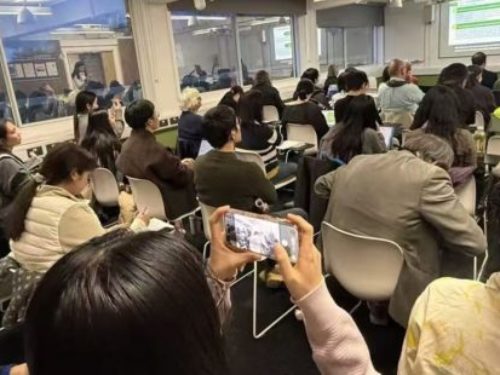
According to the planned schedule, Professor Zhang and his delegation attended the 8th UK–China Humanities Alliance for Higher Education Annual Conference (Worlds and World Views) at University College London (UCL) on 15–16 November, followed by academic exchanges in Oxford on 19–20 November.
With GCA’s coordination, the delegation also visited the Library of the Oxford China Centre, and, with arrangements made by its director Dr Mamtimyn Sunuodula, toured the Digital Library at the Bodleian Library and the Digital Collaborative Photography Centre. In addition, GCA facilitated academic exchanges with the Centre for Corpus-Based Social Science at Lancaster University and the Business School of the University of Edinburgh.

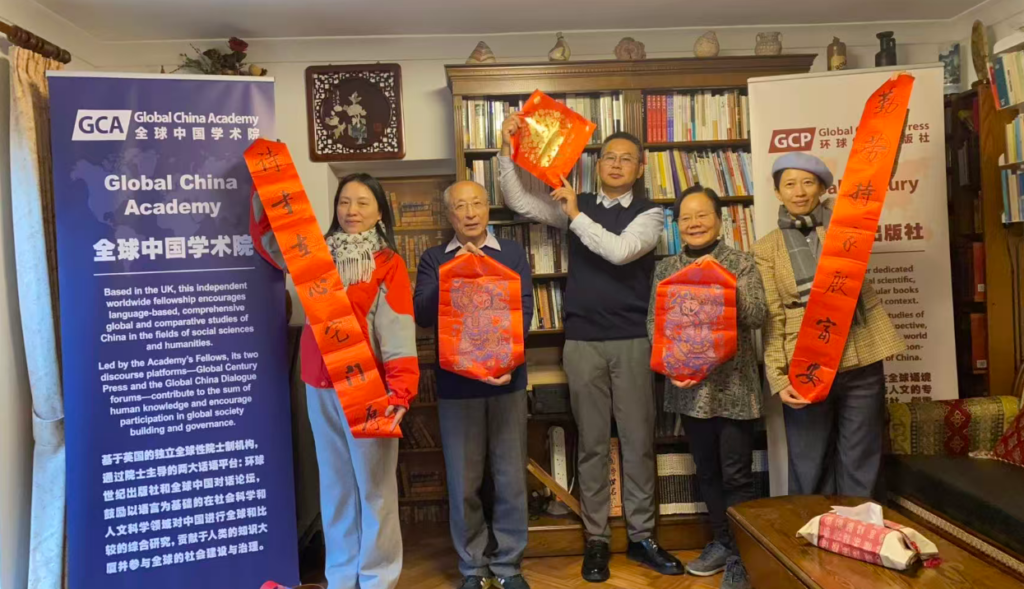
On 18 November, Professor Zhang and his colleagues visited the Global China Academy for formal exchange with the GCA team. The delegation toured the books and journals published by Global Century Press and held discussions with Professor Xiangqun Chang, President of GCA, and Mr Liu Daquan, Executive Manager of GCA.
During the meeting, Professor Zhang and Dr Wang Shunjing introduced the development and operational framework of the Global Alliance for Contemporary Social Life Archives. Initiated by Fudan University in 2016 and formally established in 2018, the Alliance is headquartered at the Fudan University Library and now brings together 34 university libraries and research institutions from East Asia and North America. It is dedicated to cross-media, interdisciplinary sharing of social life materials and international research collaboration. The Alliance has continuously supported international conferences and research projects, particularly in the areas of family studies, narrative history, and methodologies of social life archives.
At the conclusion of the exchange, the two institutions exchanged publications. As the visit took place near the end of the year, Professor Zhang’s delegation also brought silk-printed Spring Festival couplets as a gift to the GCA Fellows’ House. The couplets—symbolising scholarly continuity, diligence, and institutional well-being—became a warm and memorable moment of the visit.

The photo on the left shows a tea break during the academic meetings, where participants continued their conversations in a relaxed setting. The photo on the right captures a Chinese meal shared during the visit, where dining together extended the day’s discussions and strengthened mutual understanding through everyday social interaction, adding a human and cultural dimension to the academic exchange.

In keeping with GCA tradition, visiting scholars are invited to join a “walking dialogue”. During this visit, Professor Zhang and his colleagues participated in the sixth walking route, leading to Brocket Hall. Located in Hertfordshire, Brocket Hall is a historic estate of strong political symbolism, having once been the residence of two British Prime Ministers: Lord Melbourne and Lord Palmerston. In the mid-19th century, Palmerston played a key role in shaping Britain’s hardline China policy before and after the First Opium War—a conflict that profoundly altered China’s historical trajectory and reshaped the global order, while also influencing long-term Western political and cultural perceptions of China.
Situated along the River Lea, Brocket Hall combines classical architecture, landscape design, and waterways, forming a space where British political history and cultural landscape intersect. Today, the estate serves as a venue for international conferences and academic exchanges, carrying new public functions atop its historical foundations. GCA has long used this site as a node for academic visits and walking dialogues, transforming historical space into a platform for reflecting on global order, institutional change, and civilizational interaction.
In the final stage of the visit, scholars walked along the riverbank at Brocket Hall, continuing the day’s academic conversations through movement and dialogue. During a brief ferry crossing, the group collectively experienced the transition from sunset to nightfall. The fading light, shifting space, and uninterrupted conversation intertwined, allowing academic exchange to momentarily leave the conference room and become a situated, embodied, and shared experience.
This moment carried deep symbolic meaning: in a space once deeply entangled in the formation of global inequality and China’s modern historical fate, researchers from different academic traditions walked side by side as equals. Through slow movement and open conversation, they revisited questions of society, memory, archives, and time. Academic exchange thus gained a different rhythm and depth, endowing contemporary Sino–British collaboration with a transcultural dimension—where knowledge was not merely discussed, but re-produced and re-connected through shared experience.
Related Posts
11th Global China Dialogue: Global AI and Data Governance
Call for Papers Following ten successful Global China Dialogue (GCD) Forums, the 11th GCD – Global AI and Data Governance – will be held at the British Academy on Friday, 4 December 2026. GCD11 will focus...