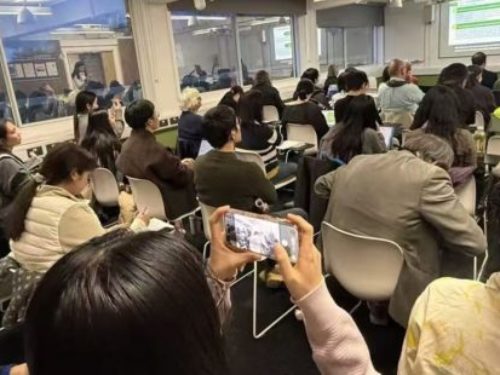
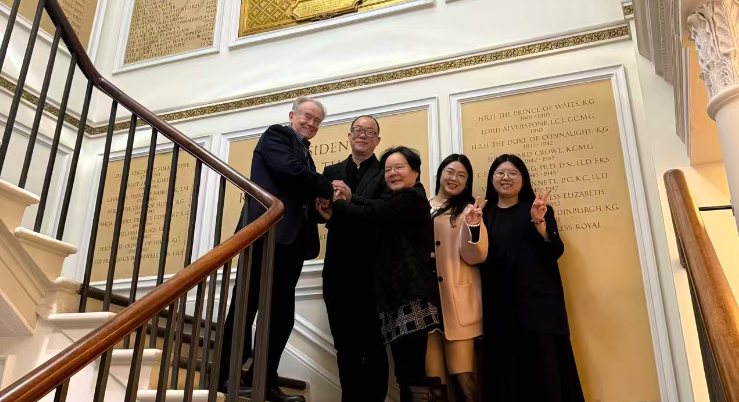
During the five-day UK study visit on the built environment, on the afternoon of 4 March 2025, Professor Li Linxue, Fellow of the Global China Academy and Professor at Tongji University, met with Professor Xiangqun Chang, President of the Global China Academy, and Professor Martin Albrow, Past Honorary President of the Academy, at the Royal Society of Arts (RSA) in London. Their discussion focused on the mission of the Academy, ongoing academic initiatives, and potential directions for future collaboration.
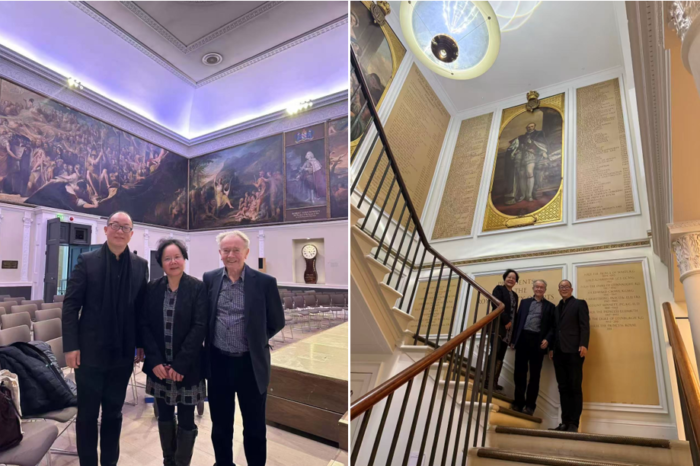
The meeting also included discussion of Professor Albrow’s newly published book, Integrity: The Rise of a Distinctive Western Idea and Its Destiny (诚信:一种独特的西方观念的形成及其命运). In the book, Albrow traces the historical development of integrity from ancient Greece and Rome, through Christianity, the Renaissance, and into modern society, showing how it evolved from an idea of value-based unity and adherence to external standards into a core ethical principle of public life. He argues that contemporary society is marked by a troubling paradox—while integrity is widely demanded, it is not necessarily a prerequisite for political success, resulting in what he calls a “politics of the integrity vacuum.” Albrow therefore calls for the renewal of integrity through dialogue with non-Western wisdom, in order to rebuild trust, reliability, and ethical foundations in public and social life.
Professor Li also introduced his architectural design philosophy and selected works. In 2001, he founded Atelier L+ (麟和建筑工作室), part of the Tongji Architectural Design and Research Institute (Group) Co., Ltd. The studio is an architect-led team grounded in architectural practice and urban research, employing “Nature–System–Construction” as its core methodological framework. Through this approach, the studio continuously explores architectural modernity and multi-scalar construction within the context of Chinese cities. Characterised by the integration of research and building practice, Atelier L+ emphasises the realisation of high-quality architecture under real-world conditions through full-process participation in design. To date, the studio has completed or is undertaking more than fifty public building projects, including urban landmarks, industrial heritage regeneration, and a wide range of educational, cultural, civic, and infrastructural complexes, establishing a distinct and influential position within contemporary Chinese architectural practice.
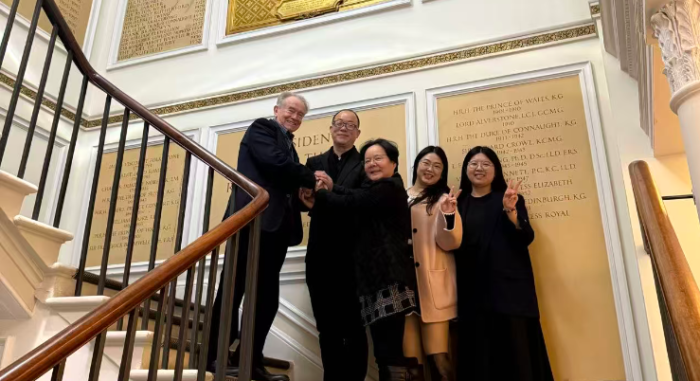
The feature image on this page captures a symbolic moment: the three scholars standing side by side, holding hands, representing trust, collaboration, and a shared scholarly community. Two of Professor Li’s colleagues, standing nearby, spontaneously responded to the camera with “V” gestures, conveying a relaxed, confident, and positive atmosphere of academic exchange. More than a group photograph, this gesture symbolises the organic emergence of a transcultural academic network at London as a global node of ideas—the joined hands representing long-term partnership and institutional commitment, while the “V” signs express openness, goodwill, and optimism for future collaboration. Set within the RSA, an institution renowned for public thought and social innovation, the image resonates naturally with the Academy’s commitment to transcultural dialogue, the co-production of knowledge, and scholarly friendship.
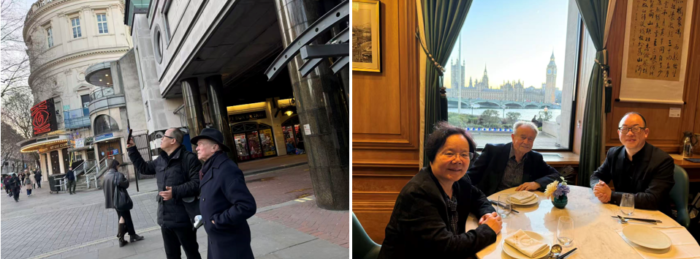
Afterwards, the three walked together through central London, with the cityscape becoming the backdrop for continuing academic exchange. The image on the left shows a street scene spontaneously photographed by Professor Li during the walk, capturing urban details as sources of architectural inspiration; the image on the right records their arrival at a riverside restaurant in County Hall on the South Bank of the Thames, with the river and the Houses of Parliament visible outside the window. Upon being seated, they took a group photograph while Big Ben and the Parliament building were still clearly visible across the river. As dinner progressed and night fell, the cityscape gradually faded into the London dusk, bringing this transcultural academic encounter to a symbolic close.
Selected Works by Professor Li Linxue
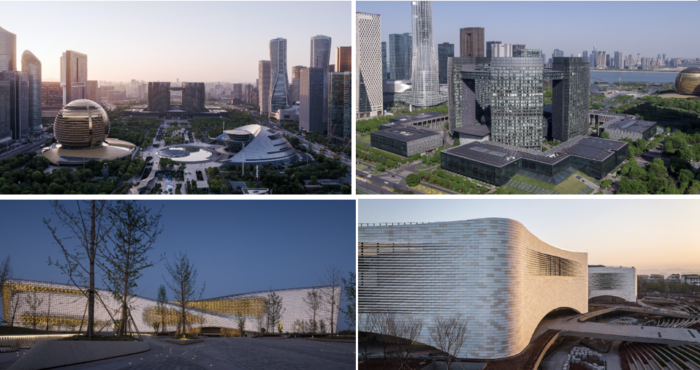
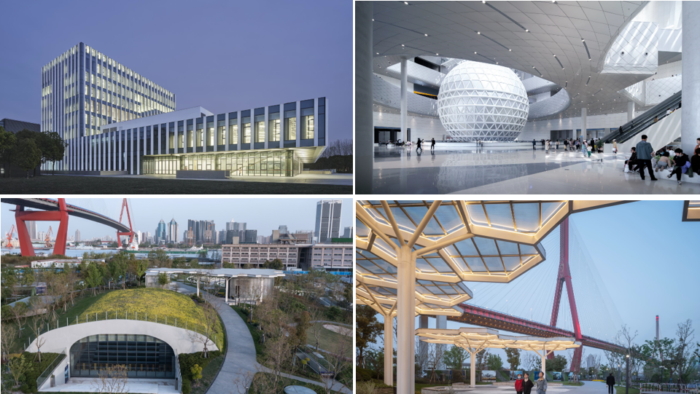
Among the eight projects shown above, the second from the left in the bottom row is the Tongji Yijia Building. Responding to the contemporary Chinese urban context through a clear and powerful modern architectural language, the building integrates function, space, and cultural expression through geometric façades, transparent glass interfaces, and abundant natural light. Its open and flexible interior spaces accommodate exhibitions, exchanges, meetings, and office use, while its emphasis on spatial adaptability and publicness encourages interaction and collaboration. In this building, a transcultural spatial practice takes form—where Chinese urban experience, global modern architectural language, and academic public life are translated and integrated within a single architectural framework. Through green landscaping, material selection, and sustainable strategies, the building further responds to environmental and real-world conditions, becoming a public platform that connects local experience with global contemporaneity, and embodies both cultural sensibility and contemporary spirit.
When Professor Li encountered the title of Martin Albrow’s new book, his spontaneous Chinese rendering was “integration.” This response was not a conceptual misreading, but rather an architect’s interpretation: how, in a highly differentiated contemporary world, values, institutions, and public life might be reconnected into a workable whole. While Albrow approaches integrity through the lens of intellectual history, questioning its meaning and crisis in public life, Li responds through architecture—by integrating different cultures, forms of knowledge, and practices in real space, enabling publicness to be built and experienced. The book and the buildings thus enter into a dialogue across disciplines, pointing toward a shared question: how trust, publicness, and reliable social order might be rebuilt in a complex and plural world.
Related Posts
11th Global China Dialogue: Global AI and Data Governance
Call for Papers Following ten successful Global China Dialogue (GCD) Forums, the 11th GCD – Global AI and Data Governance – will be held at the British Academy on Friday, 4 December 2026. GCD11 will focus...