Abstract:This blog takes two academic and cultural events attended by the author in London as its empirical point of departure and, based on on-site observation, examines the pathways through which Chinese culture and scholarship are entering the contemporary global space. It argues that the global circulation of Chinese experience is increasingly characterised by a pattern of “direct entry,” in which individuals and teams engage in cross-cultural communication and knowledge dissemination through forms of co-presence in specific institutional settings.
Building on this observation, the blog raises a further question: how can such forms of situated entry be transformed from one-off practices into sustainable mechanisms of knowledge production and institutional operation? To address this, the article adopts the perspective of “relational civilisation,” in conjunction with the theory of relational generativity and a methodological approach combining corpus analysis, artificial intelligence, and theoretical judgment. It seeks to integrate dispersed experiences and theoretical reflections into a structurally coherent system of knowledge.
At a broader level, the blog engages with Fei Xiaotong’s vision of a Chinese school of sociology and anthropology. It proposes a five-dimensional framework of knowledge production—comprising experience, concept (language), theory, method, and institution—and, through the coordinated development of academic institutions, publishing platforms, and dialogical forums, explores the structural pathways through which Chinese social scientific knowledge can enter the global knowledge system. The blog argues that “direct entry” should be understood as a starting point, whose significance lies in enabling the structural transformation and institutional extension of knowledge through the ongoing generative processes of relations.
Keywords relational civilisation; relational generativity; li shang wang lai (reciprocity); renxin; direct entry; institutionalisation; five-dimensional knowledge production framework; corpus–AI–theoretical judgment; transculturality; a Chinese school of sociology and anthropology
In the past week, I attended two events held in London, each organized and led by a Chinese writer and their team, as well as a Chinese scholar and their team. The two events differed in format and approach, yet both achieved unexpectedly positive outcomes. Through participating in these on-site experiences, I gained clearer insights into how Chinese culture and scholarship are currently entering the global space.
At the same time, I am in the process of compiling the book “40 Years of Witnessing the Globalization of Chinese Social Sciences.” Thus, after each event, I promptly recorded and organized the related materials and reflections overnight, ensuring they would not be lost over time. Using this as an opportunity, I extracted several relevant sections from the book’s overall framework, presenting them as extended discussions later on. These outline my work over the past decade or so in theoretical research, methodological and method innovations, platform development, and exploring pathways for fostering a Chinese school of sociology and anthropology.
On April 6th, I will visit China and plan to stay for three months. During this period, I will deliver academic talks at certain universities and research institutes and revisit several villages where I conducted fieldwork 30 years ago. Amid multiple ongoing projects, I had not intended to add new activities, yet these two events this week naturally became a starting point for this phase of observation and reflection. Let us begin with a recap of the most recent event.
I. Entering University Spaces via Academic Communities: The Practice of FANG Lili
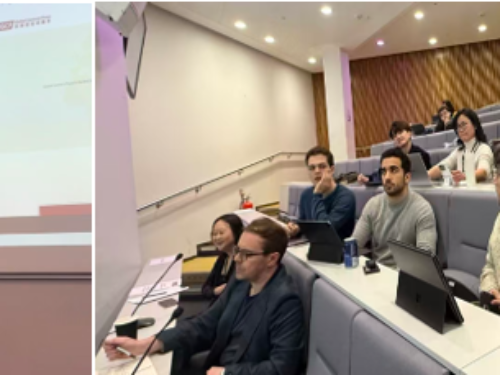
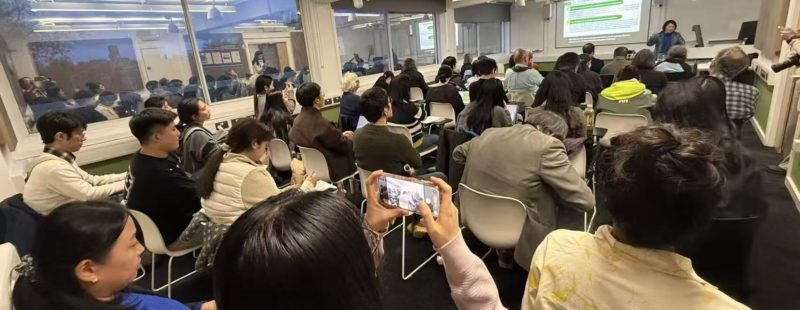
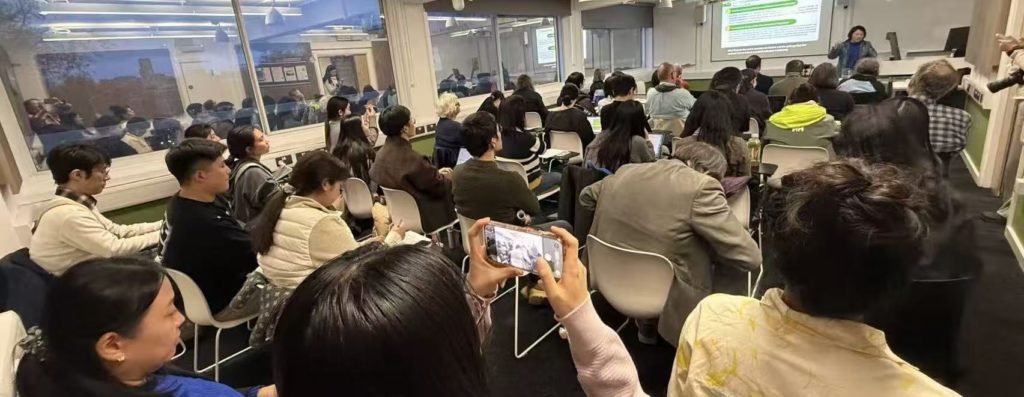
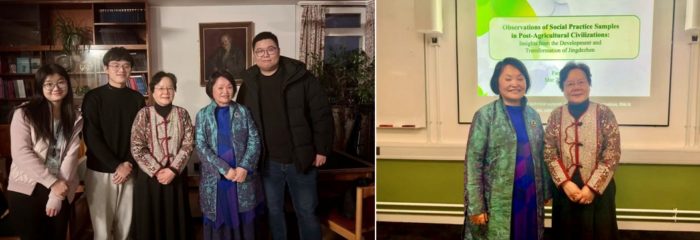
On March 27th, an event was held at the UCL Institute of Archaeology. It was, in fact, my first time in 35 years crossing disciplines to attend something in the field of archaeology in London. Originally, I went out of courtesy to support Professor FANG Lili, a friend in academic circles. However, to my amazement, the lecture hall was packed. The title of Professor Fang’s lecture was “Post-Agricultural Civilisation: Insights from the Development and Transformation of Jingdezhen, China’s ‘Porcelain Capital.’” Based on her long-term fieldwork in Jingdezhen, the concept of post-agricultural civilisation she proposed was quite inspiring. The short films played before and after the lecture added a certain “performative” layer, enriching the academic presentation.
Notably, the week-long exchange at UCL was coordinated by Professor Rodney Harrison from the Institute of Archaeology’s Heritage Studies. The short films shown before the lecture indicated that Professor Harrison had previously conducted fieldwork in China, hosted and accompanied by Fang Lili. This trip can be seen as a continuation of reciprocal visits—from China to the UK—returning to a specific academic space and forming a cross-national exchange mechanism built upon personal academic ties.
FANG Lili is the last postdoctoral researcher of Fei Xiaotong, one of the key founders of Chinese sociology and anthropology. She has inherited and expanded the platform of the Chinese Society of Art Anthropology established with support from Fei, which now has about 4,000 members. After the lecture, we reminisced about the 2019 “Fei’s Disciples Walk Fei Xiaotong’s Path” events in the U.S., including sessions at the University of Chicago. Plans back then included continuing this academic route in the UK, though these have been cancelled due to the pandemic.
Interestingly, at the UCL lecture, a scholar raised a comparison between Jingdezhen’s experience and Chile in South America. This question brought back an earlier idea: in the original UK visit plan, there was a proposal to visit Stoke-on-Trent, the UK’s “ceramics capital,” since back in 1981, when Fei Xiaotong came to the UK to receive the Huxley Award, the Royal Anthropological Institute arranged for him to visit that location. This unfinished comparative path was implicitly evoked in a new academic context.
After the lecture, during the reception, I introduced UCL anthropology PhD students to FANG Lili, and we took a group photo. To some extent, this facilitated mutual introductions between her and these younger researchers, extending academic ties between archaeology and anthropology in the UK context through direct interaction.
In the subsequent conversation, I spoke with one of Professor Fang’s doctoral students. Using theater theory as a lens, she was conducting research in Kaixiangong Village, the field site of Fei Xiaotong’s Peasant Life in China. I told her that as early as 1996, I had conducted fieldwork in that village, completing my doctoral dissertation and the book Guanxi or Li Shang Wanglai ?: Reciprocity, Social Support Networks, Social Creativity in a Chinese Village . It has now been exactly 30 years. Over the past two decades, I have revisited Kaixiangong multiple times and maintained close ties with the local community. This May, I will return once again for a brief revisit.
The chair of the event, Professor Harrison, posed the first question after FANG Lili’s talk—a classic anthropological methodological question: How representative is the case of Jingdezhen for China? This question turned a specific case into a methodological issue and became the starting point for my upcoming fieldwork. Around this question, I will not only revisit Kaixiangong but also plan to conduct a new round of fieldwork across 10 villages in five provinces, just as I did 10 years ago. Through this cross-temporal comparison, I will gather continuous data on the thirty-year changes in these villages and attempt to bring Fang Lili’s concept of post-agricultural civilisation into my field research perspective for verification and development.
II. Entering University Spaces through Literature and Publishing: The Practice of Xue Mo
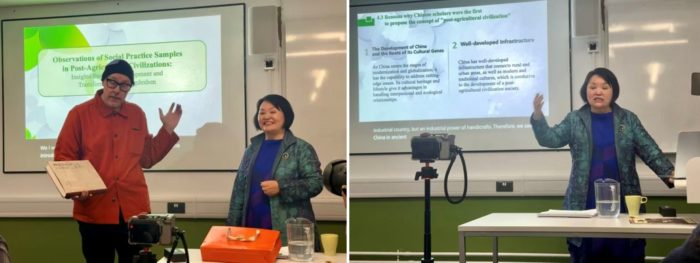
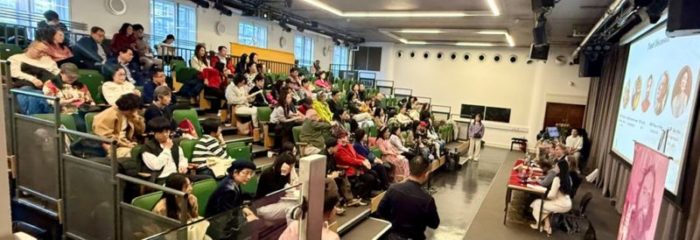
On 21 March, an event was held at SOAS, University of London. I arrived after attending another event, and the scale of the event was, comparatively speaking, quite substantial. The title was “New Literary Creation and Cross-Cultural Communication in UK Universities: A Symposium on the Works of Xue Mo and International Academic Exchange.” It reminded me of the international conference “Weber and China: Culture, Law and Capitalism” that we held at the same venue in 2013, which brought together scholars from around the world and was similar in overall scale.
Xue Mo is an internationally recognised novelist and cultural scholar. I edited the overseas Simplified Chinese edition of his book Renxin (Human Hearts and Minds), which was launched at the London Book Fair in 2024 as part of the “Chinese Concepts” series of Global Century Press. The book carries a clear intellectual orientation. In recent years, Xue Mo has continued to participate in international publishing platforms such as the Frankfurt Book Fair. Through multilingual publications, live events, and sustained visibility, he has gradually built a stable international readership and a growing network of cultural dissemination. His success is reflected not only in the cross-linguistic circulation of his works, but also in the sustained presence and visibility of both the author and his team within the global cultural space.
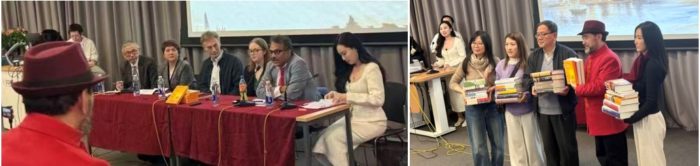
As I arrived toward the end of the event, I happened to see several speakers engaged in discussion. Two of them were familiar to me: Professor Hugo de Burgh, former Director of the China Media Centre at the University of Westminster, where I once served as a visiting professor; and Dr Yukteshwar Kumar, currently Director of the China Studies programme at the University of Bath. During the Beijing International Book Fair last year, I had chaired a dialogue between him and Xue Mo.
In the final part of the discussion, the moderator invited each speaker to leave the audience with a single sentence. Taken together, these remarks revealed a shared orientation: while participants approached Xue Mo’s work from different pathways, they all pointed toward its underlying intellectual depth. This was precisely the intention behind our publication of Renxin—to present Xue Mo not only as a novelist, but as a thinker. At the same time, this process of entering the same text through multiple perspectives generated a transcultural space of understanding across different disciplines and cultural experiences.
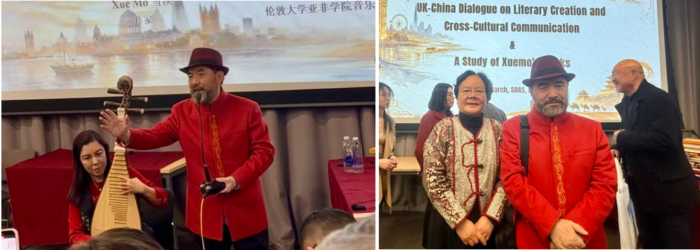
Before the event concluded, a book presentation ceremony was held. The representative receiving the donated copies on behalf of SOAS was Dr Lianyi Song, Principal Teaching Fellow at the Department of Languages, Cultures and Linguistics at SOAS, and also one of the founding editors of the Journal of Chinese for Social Sciences, published by Global Century Press.
Finally, Xue Mo collaborated with a music teacher from SOAS for a live performance, accompanied by the pipa. This moment extended what had been an academic event centred on literature and ideas into a more integrated form of cultural expression. The atmosphere shifted from discussion to participation, creating another sense of “being present.” In this process, text, sound, and embodied practice were reconnected, and academic exchange moved beyond language alone into a lived experience of relational generation.
Before leaving, I arranged to visit Xue Mo’s academy in early May, during my fieldwork trip to Gansu, in order to further experience the cultural and historical environment that informs his writing.
III. From Direct Entry to Relational Civilisation: My Methodological and Theoretical Reflections and Platform Development
In the first two sections, whether through academic communities entering university settings or through literature and publishing entering academic spaces, both cases reflect a pattern of “direct entry.” However, when these practices are considered at the level of theory and method, a further question emerges: how should we understand the position of these dispersed experiences within a broader structure of knowledge?
While listening to these presentations, I gradually became aware of a related issue: how can we move from rich but scattered experiences toward an analytical framework that allows us to grasp their overall structure? In this sense, FANG Lili’s work provides an important empirical foundation and practical inspiration for addressing this question.
This, in turn, points to a more general problem. In the Chinese academic context, research has often developed in relatively fragmented clusters, lacking an overarching structure capable of integrating these experiences into a coherent whole. This is precisely the issue that Fei Xiaotong had in mind in his vision of constructing a Chinese school of sociology and anthropology.
1. From Linear Development to Relational Civilisation: Methodological Shift and Theoretical Construction
I noticed that in this lecture, FANG Lili approached the question of civilisation primarily from her fieldwork experience, without explicitly situating it within the theoretical lineage of Fei Xiaotong’s work. From the perspective of the development of Chinese sociology and anthropology, this issue of theoretical continuity is itself of considerable significance. It also points to a more fundamental question: as empirical knowledge continues to accumulate, how can such research be brought back into existing theoretical traditions and, on that basis, developed into a knowledge system with an internal structure.
In my view, the development of human knowledge should, on the basis of accumulated experience, take the form of a “knowledge architecture” with its own internal logic and layered structure. In this sense, Fei Xiaotong’s work provides a crucial foundation. He not only proposed the relational vision of civilisation expressed in the idea of “each appreciating its own beauty and the beauty of others,” but also established a level of theoretical articulation upon which Chinese sociology and anthropology can continue to develop.
It is worth noting that Fei Xiaotong did not produce systematic monographs explicitly titled “modernisation” or “civilisation.” Instead, his reflections on these themes are dispersed across texts written in different periods and contexts. Yet it is precisely through this cross-temporal and cross-contextual body of writing that a rich and internally connected set of ideas emerges.
Against this background, a key question arises: how can dispersed fieldwork experience, theoretical reflection, and practical engagement be integrated into a coherent system of knowledge with an internal structure? This question has emerged from my long-term corpus-based research on The Complete Works of Fei Xiaotong (20 volumes). This corpus constitutes a continuous body of thought spanning approximately 80 years, systematically documenting the transformation of Chinese society from rural structures to modern forms, together with its accompanying theoretical reflections. It is one of the most extensive and structurally complete individual intellectual corpora in the history of Chinese social sciences, and is also rare in global scholarship.
On this basis, I further introduce a methodological approach combining corpus analysis, artificial intelligence, and theoretical judgment. By systematically analysing the concept of “civilisation” across the corpus, dispersed texts can be reorganised at a structural level. This allows the question of civilisation to move beyond a linear developmental framework toward an understanding based on relational structures and generative processes, thereby providing a methodological foundation for the development of a theory of relational civilisation. Along this line of inquiry, this blog seeks to advance the ideas of “relational civilisation” and “relational generativity,” responding to Fei Xiaotong’s vision of constructing a Chinese school of sociology and anthropology.
Based on corpus statistics across the 20 volumes, the term “civilisation” appears 725 times, including approximately 188 occurrences in the translated works (Volumes 18 and 19). The corpus also contains fragmentary references to or engagements with other theorists of civilisation, including Oswald Spengler, Arnold J. Toynbee, and Samuel P. Huntington. This tradition generally treats civilisation as a macro-historical unit, focusing on rise, development, and conflict, and is largely characterised by a linear model of development.
By contrast, Fei Xiaotong’s understanding of civilisation is more directly rooted in conceptual resources from his early translated works, particularly in Volumes 18 and 19. These include authors such as William F. Ogburn, Bronislaw Malinowski, Raymond Firth, C. G. Seligman, and Elton Mayo. In these texts, “civilisation” appears mainly in analyses of social development, institutional structures, social types, and industrial society, forming an important methodological foundation for his early anthropological training.
In Fei’s own writings, the term “civilisation” appears 537 times and shows a clear shift over time. In the early period (1930s–1950s), it is used largely in descriptive sociological and anthropological contexts. In the middle period (1980s–1990s), it becomes more closely associated with discussions of Chinese civilisation and social transformation. In the later period (around 2000, particularly in Volume 17), it appears 237 times—about 44% of all occurrences—marking its transition from a descriptive term to a central analytical concept. At this stage, “civilisation” is no longer treated as a given object of analysis, but is re-problematised as a question of relations between different civilisations, articulated normatively through the idea of “each appreciating its own beauty and the beauty of others.”
This shift indicates that Fei Xiaotong’s theory of civilisation moves from imported analytical tools in translation to a relational theory developed in his own writings. It not only departs from linear developmental or civilisational conflict models, but also offers an alternative approach centred on coexistence.
In this context, the concepts of complicity and commensuration proposed by Professor Hans Steinmüller in his inaugural lecture at the London School of Economics provide an important mid-level analytical perspective. Complicity refers to tacit, situational forms of alignment grounded in relationships, which increase social complexity. Commensuration refers to processes of standardisation and comparability that reduce complexity and enable large-scale social coordination. Together, they reveal the dynamic balance between complexity and simplification.
Further, in her lecture at UCL, FANG Lili, drawing on long-term fieldwork in Jingdezhen, pointed out that civilisation does not develop along a single linear trajectory, but unfolds through ongoing cycles of return and recombination between historical resources and present conditions. This observation of “indirect development” provides an empirical correction to linear models of civilisation and demonstrates how relations are realised in concrete contexts through processes of reconfiguration.
Within this framework, Fang Lili’s work and my own theory of relational generativity form a relationship of resonance with distinct emphases. Both are grounded in long-term fieldwork and focus on how relations are formed and enacted in practice. However, FANG Lili places greater emphasis on how relations are realised under contemporary conditions, while my work focuses more on the continuity of relational elements and examines how relations are generated and transformed across different historical conditions. In this sense, if Steinmüller highlights the tension between complexity and simplification, my approach further examines how this tension is sustained and transformed through ongoing generative processes.
From a more general perspective, civilisation is often understood in terms of material and spiritual dimensions: the former relating to systems of production and technology, and the latter to systems of value and meaning. On this basis, I propose a perspective of “relational civilisation”, which understands civilisation as a form of social organisation centred on relations.
Within this framework, Fei Xiaotong’s idea of “each appreciating its own beauty and the beauty of others” constitutes the normative level, pointing toward a normative goal of coexistence among different civilisations. Steinmüller’s concepts of complicity and commensuration constitute the mechanism level, explaining how relations operate between complexity and simplification. Fang’s fieldwork constitutes the practical level, demonstrating how relations are realised through processes of reconfiguration. The “theory of relational generativity” constitutes the generative level, explaining how relations are continuously produced and transformed across different historical conditions.
Building on my research on lishang wanglai or ‘recipropriety’, I have been developing the theory of relational generativity, understood as the generative logic of social relations. Here, li shang provides the structural foundation of relations as norm and expression, while wang lai constitutes the practical process of relational generation as interaction and circulation. Through their continuous interplay, relations are generated, sustained, and extended. My research further shows that the key elements of society and civilisation have not disappeared, but have instead continuously changed their forms across different historical stages, undergoing transformation and recombination while maintaining continuity. This helps explain how relations are continuously generated and transformed across contexts.
In this sense, relational civilisation is not only a normative ideal, but also a dynamic system unfolding through mechanisms, practices, and generative processes. It manifests both as structures of human coexistence and as an ongoing historical process of relational generation.
As mentioned earlier, I edited and published Xue Mo’s book Renxin. Xue Mo enters the public sphere through literature, thought, and narrative, reaching human hearts through reading and dissemination. My own work, by contrast, unfolds more through relations and practice, enabling renxin to emerge and operate through processes of relational generation in concrete interactions, fieldwork, and platform development. These two paths differ, yet converge on a shared question: how renxin can be connected, understood, and transformed into relational structures that can continue to unfold in contemporary society.
In this context, Xue Mo’s notion of renxin refers primarily to inner moral cultivation and spiritual development, representing an inward-oriented humanistic practice. By contrast, in my research on lishang wanglai, renxin refers to the ontological foundation of relational generation: the capacity of human beings, as relational beings, to make judgments, negotiate situations, and generate relations in concrete contexts. This shift moves renxin from an ethical category to an ontological basis of relational generation, transforming the question of inner cultivation into the question of how relations are generated and unfold.
In recent years, my research has moved from Marshall Sahlins’ typology of reciprocity and Max Weber’s understanding of meaningful action, toward Pierre Bourdieu’s analysis of social reproduction and Anthony Giddens’ theory of the interaction between structure and agency. Through this ongoing dialogue, I have gradually developed the basic structure of relational generativity: renxin as the ontological foundation; lishang as the dynamic structure, encompassing morality, emotion, reason, and belief; wanglai as the relational form, including generous, expressive, instrumental, and negative forms; and the generative mechanism understood as transformations between different types of relations.
On this basis, this theoretical framework advances existing social theory at three levels: it shifts the analysis of relations from structure and exchange toward generative processes, provides an ontological foundation for relations in renxin, and offers a pathway through which Chinese experience can enter theoretical structures with broader explanatory relevance.
2. Two Pathways of Entry: Situated Practice and Mechanism Transformation
1)Two pathways of entry and their contributions to cultural and academic exchange
From a broader perspective, the two events described above reveal two distinct yet equally instructive pathways through which Chinese culture and scholarship are entering the global space.
During the 2022 Frankfurt Book Fair, Xue Mo ranked first among international media trending topics outside Germany. As a writer working with his team, he has continuously entered the global cultural sphere through international book fairs and publishing systems. FANG Lili, by contrast, relied on the platform of the Chinese Society of Art Anthropology to organise a group of twelve scholars for lectures and study visits, engaging directly within university settings.
Although these two pathways differ in form, they share a common tendency: entering target spaces as active subjects, and completing communication and exchange through forms of co-presence and interaction, rather than relying primarily on external intermediary structures.
This shift is also closely related to technological conditions. Although FANG Lili’s lecture was delivered in Chinese, the use of English slides and real-time screen translation—including live interpretation during the Q&A—enabled participants from different linguistic backgrounds to engage simultaneously. Technological development has thus shifted cross-language communication from transmission mediated by others toward shared understanding in co-present settings, providing practical conditions for this mode of direct entry.
One may recall Fang Lili’s observation, based on her research on Jingdezhen, that in periods of transformation there always emerges a group of “pioneering actors.” In this sense, both Xue Mo—who continues to enter the global cultural sphere through literature and thought—and FANG Lili—who engages through academic communities in concrete institutional settings—are not merely participants, but actors shaping emerging pathways of global transformation. What their practices reveal is not simply individual success, but a new possibility for Chinese culture and scholarship in the contemporary world.
2)From pathways of entry to institutional mechanisms: a five-dimensional framework and platform development
If the pathways of “direct entry” emphasise presence and practice in specific settings, a further question arises: how can such entry be transformed from one-off actions into mechanisms capable of sustained operation?
Across forty years of academic practice, this question has gradually taken the form of a structural task: how to transform dispersed empirical research and theoretical exploration into a knowledge production system with an internal structure and the capacity for continuous development.
From this perspective, my work has not followed a single linear trajectory, but has unfolded across five interrelated dimensions: experience, concept, theory, method, and institution. Experience is grounded in fieldwork and historical materials; concepts emerge through linguistic abstraction and articulation; theory provides explanatory structure; method offers pathways for comparison and verification; and institution enables the sustained production and dissemination of knowledge.
This five-dimensional framework transforms “direct entry” from individual practice into an institutionalised mechanism that can be organised, extended, and reproduced over time.
Over the past decade, I have developed the theory of relational generativity on the basis of long-term fieldwork and comparative research, taking renxin as its ontological foundation and systematically examining how relations are generated and transformed across different contexts. At the same time, I have advanced a methodological approach combining corpus analysis, artificial intelligence, and theoretical judgment, exploring how Chinese social research can move from empirical description toward conceptual refinement, theoretical construction, and methodological innovation.
Within this framework, I propose a five-dimensional model of knowledge production—experience, concept (language), theory, method, and institution—and explore how research on Chinese society, both within and beyond China, can enter the global knowledge system through processes of structural transformation. At the same time, I have worked to promote the global dissemination and integration of Chinese social scientific knowledge through the institutional platforms I have established.
In terms of institutional and platform development, three interrelated platforms have gradually taken shape.
First, the Global China Academy is an independent, global, fellowship-based academic institution headquartered in the United Kingdom. Grounded in a global and comparative perspective, it is dedicated to advancing comprehensive research on China in the humanities and social sciences, while sustaining dialogue and collaboration within transnational academic networks.
Second, Global Century Press serves as a publishing platform. As Editor-in-Chief, I oversee the Journal of Global and China in Comparative Perspectives, the Global China Dialogue Proceedings, and several book series including Chinese Concepts, The Globalisation of Chinese Social Sciences, China and Chinese Civilisation in Comparative Perspective, Three-Eyed Transcultural Studies, and Emerging Frontiers. Through four academic journals and eight bilingual series, this platform establishes a sustained mechanism for knowledge production and dissemination.
Third, the Global China Dialogue forum operates as a platform for ongoing exchange. Based on interdisciplinary and comparative approaches, it brings together scholars, professionals, and members of the public from different countries. Through continuous dialogue, it promotes understanding of global issues and shared concerns. The forum connects universities, research institutes, governments, international organisations, media, and publishers, and develops its agenda around the United Nations Sustainable Development Goals, covering areas such as AI, energy, education, migration, health, and global security. It is gradually forming a global space of dialogue centred on transculturality and social creativity.
These three platforms have distinct functions yet operate in a mutually reinforcing manner: The academy, with fellows as its core driving force, provides an institutional framework while continuously advancing academic community building; the press sustains knowledge production and dissemination; and the dialogue platform enables ongoing exchange and problem generation. Together, they form a structural system linking research, communication, and institutional development.
Conclusion
The two events observed in London over the past week illustrate that Chinese culture and scholarship are entering the global space through multiple pathways. On the one hand, “direct entry” enables face-to-face engagement and communication in specific settings through individuals and teams. On the other hand, these practices themselves raise new questions: how can such situated forms of entry be transformed into sustainable mechanisms of knowledge and institutional operation?
In this sense, these events are not only significant in their own academic and cultural terms, but also provide an empirical basis for further structural development.
At the same time, the content of the lectures—whether grounded in fieldwork on civilisational transformation or expressed through literary and intellectual explorations of renxin—points to a deeper question: how to establish internal connections between experience, concept, and theory, so that dispersed knowledge can enter structured frameworks of understanding.
It is in response to this question that this blog has sought to develop a perspective of relational civilisation, drawing on relational generativity and the methodological approach of corpus–AI–theoretical judgment, in order to further theorise how relations are generated, operate, and transform across different levels.
From this perspective, “direct entry” is not an endpoint, but a starting point. It allows Chinese experience to become visible in the global space. Through platform development and methodological innovation, such entry can be transformed into a sustained process of knowledge production. It is precisely in this process that the relationships between experience, theory, and institution are gradually reorganised, opening pathways for Chinese social sciences to enter broader global knowledge systems.
References (omitted)
Related Posts
11th Global China Dialogue: Global AI and Data Governance
Call for Papers Following ten successful Global China Dialogue (GCD) Forums, the 11th GCD – Global AI and Data Governance – will be held at the British Academy on Friday, 4 December 2026. GCD11 will focus...